Best Continuous Gas Water Heaters for Instant Hot Water
Choosing a continuous gas water heater means balancing flow, efficiency, and installation needs. This guide highlights top on-demand models designed to deliver steady hot water across multiple fixtures. Each option below is suited for indoor installation, strong reliability, and precise temperature control. Read on to compare features and find the right fit for your home.
| Model | Max Flow (GPM) | BTU | Best For |
|---|---|---|---|
| NOVIEEX Tankless Water Heater | Up to 4.3 | 100,000 | Small to mid-sized homes |
| Rheem Natural Gas Condensing | 0.4 – 9 | 180,000 | Larger households |
| APUS Natural Gas Tankless | Up to 6.8 | 140,000 | Two showers plus sink |
| Nessxa Tankless Water Heater | Up to 3.7 | 95,540 | Compact spaces |
| FOGATTI Indoor 170S | Up to 7.5 | 170,000 | High-demand homes |
NOVIEEX 4.3 GPM On-Demand Gas Heater

The NOVIEEX tankless water heater is a compact, indoor unit designed for natural gas supply and instantaneous hot water. With a 100,000 BTU burner, it delivers up to 4.3 GPM and supports simultaneous use for a shower, kitchen faucet, and bathroom sink. Temperature control is precise, offering a range from 95°F to 149°F with a ±1°F accuracy via a built-in digital thermostat. The unit is engineered to maintain stable temperatures even during peak demand, making it suitable for mid-sized homes or busy households that want dependable hot water without storage tanks.
Rheem Condensing Tankless: High-Flow Gas Hot Water

The Rheem unit excels in delivering a broad flow range, from 0.4 to 9 GPM, with temperature settings between 100 and 140°F (default 120°F). It uses electric ignition and supports high-demand households that require hot water across several outlets. Its condensing design emphasizes efficiency and reliability for continuous usage, making it a strong choice for larger homes or installations where multiple fixtures run simultaneously.
APUS 140,000 BTU Tankless With Smart Control
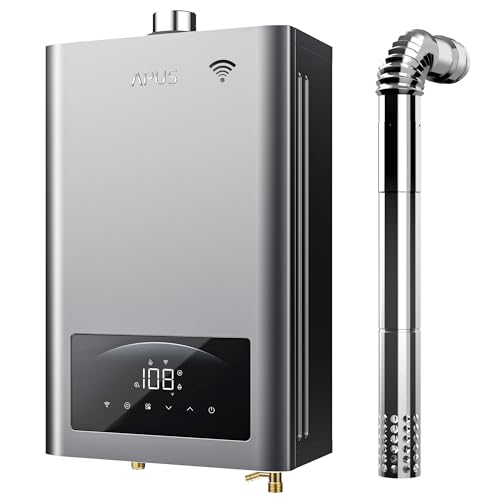
APUS combines a 140,000 BTU burner with 6.8 GPM capacity and smart Wi‑Fi app control. It features instant hot water on demand, zero cold-water delay through its single-circulation technology, and a built-in booster pump that can increase flow by up to 130%. This setup supports two showers and two sinks simultaneously without noticeable temperature fluctuations, making it ideal for multi‑bath homes seeking reliable, on-demand hot water with remote monitoring capabilities.
Nessxa 14L/3.7 GPM Propane Tankless
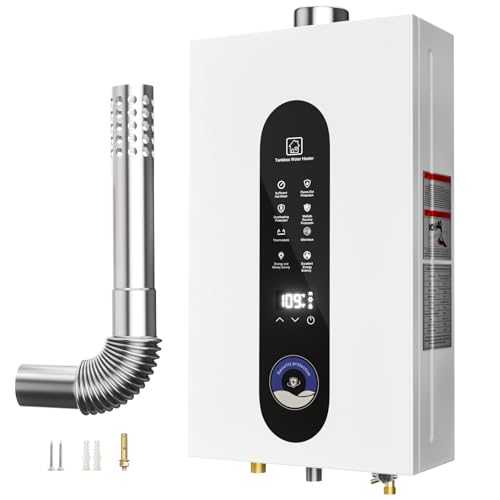
This Nessxa model provides instant hot water on demand with 95,540 BTU propane input and a flow of 3.7 GPM. It features a Fahrenheit/Celsius digital display for precise temperature control (±1°F) and a robust metal housing with an efficient heat exchanger designed to resist corrosion. It’s well-suited for indoor installations in smaller homes or spaces where a compact, reliable on-demand heater is needed.
ThermoMate CZ422NG: 5 GPM Indoor Tankless

The ThermoMate CZ422NG delivers up to 5 GPM with 113,000 BTU. It features multiple safety protections—boil-dry, freeze, flame-out, overheating, and more—and a copper heat exchanger for improved heat transfer and durability. The unit emphasizes tight temperature control (±1°F) and energy efficiency with a high-performance heat exchanger, making it a solid option for households needing reliable hot water across two showers or multiple fixtures.
FOGATTI 170S Indoor Tankless: 7.5 GPM

The FOGATTI Instagas Comfort 170S Series offers a high heating power of 170,000 BTU and a generous flow up to 7.5 GPM. It is designed for indoor use with a four-stage combustion system that maintains temperature within ±1°F and supports multiple outlets efficiently. Its compact design is suitable for homes with higher hot water demand, delivering reliable performance across showers, sinks, and appliances without compromising comfort.
Buying Guide: Key Considerations When Choosing a Gas Tankless Water Heater
- Flow rate and simultaneous usage: Calculate the number of fixtures that will run at once (showers, sinks, laundry) and choose a model that can comfortably handle that load. Higher GPM ratings provide more flexibility during peak usage.
- BTU rating and efficiency: BTU indicates heating capacity; higher BTU supports higher flow and faster recovery. Look for condensing designs for improved energy efficiency and lower operating costs.
- Temperature stability: Temperature fluctuations can be uncomfortable. Seek units with precise digital thermostats and sensors that maintain water temperature within a small range (often ±1°F).
- Ventilation and installation: Gas tankless heaters require proper venting and adequate clearance. Indoor units may need dedicated venting paths, while outdoor units must be weather-rated for exterior use.
- Cold-water sandwich prevention: Some models employ technologies to minimize initial cold-water shocks when other fixtures use hot water. Features like instant-on and circulation aids help maintain comfort.
- Smart controls and monitoring: Wi‑Fi controls and app connectivity allow remote status checks, maintenance reminders, and troubleshooting. This can simplify management and diagnostics.
- Durability and maintenance: Copper heat exchangers and protective housings influence longevity and resistance to corrosion. Consider models with clear maintenance guidance and accessible service options.
- Safety features: Look for protections against boil-dry, flame-out, overheating, and fault alarms. A robust safety suite improves reliability in diverse climates and water conditions.
- Space and installation constraints: Indoor units vary in size. Ensure adequate space for service access and proper venting clearances based on local codes and manufacturer guidelines.
- Cost of ownership: Evaluate upfront cost, efficiency ratings, and expected energy savings. While higher efficiency often reduces bills, installation and maintenance should also be considered.