Best 60-Gallon Electric Water Heaters for Home Use
Finding a reliable 60-gallon electric water heater can balance capacity, efficiency, and space in diverse homes. This guide highlights five strong options that align with larger household hot-water needs while offering practical installation and operation features. Each product section includes direct access to the Amazon listing, a quick image reference, and key features drawn from the official product descriptions. A concise buying guide follows to help compare performance, energy use, and installation considerations across models.
| Product | Brand | Capacity (Gallons) | Key Benefit |
|---|---|---|---|
| Rheem 72-40-2 | Rheem | 40 | Solid mid-range option with strong insulation |
| GE Appliances 18 Gal | GE | 18 | Compact plug-and-play for small spaces |
| VEVOR 18 Gal Tank | VEVOR | 18 | On-demand features with LED display |
| Rheem PROE50 M2 RH95 | Rheem | 50 | Space-saving design with robust performance |
| ACiQ 50 Gal Hybrid | ACiQ | 50 | Heat-pump efficiency with quiet operation |
Rheem 72-40-2 Electric Water Heater

The Rheem 72-40-2 offers a 40-gallon storage capacity with a 4500W/240V electric element, making it suitable for mid-sized households or as a replacement in spaces with existing connections. A glass-lined tank helps resist corrosion, and R-Foam insulation minimizes standby heat loss to improve daily efficiency. The integrated anode rod provides ongoing protection against corrosion, extending the unit’s lifespan and reducing maintenance needs when paired with proper water testing and periodic servicing.
GE Appliances 18 Gallon Versatile Plug and Play Electric Water Heater

Although smaller in capacity, this GE model is ideal for compact spaces and limited installations. It provides plug-and-play convenience with an adjustable thermostat and straightforward hookup using standard NPT connections. Its compact design makes it a practical option for apartments, studios, cabins, or rooms where space is at a premium, while still delivering reliable hot water for a single or small-scale setup.
VEVOR Electric Water Heater 18 Gal Tank
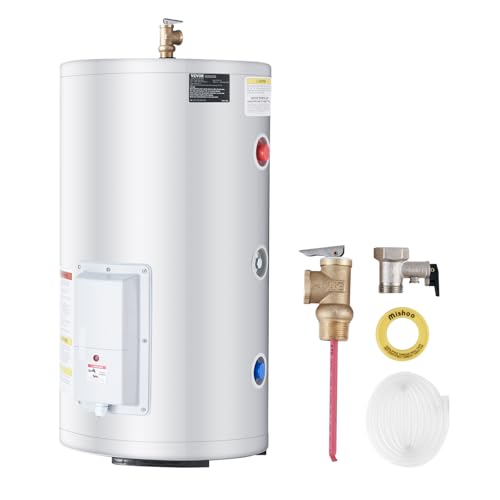
VEVOR’s 18-gallon heater adds value through an immediate hot-water solution with a 1600W high-power heater. It features an extended immersion heating element for continuous supply and an LED display with adjustable thermostats for precise control. An enamel coating provides extra safety and durability, supporting reliable daily use for households needing a compact secondary heater or point-of-use solution.
Rheem PROE50 M2 RH95 50-Gallon

The Rheem PROE50 M2 RH95 is designed for households with 3–5 people, offering a substantial 50-gallon capacity in a compact footprint. Its automatic thermostat helps regulate water temperature, and the unit includes an anode rod to combat corrosion. This model is positioned as a reliable upgrade or replacement option in space-constrained settings, balancing capacity with efficient operation and a dependable Rheem reputation.
ACiQ Electric Residential Hybrid 50 Gal

The ACiQ 50-gallon hybrid model combines electric heating with heat-pump efficiency. Energy Star certified, it aims to reduce energy use by extracting heat from the surrounding air, which can lower operating costs over time. It’s designed for indoor installation in stable temperatures and typically suits basements or garages where airflow and space permit proper operation. The unit emphasizes quiet operation and 60Hz electrical compatibility, aligning with standard American home wiring.
Buying Guide: Key Purchase Considerations
- Capacity and household size: For larger families or heavy hot-water users, a 50–60 gallon range generally meets daily needs without excessive cycling. In smaller homes, 18–30 gallons may suffice but can lead to more frequent heat cycles.
- Space and installation: Consider footprint, ventilation, and access for maintenance. Compact or low-profile units fit tight utility spaces, while taller tanks may require ceiling clearance checks.
- Energy efficiency: Look for high energy factor (EF) or uniform energy factor (UEF) ratings, along with insulation thickness. Hybrid heat-pump models can offer the lowest operating costs in temperature-friendly climates.
- Recovery rate and wattage: Higher wattage accelerates hot-water recovery after draws. A 4500W–5500W element is common in 40–50 gallon units, while larger capacities may use multiple elements or larger circuit draws.
- Materials and longevity: Glass-lined or enamel coatings protect against corrosion. Anode rods help guard against tank deterioration; check replacement intervals in product specs.
- Smart features and controls: Some models include adjustable thermostats, digital displays, Wi-Fi connectivity, and vacation modes, enabling remote monitoring and better energy management.
- Installation considerations: 120V models are easier to install in spaces with standard outlets but capacity is limited. 240V units provide higher heating power but require appropriate electrical wiring and potential professional installation.
- Maintenance needs: Periodic flushing, pressure relief valve checks, and anode rod replacement contribute to longer life and consistent performance.
Comparative Snapshot
- Best for compact spaces: GE 18 Gal Plug & Play and Thermomate 8 Gal offer easy placement but not high-volume hot-water delivery.
- Best for space-conscious larger homes: Rheem PROE50 M2 RH95 and ACiQ 50 Gal Hybrid balance capacity with a smaller footprint compared to many traditional 50+ gallon tanks.
- Best energy efficiency option: ACiQ Hybrid 50 Gal emphasizes heat-pump efficiency for lower operating costs in suitable climates.
- Best value for mid-range demand: Rheem 72-40-2 40 Gal provides reliable performance with standard insulation and basic corrosion protection.
When selecting a 60-gallon-class electric system, prioritize the alignment between capacity, space, and energy use. The five options covered here illustrate a spectrum from compact to high-efficiency, helping households decide between traditional storage and hybrid heat-pump designs, while accounting for installation realities and ongoing costs. Always verify compatibility with existing plumbing and electrical setups before purchasing.