Best Tankless Water Heater Whole House Gas for Efficient Hot Water
Finding a reliable tankless water heater that runs on natural gas and can supply whole-house hot water is essential for busy homes. This guide highlights five top options, focusing on flow rates, energy efficiency, installation versatility, and smart features. Each product is evaluated on its ability to deliver nonstop hot water for multiple outlets while maintaining stable temperatures. Use the buying guide below to compare installations, warranties, and control options across models.
| Product | BTU / GPM | Installation Type | |
|---|---|---|---|
| ThermoMate CZ422NG | 113,000 BTU, Up to 5 GPM | Indoor | High efficiency with advanced flow sensing and ±1°F stability |
| APUS 190,000 BTU Outdoor | 8.1 GPM, 190,000 BTU | Outdoor | Remote app control and robust simultaneous-use capacity |
| APUS 140,000 BTU Indoor | 6.8 GPM, 140,000 BTU | Indoor | Zero cold-water feature and built-in booster pump |
| Rinnai RX199iN | 199,000 BTU, Up to 11.1 GPM | Indoor/Outdoor | Versa Vent compatibility and high flow for large homes |
| NOVIEEX | 100,000 BTU, Up to 4.3 GPM | Indoor | Precise digital control for multi-fixture usage |
ThermoMate CZ422NG Gas Tankless—Indoor, 5 GPM

The ThermoMate CZ422NG is a compact gas-fired tankless water heater designed for whole-house use with up to 5 GPM at 113,000 BTU. Its advanced flow sensor continuously adjusts heating power—up to 20,000 adjustments per second—to keep water temperatures within ±1°F, reducing water-waste and improving comfort. The unit includes eight protections (boil-dry, freeze, flame-out, overheating, over-temperature, pipe blockage, high-temperature lock, excessive air pressure) and four ceramic heating cores that activate frost protection at 41°F. With a high-conductivity copper heat exchanger and a stated energy factor of 0.81, it aims to balance steady performance with energy savings.
APUS 190,000 BTU Outdoor Tankless—8.1 GPM

APUS’s outdoor model delivers 190,000 BTU and 8.1 GPM, designed for whole-home performance. It supports multiple outlets simultaneously—three showers plus two faucets—and preserves flow under low water pressure with a minimal 0.79 GPM. The heater integrates a Tuya-app compatible smart control for remote adjustments and a wired controller, enabling precise temperature settings between 95°F and 149°F. Its outdoor-friendly design supports straightforward integration while maintaining indoor space efficiency.
APUS 140,000 BTU Indoor Tankless—6.8 GPM
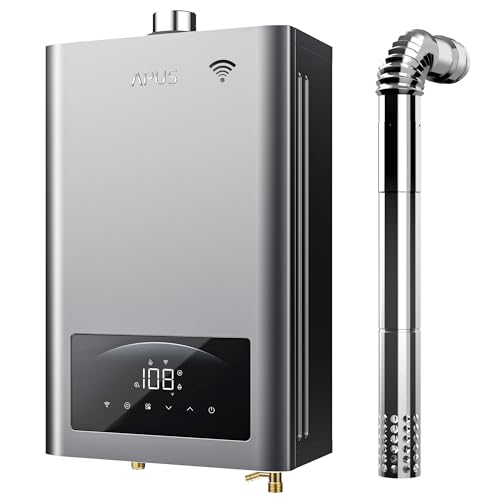
This indoor APUS unit uses 140,000 BTU to deliver up to 6.8 GPM with zero cold-water delay, thanks to APUS’s single-circulation technology. The built-in booster pump increases flow for simultaneous usage and supports two showers and two sinks without temperature swings. The 24/7 ECO smart cycle promises additional energy savings, while the compact footprint simplifies indoor installation and connections to standard gas lines and water lines.
Rinnai RX199iN Condensing Tankless—Indoor/Outdoor

The Rinnai RX199iN is a high-capacity, condensing model rated up to 11.1 GPM with 199,000 BTU. It’s installable indoors or outdoors and uses Versa Vent for flexible venting. A Smart Sense gas control system supports efficient operation, with Quick Flush features for maintenance and a high UEF rating for energy efficiency. The model is designed to scale for larger homes and higher simultaneous hot-water demand, with remote WiFi control via an optional module.
MIZUDO Natural Gas Tankless—Indoor/Outdoor

Mizudo offers a flexible indoor-outdoor convertible tankless water heater with CSA certification for large families. It emphasizes smart WiFi and app control to monitor energy usage and performance. The unit’s advanced temperature control maintains water output within about 1°F during multi-fixture use, reducing temperature fluctuations and ensuring comfortable showers even when several outlets run at once.
APUS Propane Tankless—Indoor, 6.8 GPM
The propane version from APUS mirrors its natural-gas sibling with a 140,000 BTU burner and up to 6.8 GPM. It features zero cold-water technology, a 24/7 ECO smart cycle, and a booster pump to support multiple fixtures. Its app-based control keeps users informed and allows temperature adjustments remotely, making it a strong option for households seeking flexible fuel compatibility and smart control in a compact unit.
Buying Guide: Key Purchase Considerations
- Hot water demand and flow rate: Determine the maximum simultaneous outlets (showers, sinks) you need. Choose models with higher GPM ratings (APUS outdoor, Rinnai RX199iN) if your household frequently runs multiple fixtures at once.
- Gas type and venting: Verify whether the unit supports your available fuel (natural gas vs propane) and assess venting requirements. Condensing options (Rinnai RX199iN) can offer higher efficiency but may require specific venting compatible with your home.
- Installation location: Indoor installations save exterior space but may require more precise venting and exhaust routing. Outdoor units reduce indoor footprint but must be weather-rated and protected from the elements.
- Energy efficiency: Look for high UEF and stable outlet temperatures. Models with smart controls and flow-sensing technology typically deliver better temperature stability and lower energy use (ThermoMate, Mizudo).
- Temperature control: Digital thermostats and precise ±1°F control help prevent scalding and temperature swings when several fixtures run simultaneously.
- Smart features: Remote apps and WiFi controls can simplify monitoring, maintenance reminders, and fault alerts, contributing to long-term savings.
- Durability and warranty: Copper heat exchangers and ceramic heating cores tend to offer longevity. Review warranty terms for heat exchangers, parts, and labor to assess long-term value.
- Maintenance accessibility: Quick access for flushing, descaling, and service can reduce downtime. Quick Flush features on high-capacity units simplify maintenance.
Across these options, consider your climate, water quality, and typical household patterns to balance capacity, efficiency, and cost. For homes with high simultaneous demand, prioritizing higher GPM and BTU ratings (such as Rinnai RX199iN) can improve reliability, while households seeking energy savings may lean toward models with advanced sensors and smart controls (ThermoMate, Mizudo).