Best Serger Sewing Machine for Beginners: Top Picks for Easy Overlocking
New to serging or upgrading from a basic machine? This guide highlights beginner-friendly sergers that balance ease of use with solid performance. Whether you sew lightweight knits or sturdy denims, these models are chosen for straightforward threading, reliable stitch quality, and clear setup. The best buyers are beginners seeking simple setup, adjustable differential feeding, and clear guidance to start finishing seams quickly.
Summary of selected products
| Product | Best For | Key Benefit |
|---|---|---|
| Brother 1034D | All-purpose home projects | Metal frame, 1,300 SPM |
| SewLaVie 360 | Beginner-pros with open threading | Open threading area, 12 stitches |
| SINGER S14-78 | Budget-conscious sewers | 2–4 thread capability, inclusive kit |
| FEIYUE FY505 | Heavy fabrics and precise cuts | Durable metal frame, rolled hem option |
| SINGER X5004-HD | Durable, versatile finishing | 6 stitches, LED lights, strong frame |
Brother 1034D Serger: Solid Starter Overlocker

The Brother 1034D is a sturdy, metal-framed serger designed for beginners who want reliable performance without fuss. It supports 3 or 4 thread operations, making it versatile for finishing seams on knits and woven fabrics. A key advantage is its 1,300 stitches per minute, which speeds up project completion while maintaining control with the foot pedal. This model is best for hobby sewists tackling everyday garment construction and light denim.
Who it’s best for: beginners seeking a durable, straightforward serger with solid speed and a metal frame for long-term reliability. Why chosen: its balance of accessible threading options, robust build, and clear speed control makes initial learning smoother.
Limitations: some users may prefer more open threading or extra built-in stitches found in higher-end models, but it remains a dependable starting point for most standard projects.
SewLaVie 360 Upgraded Serger
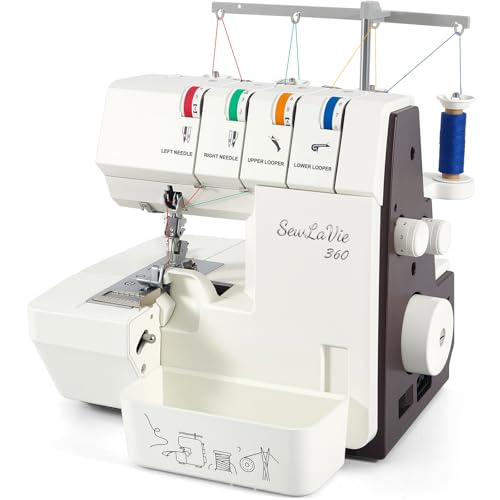
This upgraded model emphasizes beginner-friendly threading with an accessible open-threading area and a visual alignment guide. It supports 2/3/4 thread configurations and runs at 1,300 stitches per minute. Built for efficiency, it finishes edges while forming strong seams across a range of fabrics from knits to light wovens. The differential feed helps prevent wrinkling on delicate or stretchy fabrics, making it a strong pick for new garment makers.
Who it’s best for: beginners who value quick setup, clear threading demonstrations, and consistent results with a mix of fabrics. Why chosen: open threading and guided alignment reduce the common frustrations of learning on a serger.
Limitations: as a pro-series option, it may offer more features than some casual sewers use; assess your typical projects before investing in higher-end options.
SINGER S14-78 Serger With Accessory Kit

The SINGER S14-78 provides 2/3/4 thread options with a practical accessory kit included. Its LED light helps visibility for intricate finishing, while the free arm enables easier sewing around cuffs and sleeves. This model is well-suited for sewists who are expanding into garment construction or home décor with varied seam finishes.
Who it’s best for: beginners who want versatility with a ready-to-use accessory kit and a bright work area. Why chosen: strong 1,200 SPM performance and 2/3/4 thread versatility cover a broad range of common serging tasks.
Limitations: some users may find the threading sequence slightly more complex than ultra-simplified entry models; practice helps minimize setup time.
FEIYUE FY505 Serger Overlock

The FEIYUE FY505 emphasizes a durable metal frame and 2/3/4 thread capability, making it suitable for a range of fabrics and project types. It highlights a built-in rolled hem and precise blade performance for clean edges. This model is a solid choice for beginners who plan to tackle heavier fabrics while wanting a reliable finish.
Who it’s best for: sewers who anticipate heavier-duty projects and rolled hems as a standard option. Why chosen: robust construction paired with versatile threading supports a broad set of applications.
Limitations: fewer explicit beginner aids compared with some entry-focused models; users may benefit from a practice sampler to master the rolled hem and differential feed.
SINGER X5004-HD Serger & Overlock

The SINGER X5004-HD pairs a heavy-duty metal frame with 2–4 thread options, offering six different stitch types for a broad finishing repertoire. A 1,300 SPM speed supports larger projects, and adjustable differential feed helps address fabric puckering and stretch. It’s a strong all-around option for beginners who want room to grow into more complex projects.
Who it’s best for: beginners seeking a durable, flexible serger that can handle a wider variety of fabrics and stitches. Why chosen: combined stability, versatile stitch options, and higher speed make it an adaptable long-term choice.
Caution: the range of stitches may require a bit of initial learning compared with simpler 2- or 3-thread models.
Buying Guide: Key Considerations For Your First Serger
- Threading ease: Look for open threading areas and color-coded guides to reduce setup time. If you’re new, models with a visual alignment guide help you start faster.
- Stitch options: Decide if you want 2/3/4-thread capability and whether you’ll need rolled hems. More threads offer greater flexibility but may add complexity.
- Speed and control: A machine that offers adjustable speed (via a foot pedal) helps you learn gradually and manage trims on multiple layers.
- Fabric handling: Differential feed is important for knits and delicate fabrics to prevent stretching or gathering. Choose a model with adjustable feed.
- Construction and durability: A metal frame typically offers better longevity and stability during operation, especially on thicker fabrics.
- Included accessories: A starter kit with feet, tweezers, and a screwdriver can save setup time and get you sewing faster.
- Maintenance: Check for accessible blades and simple cleaning routines. Ergonomic design can reduce fatigue during longer sessions.
Frequently Asked Questions
- What does a serger do that a sewing machine can’t? It finishes edges and sews while trimming fabric, producing professional-looking seams with minimal bulk.
- Do beginners need 4 threads right away? Not necessarily. Start with 2 or 3 threads to learn basics, then explore 4-thread capabilities as you gain experience.
- Is a metal frame important for a beginner serger? Yes, a metal frame offers durability and stability, especially when sewing heavy fabrics or multiple layers.
- What should I look for in a beginner-friendly serger? Look for easy threading, differential feed, adequate lighting, and a straightforward manual or visual guides.
- Can I use imported or generic feet with these machines? Most sergers use standard feet, but always verify compatibility with your model before buying accessories.