Best High End Embroidery Machines for Pros and Hobbyists
Are you searching for a high-end embroidery machine to elevate your projects? This guide highlights five top options, detailing who each machine is best for, and why. It targets advanced hobbyists, small business owners, and professional sewists seeking robust features, large embroidery areas, and seamless digital integration. The selection emphasizes connectivity, design libraries, speed, and ease of use to help you choose confidently.
Summary of selected products:
| Product | Best For | Key Feature |
|---|---|---|
| Brother SE700 | Beginner-to-intermediate with wireless transfer | Built-in designs and wireless design transfer |
| Brother SE2000 | Design flexibility with extended embroidery options | Over 190 built-in designs and 50 downloadable patterns |
| Smartstitch S-1001 | Commercial-grade capability in a compact footprint | 10 needles, laser positioning, auto color changes |
| Brother NQ1700E | Advanced lettering and versatile hoop options | BES Blue lettering software included |
| Poolin EOM | Large-scale hats, caps, and multi-color production | 15-needle setup with auto color change |
Best All-Around For Connectivity And Built-In Designs
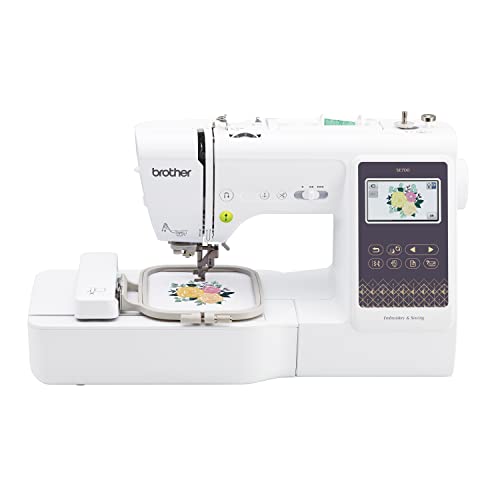
The Brother SE700 combines sewing and embroidery in one unit with a 3.7-inch touchscreen and a 4″ x 4″ embroidery area. Best for buyers who prioritize wireless file transfer and quick design access, SE700 supports wireless Design Database Transfer and ArtSpira Mobile App integration. This model suits hobbyists expanding into embroidery with moderate design libraries and easy setup. A potential limitation is the relatively small embroidery field for larger designs, making it ideal for monograms and small motifs.
Flexible, Design-Heavy Choice With Extensive Built-In Designs

The Brother SE2000 fuses embroidery and sewing with over 190 built-in embroidery designs and 50 downloadable designs plus 241 sewing stitches. It offers wireless transfer via Design Database Transfer and App connectivity for pattern creation on mobile devices. Best for users who want a broad design library and strong automation features. The trade-off is that it remains a mid-to-large footprint machine for home studios rather than compact travel use.
Commercial-Grade Capable, Compact Footprint

The Smartstitch S-1001 Upgraded Embroidery Machine targets small businesses with a 9.5″ x 14.2″ (and larger) embroidery area, 10 needles, 1200 SPM, and a 7″ touchscreen. It emphasizes precision, auto features (thread trimming and color changes), and a maintainable design. Best for users needing higher production capability in a compact form. A possible limitation is the learning curve for complex commercial workflows, though training resources are highlighted by the brand.
Advanced Lettering And Large Workspace

The Brother NQ1700E focuses on advanced lettering with BES Blue software included, plus a generous 6″ x 10″ embroidery field and wireless capabilities. It suits studios that require large text and versatile font management, supported by a broad software ecosystem. A limitation to note is the need for compatible hoops and space to accommodate the larger field and software workflow.
Large-Scale Production For Hats And Caps

Poolin EOM targets high-output environments with 15 needles, fast color changes, and a large embroidery area suitable for hats, caps, and 3D caps. It is best for small businesses seeking scalable multi-color embroidery with reduced manual steps. A caution is that it may require more initial setup and ongoing maintenance due to its commercial-level features.
Buying Guide: Key Purchase Considerations
What embroidery field size do you need?
Consider the largest design you plan to stitch. Larger fields support bigger artwork but require a bigger machine footprint and hoop options. If you mostly do small motifs, a 4″ x 4″ to 5″ x 7″ field may be sufficient.
How important is wireless transfer and software?
Wireless transfer and companion apps streamline pattern exchange and customization. If you work with designs from multiple devices, prioritize machines with reliable wireless transfer and a robust app ecosystem.
What about needle count and production speed?
More needles enable multi-color embroidery without rethreading. Higher stitches-per-minute (SPM) supports faster production, but may increase machine cost. Align speed with your workload and whether you need color variety on every design.
Is software included or required?
Some machines bundle lettering and design software. Verify whether software is included or sold separately, and confirm compatibility with your computer or mobile devices.
What is your space and workflow?
Consider the machine’s footprint, weight, and hoop options. A larger embroidery area is valuable for business orders, but a compact unit may suit a home studio with limited space.
Support and training availability
Access to manuals, videos, and customer support helps reduce setup time. Machines with active user communities and official training resources can shorten the learning curve for complex projects.
FAQ
-
What is the typical embroidery area I should expect in high-end machines?
High-end machines commonly offer 5″ x 7″ or larger fields, with some models offering up to 7.9″ x 15″ for larger designs. Larger fields enable more ambitious projects with fewer rehoops.
-
Do these machines require a computer to transfer designs?
Most models support USB transfer and wireless transfer from PCs or mobile apps. Some designs can be imported directly via connected software, depending on the model and firmware.
-
Is a multi-needle setup necessary for professional results?
For frequent multi-color embroidery, a multi-needle setup speeds production by eliminating frequent color changes. It also reduces manual intervention during busy runs.
-
Can I use these machines for hats and caps?
Many high-end machines support hat embroidery with specialized hoops. Check each model’s compatibility with cap hoops and thick materials.
-
What type of support is typically available after purchase?
Expect manuals, online tutorials, and vendor support. Some brands offer community forums and dedicated technical assistance to help with setup and ongoing use.
-
Are bundled software and hoops essential?
Bundles add value by providing tools for immediate use. However, you can often purchase separate hoops and software if you already own preferred brands or prefer particular features.