Best Small Spiral Dough Mixer for Home Bakers and Small Kitchens
Answering the search for compact, high-performance spiral dough mixers, this guide highlights five top options suited for home bakers and small commercial setups. Each product targets dough enthusiasts who want bakery-quality results without a full-size mixer. Choose this mixer’s strength based on capacity, power, and fermentation features. The quick reference table below helps compare core specs at a glance.
| Product | Capacity | Power | Best For | Key Benefit |
|---|---|---|---|---|
| Ooni Halo Pro Spiral Mixer | 7.3 qt | Multi-speed (58 settings) | Home bakers and pizzerias | Rotating bowl with patent-pending breaker bar for stronger gluten |
| Joydeem Electric Dough Maker | 3.7 qt | 150W | Budget-conscious homes | Seasonal fermentation modes for year-round doughs |
| WantJoin Commercial Dough Mixer | 10.5 qt | 750W | Small restaurants and bakeries | Dual rotating kneading with digital timer |
| TERUISI Commercial Dough Mixer | 13.8 qt | 500W | Busy kitchens | Smart fermentation and quiet operation |
| VEVOR Commercial Food Mixer | 15 qt | 500W | Medium kitchens | Three attachments and versatile speeds |
Ooni Halo Pro Spiral Mixer – 7.3 Quart

The Ooni Halo Pro uses professional spiral mixing technology in a compact home-friendly form. It features a rotating bowl, a spiral dough hook, and a patent-pending removable breaker bar to enhance gluten development for bread and pizza dough. With 58 speed settings ranging from 60 RPM to over 1,000, it offers precise control for diverse dough textures. Best for serious home bakers who want bakery-grade dough without commercial equipment.
Who it’s best for: dedicated home bakers and small pizzerias seeking robust gluten development in a compact unit. Why chosen: it combines professional spiral mixing with extensive speed control and a rotating bowl for improved dough consistency. Caution: higher-end settings may require user familiarity to optimize results.
Joydeem Electric Dough Maker

This dough maker mimics hand-kneading with a 150W motor operating in intervals, ideal for bread, pizza, pasta, sourdough, roti, dumplings, and steamed buns. It includes dual fermentation modes to adapt to seasonal needs, maintaining temperatures that support yeast activity. The 3.7Qt capacity suits small batches and quick testing of dough recipes. Best for: home bakers who want assisted kneading and year-round fermentation with minimal setup.
Selected for: its combination of interval kneading and built-in fermentation modes. Limitation: capacity is modest, so larger batches require multiple cycles.
WantJoin Commercial Dough Mixer

This 10.5 qt spiral mixer is designed for busy kitchens, offering a 750W motor and a dual-rotation kneading system. The bowl rotates at 30-50 RPM while the dough hook spins at 120–230 RPM, enabling a strong gluten structure for breads, pizzas, bagels, and pastries. The intuitive digital control panel with a 60-minute timer simplifies batch planning. Best for: small restaurants and bakeries that need reliable capacity and clear timing controls. Caution: ensure enough space for the larger bowl footprint in compact kitchens.
VEVOR Commercial Food Mixer

The VEVOR mixer offers a 15 qt capacity with a 500W motor and three attachments—dough hook, flat beater, and wire whip. It’s suited for doughs, batters, and whipping tasks, providing versatile performance in medium-sized kitchens. This model emphasizes a robust build with stainless steel components and reliable speed options. Best for: kitchens needing a flexible mixer for multiple tasks without stepping up to full commercial models. Limitation: higher capacity can demand more counter space and maintenance.
CUBELLIN 10L Spiral Mixer
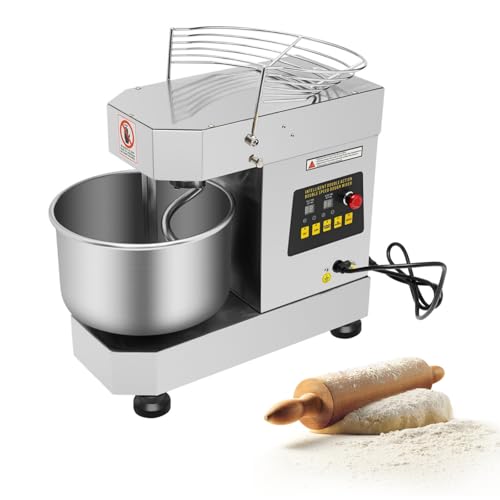
The CUBELLIN 10L spiral mixer features a 750W motor and a 10L (2.6 gal) stainless steel bowl. It’s designed for even dough mixing by combining the spiral rod and bowl rotation, suitable for dough, cream, and other mixing tasks. Best for: small-scale bakeries or home kitchens needing dependable, compact spiral mixing with solid capacity. Limitation: may require careful supervision to avoid over-proofing dough in high-humidity environments.
Buying Guide: Key Considerations For Choosing A Small Spiral Dough Mixer
What capacity do you actually need? Consider batch sizes and whether you will scale up during peak seasons. For home kitchens, 3–7 qt models are common; for small commercial use, 10–15 qt models provide more practical output without full-size equipment.
How important is fermentation and temperature control? Some models integrate fermentation modes or temperature controls that stabilize dough proofing, improving consistency for breads and pastries.
What’s your power and noise tolerance? Higher wattage supports tougher doughs, but may increase footprint and noise. Quiet operation is a plus in busy home kitchens or open-plan spaces.
What attachments and versatility matter? If you need to whip, beat, or cream in addition to kneading dough, look for a mixer with a broad range of attachments and compatibility with standard accessories.
How easy is cleaning and maintenance? Stainless steel bowls and food-grade components simplify cleaning. Removable parts and accessible lids reduce downtime between batches.
Practical buying questions
- Is a spiral mixer necessary for my dough type, or would a planetary mixer suffice?
- Do I prioritize capacity over speed control?
- Will I operate this in a small home or a busy kitchen?
- Does the model include a reliable safety shield and simple troubleshooting?
FAQs
- What is the advantage of spiral mixing over planetary mixing? Spiral mixing develops gluten more evenly, often producing stronger dough and better crumb.
- Are these mixers suitable for sourdough fermentation? Some models offer fermentation modes that help with yeast activation and consistent dough proofing.
- Can I use these mixers for dessert batters or meringues? Yes, models with a wire whip or multiple attachments handle lighter mixes as well.
- Do these units require professional installation? Most are plug-and-play, but check your electrical setup for high-wattage models.
- Which model is best for small business use? For steady output with larger batches, look at the 10–15 qt options like WantJoin or TERUISI.
- Is stainless steel essential for food safety? Stainless bowls and components enhance durability and ease of cleaning in food operations.