Best Embroidery Machine Single Head Options for Small Shops and Crafters
Whether you’re starting a home-based embroidery business or upgrading a personal workstation, a single-head embroidery machine can offer reliable, straightforward performance for caps, shirts, and small items. This guide highlights five suitable single-head machines, detailing who they’re best for, key features, and practical trade-offs. It’s ideal for hobbyists, small business owners, and beginners seeking an approachable path into computerized embroidery.
Buyer summary table:
| Product | Best For | Why It Stands Out |
|---|---|---|
| Brother Skitch Single-Needle Embroidery Machine | Beginners and hobby sewers | Entry-level, app-enabled design work, compact footprint |
| Brother Persona PRS100 Single Needle Embroidery Machine | Caps, hems, small items | Tubular free arm design, cap-focused frames |
| PooLin EOC06 Embroidery Machine | Beginner to intermediate, flexible file transfer | 7″ touchscreen, multiple transfer options |
| Brother SE700 Sewing and Embroidery Machine | Combined sewing and embroidery projects | Wireless transfer, built-in designs and App compatibility |
| Poolin EOM 15-Needle (multi-head) | Higher-volume or larger designs | 15-needle capacity for colorwork and speed |
Brother Skitch Single-Needle Embroidery Machine

The Brother Skitch is a single-needle embroidery machine designed for entry-level users and those expanding into digitized embroidery. Best for beginners and hobby crafters who want a straightforward device with app-assisted design preparation. The machine emphasizes ease of use and connectivity via compatible apps, enabling faster workflow for simple projects.
Best for: New embroiderers and small batch projects on caps, t-shirts, and basic apparel. It’s chosen here for its approachable feature set and compact footprint.
Limitation: It provides a single needle, which can slow multi-color designs; plan color changes accordingly to minimize stops.
Smartstitch S-1501 Commercial Embroidery Machine

The S-1501 is a single-head system noted for its 15-needle capability and a large 14″ x 20″ embroidery area. It includes features like laser positioning, automatic color change, and a smart control system, designed to support a growing embroidery business while maintaining a relatively simple learning curve. This makes it suitable for shops expanding beyond basic designs and into larger or more complex motifs.
Best for: Shops needing larger designs and more color options in a single-head format. Choose this if capwork and larger flat items are common demands and you want robust control with room to grow.
Caution: While it offers many advanced features, the upfront investment is higher than entry-level models; ensure your production pipeline justifies the scale.
Poolin EOM 15-Needle Commercial Embroidery Machine

The EOM 15-Needle offers 15 separate color capabilities with a large embroidery area and automatic color changes, making it well-suited for higher-volume workloads. It’s designed for hats and caps with stable stitching on structured fabrics, plus a straightforward transfer pipeline via WiFi/USB. This model is better for mid-to-large scale operations requiring faster throughput and more color options in a multi-needle head setup.
Best for: Businesses needing faster production and multi-color capacity. It’s a strong pick when cap work and bold designs are a daily requirement.
Limitation: As a higher-needle-count machine, it is more complex and may demand more maintenance compared to single-needle models.
Brother SE700 Sewing and Embroidery Machine
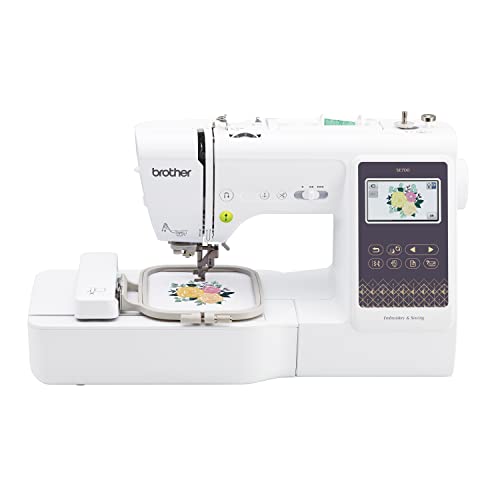
The SE700 combines sewing and embroidery in one compact unit, with 4″ x 4″ embroidery space and 135 built-in designs. It’s connected wirelessly via LAN and integrates with the Artspira app for pattern creation and transfer. The dual-functionality and wireless capabilities make it a practical choice for learners who want to explore both sewing and embroidery without buying separate machines.
Best for: Beginners who want an all-in-one starter machine and the flexibility to switch between sewing and embroidery projects. Choose this if you value app-based workflow and wireless transfers.
Limitation: The embroidery area is smaller than dedicated single-head units designed for larger motifs; plan projects accordingly to avoid design constraints.
Smartstitch S-1001 Upgraded Embroidery Machine

The S-1001 is a compact 10-needle machine designed for flat work, hats, and light-medium production. It features auto color changing, auto thread trimming, a self-lubrication system, laser positioning, and a user-friendly learning curve through community support. The machine is suited for small shops seeking a reliable single-head option with modern automation features to speed up routine tasks.
Best for: Small studios and hobby businesses that want a capable single-head setup with modern automation and a supportive learning ecosystem. Consider this if you value stable performance and ongoing training resources.
Caution: Although improved, the machine’s 10-needle setup may be limiting for very large multi-color designs; prep for color-planned workflows to minimize changes.
Buying Guide: Key Considerations for a Single-Head Embroidery Machine
- Needle count and design scope: More needles enable multi-color designs in a single pass, reducing color-change time. If you primarily sew simple designs or caps, a 1- to 10-needle model can be efficient.
- Embroidery area size: Larger fields allow bigger motifs and full-back designs. Assess typical project sizes to match your most common needs.
- Cap and tubular work capabilities: For hats and curved surfaces, look for tubular frames, cap drivers, and rotating systems designed to hold caps securely.
- Automation and workflow: Features such as automatic color change, trim, laser positioning, and self-lubrication improve efficiency and reduce operator fatigue.
- Transfer and software compatibility: Evaluate whether the machine supports USB/WiFi transfers, and whether its design software integrates with popular formats (PES, DST, etc.).
- Support and training: Consider vendors offering manuals, video tutorials, online groups, or live demos to ease onboarding and troubleshooting.
- Footprint and noise: Compact machines are ideal for home-based setups; check noise levels and maintenance requirements for your workspace.
- Cost of ownership: Balance upfront price with ongoing consumables, maintenance, and potential frame upgrades or software subscriptions.
Frequently Asked Questions
- What is a single-head embroidery machine?
– It is a machine with one embroidery head, capable of stitching designs onto fabrics. It is typically simpler and more affordable than multi-head models. - What projects are best for single-head machines?
– Small businesses and hobbyists focusing on caps, shirts, and lightweight garments, as well as items requiring limited color changes. - Do single-head machines support cap embroidery?
– Many do, with dedicated cap frames or rotating cap drivers. Always verify cap compatibility and included frames before purchase. - Is wireless transfer important?
– Wireless transfer can streamline pattern uploads. If you plan frequent design changes, a model with WiFi/Bluetooth can save time. - Are larger embroidery areas necessary for growth?
– For expanding beyond small items, larger fields (14″x20″ or bigger) offer more design versatility and batch productivity. - What kind of maintenance is required?
– Regular cleaning, lubrication, and occasional part replacements keep performance stable. Choose machines with automatic lubrication or easier maintenance features if possible.