Best Sausage Maker Dry Curing Cabinet: Top Drying Solutions for Home and Small-Batch Pros
The top choice for sausage makers seeking reliable dry curing cabinets is a device with precise temperature control, ample capacity, and even airflow. This guide highlights five cabinets that fit different budgets and needs—from large commercial setups to compact home kitchens. Each option suits different buyers: professional small-business operators, serious home cooks, and hobbyists expanding from DIY curing to consistent results.
Summary table of selected products:
- Commercial Dry Curing Chamber (7.5 kg) — Best for small commercial setups needing even drying and a robust stainless build.
- RUGGARD Electronic Dry Cabinet (50 L) — Best for dust protection and humidity control in storage spaces.
- The Moupeaktain Sausage Dryer Cabinet (7.5 kg) — Best for adjustable heat, multiple meats, and efficient airflow.
- 12 Hook Upgraded Commercial Dehydrator — Best for clear digital controls and high-efficiency drying with a classroom-friendly setup.
- Levigationlu Commercial Meat Curing Chamber — Best for 360° drying and general versatility with a smart control panel.
Commercial Dry Curing Chamber Cabinet, 7.5KG/15KG Capacity

Best for small commercial setups requiring consistent airflow and controlled temperatures. This stainless steel cabinet mimics natural air-drying with a precise, constant-temperature system that evenly circulates heat to remove moisture while preserving flavor and nutrients. The 360° rotary drying and 14 stainless steel hooks ensure uniform heat exposure, aiding in reliable curing for beef, pork, bacon, and sausages. A side-ventilation design helps maintain a stable internal environment, preventing flavor cross-over and edge-to-center dryness.
Who it’s for: best for small butcher shops, deli counters, or serious hobbyists who want restaurant-style dry aging capacities in a compact unit. Limitations include the need for space and ongoing monitoring to ensure even airflow across larger batches.
RUGGARD Electronic Dry Cabinet (50L)

Best for storage and humidity control in a dedicated drying or curing area. This cabinet electronically reduces humidity to protect stored items from dust and dirt, with adjustable shelves and padded liners for delicate cuts. A sealed, locking door adds security in busy kitchens or prep spaces. It’s well-suited for dry-cured products that benefit from stable humidity while aging, such as salami or jerky components.
Who it’s for: ideal for commercial kitchens, fermentation rooms, or basements where controlling ambient humidity is critical. Caution: it does not substitute for a dedicated curing chamber for long-term dry aging, but it excels at moisture management between batches.
The Sausage Maker® 3 Dry Age Bags For Meat (Dry Aging Kit)

Best for adding dry aging capability to standard refrigeration. This kit provides dry aging bags plus a netting roll to transform a regular fridge into a dry aging chamber, suitable for up to 16 lbs of cuts like ribeye or sirloin. The breathable membrane material supports a safe aging environment without a dedicated curing cabinet. Useful for beginners or cooks expanding into dry-aged beef at home.
Who it’s for: perfect for home cooks exploring dry aging with minimal equipment costs. Limitation: not a stand-alone curing cabinet; rely on an existing fridge for aging air inside the bags.
Sausage Dryer Meat Curing Cabinet, 800W

Best for mid-sized operations needing a controlled 30-90℃ environment with substantial capacity. This cabinet uses an 800W motor to deliver stable airflow for even drying, reducing the need for frequent repositioning. It includes 14 stainless steel hooks and a 7.5 kg capacity, suitable for sausages, bacon, jerky, and other cured products. A digital thermostat and timer provide precise control for various recipes.
Who it’s for: suitable for small restaurants, market stalls, or families producing regular cured products. Caution: check space requirements and ensure ventilation in the prep area to manage heat output.
12 Hook Upgraded Commercial Dehydrator
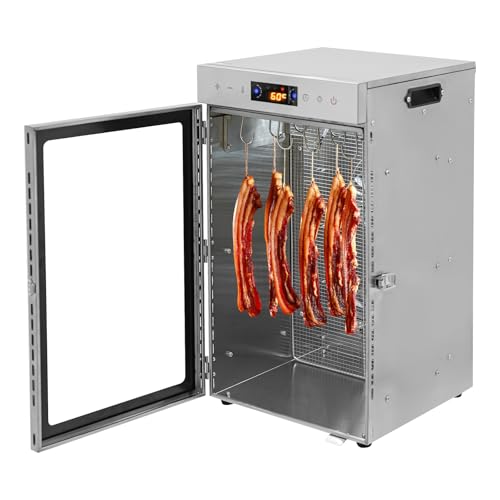
Best for buyers needing clear, real-time temperature display and flexible timing. This 12-hook cabinet uses 800W power and stainless steel construction to support heavy-duty drying. Temperature can be set between 86-176 °F with a timer from 0.5 to 24 hours, enabling precise control for meat patties, salami, jerky, and other products. A transparent door and interior light help monitor progress without opening the unit.
Who it’s for: ideal for culinary schools, small processing facilities, or serious hobbyists who want a robust, easy-to-read control panel. Limitation: the capacity is moderate, so larger batch operations may require multiple units or alternative high-capacity models.
Levigationlu Commercial Meat Curing Cabinet

Best for users seeking 360° rotary drying and a compact footprint with smart controls. This cabinet features an adjustable digital thermostat (30-90℃), a 24-hour timer, and an 800W motor that enables even air circulation without needing to rotate trays. With 14 hooks and a reinforced lockable door, it accommodates a variety of meats and dried products while supporting consistent results.
Who it’s for: well-suited for small-scale producers and home enthusiasts who value uniform drying and a straightforward user interface. Limitation: as a multi-purpose unit, it may require careful setup to optimize airflow for very dense loads.
Buying Guide: Key Considerations For Choosing A Dry Curing Cabinet
What capacity do you need? Capacity ranges from 50 liters to larger commercial units. Consider your typical batch size and future growth. Look for models with 14 or more hanging hooks for flexibility and even airflow distribution.
How important is precise temperature control? Dry curing and aging demand stable temperatures. Seek models with digital thermostats, clear readouts, and low-temperature drift to ensure consistent results across batches.
Is airflow critical for your products? Cabinets with 360° rotation or reinforced, evenly distributed airflow help prevent uneven drying and flavor cross-contamination. Side vents can contribute to stable internal conditions.
Do you need humidity management? Humidity control is crucial for dry aging and preventing mold growth. If your setup lacks a dedicated humidity system, pair a dry cabinet with a humidity-controlled environment or select a model designed for dust and moisture management.
What is your space and budget? Smaller home setups benefit from compact, user-friendly designs with clear digital controls. For small businesses, durable stainless steel construction, safety features, and the ability to operate continuously are essential. Always verify power requirements and space clearance before purchase.
FAQs
- What is a dry curing cabinet used for? It preserves meat by controlled air flow, temperature, and, in some models, humidity, enabling dry aging and jerky production.
- Why is 360° rotary drying beneficial? It ensures uniform heat exposure and airflow for all sides of the meat, producing consistent texture and color.
- How important are digital controls? Digital controls provide precise, repeatable settings, reducing batch-to-batch variability and improving safety.
- Can these cabinets replace a dedicated dry aging room? They can handle many home and small-business needs, but very large aging projects may require a specialized environment with rigorous humidity control.
- Are these cabinets easy to clean? Stainless steel interiors and removable components simplify cleaning, though some models allow dishwasher-safe hooks or parts.
- What safety features should I look for? Locking doors, sturdy shelves, automatic shutoffs, and proper venting help ensure safe operation in busy kitchens or prep areas.