Best Smart Home Freezer Sensor Solutions for Real-Time Temperature Control
Answering the search for a reliable smart freezer sensor, these picks cover WiFi and LoRa options with app alerts, remote monitoring, and precise temperature measurement. They’re ideal for households, small businesses, and anyone who needs constant visibility into freezer conditions. This guide highlights five top options, explains who they’re best for, and compares key features to help buyers choose confidently.
Summary table of chosen products:
| Product | Best For | Connectivity | Alerts | Notes |
|---|---|---|---|---|
| GoveeLife WiFi Refrigerator Thermometer (2 Pack) — B0CLB358BJ | Homes needing dual-sensor coverage with local/remote alerts | WiFi (2.4 GHz) | App alerts, remote alarms | Supports up to 10 sensors via gateway |
| GoveeLife WiFi Refrigerator Thermometer (2.4G Only) — B0DZCQFZB6 | Families wanting precise, continuous monitoring | WiFi (2.4 GHz) | App, email, buzzer | High-precision probe, wide range |
| YoLink Smart Wireless Thermometer Hygrometer — B0F245PNYH | Locations without reliable WiFi | LoRa (hub required) | Text, email, push alerts | Long range, 1/4 mile open air |
| YoLink Smart Temp & Humidity Sensor — B08JP39RLP | Multi-room monitoring with long battery life | LoRa (hub included) | App + SMS + email | 2-year battery life, versatile use |
| GoveeLife WiFi Freezer Thermometer — B0CL9YZQLH | Refrigerators/freezers requiring gateway-based WiFi | WiFi (2.4 GHz) | App alarms, continuous updates | Gateway needed for full WiFi functionality |
GoveeLife WiFi Refrigerator Thermometer (2 Pack) with Alarm

The GoveeLife 2-pack is designed for constant digital monitoring of freezer and fridge temperatures, with remote data access through the app. It is best for households that want multiple sensors reporting to a single gateway and immediate alerts when temperatures drift outside preset ranges. The two-sensor setup is ideal for double-door or separate-freezer compartments. A notable strength is reliable app-based alarms and ongoing data export, which supports long-term traceability. Caution: Requires a WiFi gateway and 2.4 GHz network; does not operate on 5 GHz networks.
- Best for: households needing simultaneous monitoring of two zones.
- Why selected: continuous updates and alarm reliability reduce the risk of spoiled food.
- Limitation: requires gateway and compatible WiFi network.
GoveeLife WiFi Refrigerator Thermometer (2.4G Only) with Alarm

This variant emphasizes high-precision temperature sensing and remote monitoring, suitable for families seeking real-time visibility with 24/7 alerts. The 2.7mm NTC probe provides fast response across a broad -40°F to 158°F range, helping keep frozen and refrigerated foods within safe limits. It’s best for busy households that want immediate notifications via multiple channels. Caution: Some users may need to manage Bluetooth or gateway integration to access full remote features.
- Best for: real-time remote monitoring with precise sensing.
- Why selected: fast response and loud, built-in audible alarm options.
- Limitation: feature set depends on maintaining gateway/app connectivity.
YoLink Smart Wireless Thermometer Hygrometer (3-Pack)

YoLink’s 3-pack leverages LoRa for long-range, low-power monitoring without crowding WiFi networks. It’s best for locations where WiFi is unreliable or nonexistent—such as basements, detached garages, or wide storage rooms. The system supports multiple alert methods, including SMS, email, and push notifications, with hub-based integration. Caution: LoRa-based devices require the included hub and may have different coverage in densely built areas.
- Best for: areas with weak WiFi or extensive layouts needing long-range coverage.
- Why selected: independent from WiFi, broad monitoring scope.
- Limitation: needs LoRa hub for full operation; SMS allowances exist.
YoLink Smart Temp & Humidity Sensor (2 Pack) with Hub

This YoLink pair focuses on humidity alongside temperature, expanding environmental monitoring for freezers, wine cellars, or nurseries. It’s best for multi-condition monitoring with a single platform, providing alerts via app, email, or SMS. The included hub and long battery life make it practical for locations where power access is limited. Caution: Not intended for outdoor use; performance depends on LoRa network reliability.
- Best for: combined temperature and humidity monitoring in multiple rooms.
- Why selected: long-range, long battery life with diverse alert options.
- Limitation: not built for outdoor exposure.
GoveeLife WiFi Freezer Thermometer with Gateway

This option focuses on gateway-based WiFi temperature monitoring for refrigerators and freezers, offering continuous updates and 24/7 alarms. It’s best for users who want reliable, centralized monitoring through a gateway with 2.4 GHz WiFi. The system supports a range of up to roughly 131 feet to the gateway, enabling remote oversight from a central location. Caution: Gateway hardware is a prerequisite for full WiFi functionality.
- Best for: centralized monitoring via gateway in WiFi-rich homes.
- Why selected: continuous temperature updates and reliable alarm behavior.
- Limitation: requires a compatible gateway for full operation.
GoveeLife WiFi Refrigerator Thermometer (2.4G Only) — Another Variant
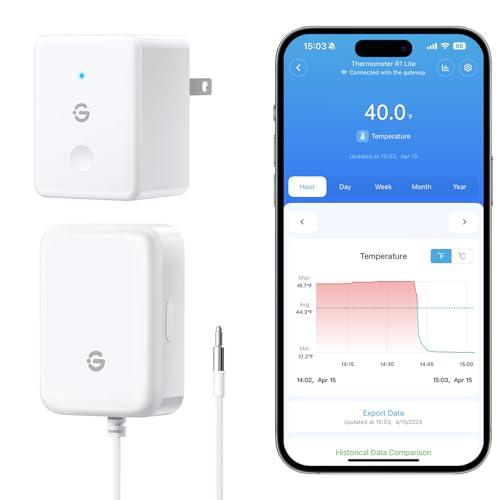
This variant emphasizes 3-way alerts and remote monitoring across a single gateway that can manage up to 10 sensors. It’s best for households expanding monitoring to multiple fridges or freezers within a home, or for users who want centralized data access for ongoing safety compliance. Caution: Remote functionality depends on gateway connectivity and 2.4 GHz WiFi reliability.
- Best for: expanding to multiple sensors under one gateway.
- Why selected: centralized, multi-sensor monitoring with remote alerts.
- Limitation: relies on gateway stability and WiFi network health.
Buying Guide
What should you consider when choosing a smart freezer sensor?
- Connectivity: Do you want WiFi, LoRa, or a hybrid system? WiFi provides easy remote access but depends on home network stability; LoRa extends range without WiFi but requires a hub and may incur higher setup needs.
- Range and placement: How large is the monitored area? Consider the distance from the gateway or hub to each sensor and whether multiple zones require separate sensors.
- Alerts and data: Do you need push notifications, email, or SMS alerts? Look for systems offering customizable thresholds and audible alarms for fast response.
- Sensor accuracy: What temperature range and precision are you targeting? Probes with ±0.5°C/±0.9°F accuracy and fast refresh improve decision timing.
- Power and battery life: Are battery-powered sensors acceptable? LoRa devices often offer long battery life, which reduces maintenance.
- Data export and history: Is long-term data export important for inventory logs or compliance? Some models provide 2-year free data export and easy access via apps.
- Ease of integration: Will you be integrating with existing smart home hubs (Alexa, IFTTT), or using a standalone app? Check compatibility and required hubs.
- Gateway requirements: Some models require a gateway for full functionality. Confirm if you already own a compatible gateway or plan to purchase one.
FAQ
- Q: Do these sensors work without a constant internet connection?
A: LoRa-based sensors work with a hub and don’t rely on WiFi, but app-based remote access may require cloud connectivity. - Q: Can I monitor multiple fridges with one gateway?
A: Yes, many systems support multiple sensors per gateway, but check the maximum sensor count per gateway in the product specs. - Q: How precise are freezer temperature readings?
A: Most high-quality sensors report within about ±0.5°C (±0.9°F) with fast 2-second refresh times. - Q: Are there audible alerts, and can I mute them?
A: Several models include built-in audible alarms; some allow muting or silencing under settings. - Q: Do I need a subscription for app data export?
A: Some options offer free data export for a fixed period; verify the policy for continued access. - Q: Which setup is best for a busy family with kids?
A: A model with 24/7 remote monitoring, multiple alert types, and a loud audible alarm is usually best.