Best Food Scale for Meat: Accurate Kitchen Scales for Precise Portions
When measuring meat portions, precision matters for carnivore meal plans, dietary tracking, and bulk meal prep. The top picks below are selected for steadiness, unit options, and easy tare functions to keep your kitchen accurate and efficient. This guide highlights five scales that are well suited for weighing meat, from compact digital options to sturdy mechanical models. The buyer profile for each product is noted to help you choose based on your cooking habits, container needs, and preferred readouts.
Summary of chosen products
| Product | ||
|---|---|---|
| Etekcity Food Kitchen Scale | Daily meat portioning and meal prep | 1 g increments; 11 lb capacity; compact stainless steel |
| Taylor Mechanical Kitchen Scale | Old-school reliability; heavier meat portions | 11 lb capacity; battery-free analog |
| Greater Goods Digital Food Scale | Bulk batch cooking and baking with large bowls | 22 lb capacity; clear display; 1 g precision |
| Nicewell Food Scale | Multi-unit flexibility; easy readouts | 1 g / 0.1 oz; tempered glass; large platform |
| Amazon Basics Digital Kitchen Scale | Budget-friendly, reliable daily use | 11 lb capacity; multiple units; BPA-free components |
Etekcity Food Kitchen Scale

Best for compact, precise meat portioning during daily meal prep. This scale weighs up to 11 lb (5 kg) with 1 g increments and supports multiple units (oz, lb, fl oz, g, mL). It includes a tare function and runs on two AAA batteries for straightforward operation. Its small footprint makes it ideal for apartment kitchens or RV setups where space is at a premium. A potential limitation is the battery dependency and limited maximum capacity if dealing with large cuts.
Food Scale – 33lb Digital Kitchen Scale (GGQ)
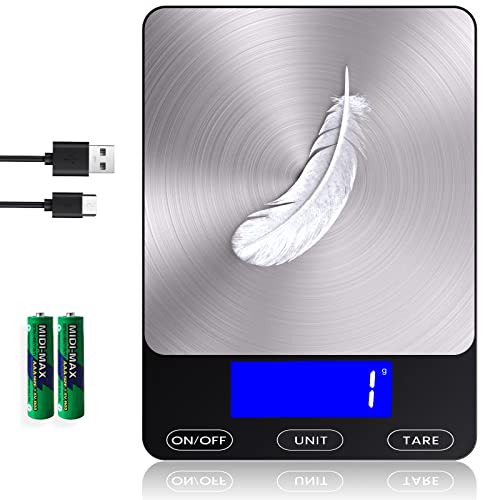
Better for larger meat portions and bulk prep. It offers four high-precision load sensors and a 1 g graduation with a 33 lb (15 kg) capacity. The scale supports multiple units and features a tare function to subtract container weight. A practical caveat is that the scale is designed for general kitchen use and may not be ideal for microgram-level measurements or extremely large quantities beyond its stated capacity.
Taylor Mechanical Kitchen Scale with Bowl

Best for meat portions without batteries. This analog scale weighs up to 11 lb (5 kg) in 1 oz (50 g) increments and includes a removable, dishwasher-safe weighing bowl for easy cleanup. It’s ideal for users who prefer a durable, no-power option and a classic display. It may be less convenient for precise digital readings in tight spaces or during quick tare cycles.
Mik-Nana Food Scale

Best for versatile units and reference-friendly measurements. This scale provides 10 kg/22 lb capacity with 1 g/0.1 oz resolution and six units (g, kg, lb, oz, ml, milk ml), plus a tare function. It’s suitable for meat prep, baking, and weight-loss tracking. The higher unit variety can add slight complexity for first-time users, but improves flexibility for mixed recipes and portion control.
Nicewell Food Scale
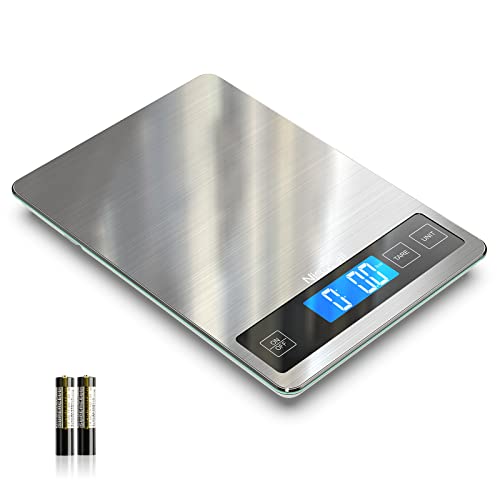
Chosen for its balance of precision and readability, Nicewell weighs up to 22 lb with 1 g/0.1 oz increments. It features a large platform and a tempered-glass surface for durability and easy cleaning. Best for cooks who frequently weigh multiple meat portions or bulk ingredients; a potential downside is the slightly larger footprint compared with ultra-compact scales.
Amazon Basics Digital Kitchen Scale

Best for straightforward, budget-friendly meat weighing. This scale supports multiple units and includes batteries. It’s a practical choice for those who want reliable daily use without extra features. The simpler interface may be less ideal for advanced cooks who rely on many measurement units or extended tare histories.
Buying Guide: Key Considerations For Meat Weighing
- Capacity: Choose a scale that can comfortably handle the largest meat portion you weigh. For typical home use, 11 lb to 22 lb capacities are common and sufficient for most cuts.
- Readout accuracy: Aim for 1 g or 0.1 oz precision for precise portioning. If you frequently measure tiny portions, higher resolution helps.
- Units: Ensure the scale supports grams, ounces, pounds, milliliters, and fluid ounces if you track recipes, marinades, or sauces with different measurements.
- Tare functionality: A reliable tare feature subtracts container weight, making accurate net weight quick and repeatable.
- Platform size and material: A larger platform accommodates bigger bowls and meat cuts. Stainless steel or tempered glass tops resist staining and are easy to clean.
- Power options: Battery-powered models offer portability; mechanical scales provide battery-free operation but lack digital readouts.
- Readability: A clear LCD or large display helps when reading measurements from above large bowls or in dim kitchens.
- Durability and maintenance: Look for easy-clean surfaces and bowls that are dishwasher-safe if you handle frequent meat weighing.
Frequently Asked Questions
- What scale is best for weighing raw meat portions?
Look for a scale with at least 11 lb capacity, precise 1 g or 0.1 oz increments, and a tare function to subtract container weight. - Can I weigh hot meat on kitchen scales?
Yes, but give it time to cool slightly; many scales tolerate warm items, though extreme heat can affect electronics over time. - Is a mechanical scale better than a digital one for meat?
Mechanical scales are battery-free and durable, but digital scales typically offer higher precision and tare convenience. - Do all meat scales measure in milliliters?
Not all; only scales with ml or milk-ml options can display volume-based readings. Check unit options before buying. - How important is platform size for meat prep?
A larger platform reduces spillage and accommodates bigger bowls, making meal prep smoother. - Should I buy a scale with a large display?
A larger display improves readability under bowls and in low-light kitchens, especially when weighing multiple portions.