Best Pizza Oven Temp Gauges for Accurate Heat Control in Home Kitchens
Find the right pizza oven temperature gauge to monitor heat efficiently and achieve consistent crust results. This guide highlights popular infrared and analog oven thermometers that cater to home cooks, pizza lovers, and hobby bakers. Each product is chosen for clarity, reliability, and ease of use in a pizza-focused kitchen.
The following quick-reference table summarizes the five selected products, including their primary strengths and ideal users.
| Product | Best For | Key Benefit | Type |
|---|---|---|---|
| KIZEN Infrared Temperature Gun | Home cooks and hobby bakers | Wide range with adjustable emissivity | Infrared |
| TempPro TP30 Infrared Thermometer | Pizza ovens and griddles | Ultra-fast response and emissivity control | Infrared |
| AcuRite 00620A2 Stainless Steel Oven Thermometer | Traditional oven use | Stainless steel durability | Analog |
| Tidevib Heat-proof Oven Thermometer | Wood-fired and high-temp ovens | High max temperature reading | Analog |
| PECULA Stainless Steel Oven Thermometer | Oven, grill, smoker combos | Battery-free with dual-zone dial | Analog |
KIZEN Infrared Temperature Gun For Cooking
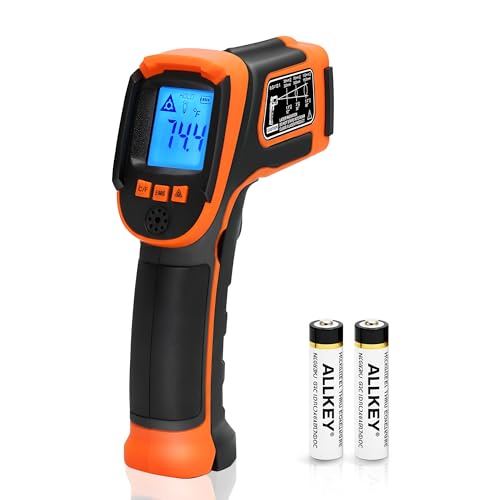
The KIZEN laser thermometer covers a wide measurement range suitable for pizza ovens, griddles, and ovens. It offers an emissivity range from 0.1 to 1.0 for surface-adapted accuracy, and a recommended 14-inch distance for best readings. Best for cooks who need quick surface temps on diverse materials without contact. Caution: readings can be affected by reflective surfaces; calibrate emissivity accordingly.
TempPro TP30 Infrared Thermometer Gun

TempPro TP30 is designed with a 12:1 distance-to-spot ratio and a rapid <500 ms response time, making it ideal for pizza ovens and hot surfaces. It supports emissivity adjustments from 0.1 to 1.0 and reads from -58°F to 1022°F. This is best for cooks who want fast, repeatable surface measurements and flexible surface compatibility. Limitation: infrared devices measure surface temperature, not internal oven air temperature.
AcuRite 00620A2 Stainless Steel Oven Thermometer

AcuRite’s oven thermometer provides a durable stainless steel build with a protective glass lens and a 150–600°F measurement range. It’s a straightforward, battery-free option that offers reliable, instant readings. Best for traditional ovens or grill setups where a simple dial is preferred. Caution: analog gauges require careful placement to avoid misreading due to heat shadows.
TempPro 2-Pack Oven Thermometer

This 2-pack from TempPro covers 50–600°C/100–600°F, using durable 431 stainless steel and a clear, high-contrast display. It’s ideal for cooks who need multiple monitoring points or a spare thermometer for a second oven. Best for serious bakers who run high-heat sessions and want robust, battery-free operation. Limitation: Analog readouts may require calibration for precise bake timing.
Tidevib Heat-proof Oven Thermometer

Tidevib focuses on high-temperature monitoring with a 500°C max reading, featuring robust stainless steel construction for wood-fired or stone ovens. It’s best for pizza ovens that require precise, high-heat control. Limitation: Analog devices may be slower to react to rapid temperature changes than infrared models.
Buying Guide: Key Considerations For Pizza Oven Temperature Gauges
- Direct vs. surface reading: Infrared thermometers measure surface temps; analog dial thermometers measure ambient or inserted surface temps. Choose based on how you bake pizza (stone surface, air temp, or interior oven temp).
- Temperature range: Ensure the gauge covers 100–600°F (or higher) to accommodate typical home pizza ovens and stone temps. High-heat models are essential for wood-fired or brick ovens.
- Emissivity control: For infrared tools, an adjustable emissivity (0.1–1.0) improves accuracy across materials like metal, stone, and ceramic baking surfaces.
- Distance-to-spot ratio: A higher D:S ratio means you can measure a smaller area from a greater distance. This helps when you want quick readings without opening the oven door too often.
- Power and maintenance: Analog gauges are battery-free and require minimal upkeep. Infrared models need occasional battery swaps but offer faster readings.
- Ease of use: Consider whether you prefer a single instinctive reading, a dial you can glance at, or a device you can mount near the oven for constant monitoring.
- Placement and safety: For inside-oven probes, ensure the gauge or probe passes safely through doors without interfering with seals or heating elements.
Frequently Asked Questions
- What’s the best type of thermometer for pizza ovens?
- How should I position an infrared thermometer for pizza crust results?
- Do I need a thermometer with a high temperature range for wood-fired ovens?
- Are battery-free thermometers better for frequent use?
- Can I use these thermometers for other cooking tasks?
- What should I avoid when choosing a pizza oven thermometer?
The choice depends on your setup. Infrared thermometers are great for quick surface readings of the stone and oven walls, while analog oven thermometers provide reliable ambient temperature in the oven itself.
Keep the device about 14 inches (36 cm) away from the target surface and ensure an emissivity setting close to the baking material for accurate surface temperature readings.
Yes. Wood-fired ovens can exceed 500°C in some designs. Choose a model that reads up to at least 500°C (or 1000°F) if you bake at high heat.
Battery-free models are low-maintenance and reliable for consistent readings, but infrared options offer the fastest feedback for ongoing cooking sessions.
Yes. Many units work for grills, griddles, candy making, and general oven monitoring. Emissivity control expands their usefulness on diverse surfaces.
Avoid gauges with very narrow temperature ranges, poor readability, or those that require frequent recalibration, which can disrupt high-heat cooking sessions.