Best 3 Roller Grain Mills for Homebrew: Precision Milling for Malt and Barley
The top choice for serious homebrewers seeking consistent, crush-friendly milling is a 3-roller grain mill. These mills provide smoother feeds, better hull integrity, and more uniform grind sizes than many 2-roller models, helping you maximize mash efficiency. This guide highlights five options that emphasize 3-roller design where available and clearly compares them to notable 2-roller alternatives. Ideal buyers include serious homebrewers, small-batch kegerators, and brew clubs looking to optimize malt extraction without hull damage.
| Product | Roller Type | Hopper Capacity | Best For |
|---|---|---|---|
| Brewland Grain Mill Pro with 3 Rollers | 3 rollers | 15 lb | Large-batch brewers seeking precise adjustment |
| CHYLMAPHEN 3-Roller Grain Mill | 3 rollers | not specified | Versatile manual option with robust build |
| Ferroday Malted Grain Mill (2 Rollers, with Base) | 2 rollers | 7.7 lb | Compact, with base; good for regular homebrewers |
| Ferroday Malted Grain Mill (2 Rollers, No Base) | 2 rollers | 7.7 lb | Sturdy, portable setup without fixed base |
| VEVOR Manual Grain Mill (2 Rollers) | 2 rollers | 4 L hopper | Budget-friendly, high-capacity manual grinding |
The selections below prioritize 3-roller designs first while clearly noting the strengths and limitations of each model. Each entry provides practical guidance on who benefits most and where to consider alternatives.
Brewland Grain Mill Pro With 3 Rollers

Features a 15 lb hopper and an 8-roller spacing calibration that ranges from 0.025 to 0.1 inch. It supports manual grinding and can connect to a low-speed drill for powered crushing. Not suited for corn, coffee beans, soybeans, or sugarcane; not designed to mill grains into powder.
Best for: Homebrewers doing larger batches who want precise roller gap control and the option to scale with a drill for faster milling. Choose this if you value a high-capacity hopper and direct drill compatibility as part of your brewing workflow.
Caution: The mill is optimized for malt, barley, and grain; ensure you’re not milling non-grain materials that could clog or damage the mechanism.
CHYLMAPHEN 3-Roller Grain Mill

Equipped with 3 rollers and sturdy knurls, this model aims for efficient throughput with a consistent crush size. The unit is designed to be manual-friendly but can be paired with a low-speed drill for higher throughput. Not recommended for corn or soybeans; not for flake or flour production.
Best for: Homebrewers who want a robust, manual-optimized unit with the option to upgrade to drill-assisted milling without paying for a base-heavy setup. Ideal when you prioritize hull preservation for sparging.
Caution: Availability of a fixed base is not indicated; consider floor space and stability when positioning on a counter or table.
Ferroday Malted Grain Mill (2 Rollers, With Base)

2 rollers with a 7.7 lb hopper and adjustable 0.025–0.1 inch gap. Drill mode lets an electric drill power the milling process, improving throughput for larger batches. Not designed for corn or soybeans; not a powder mill.
Best for: Brewers who want a strong drill-supported option in a compact, base-mounted setup, with reliable hull preservation. Choose this if you want a balanced mix of manual and motor-assisted milling.
Caution: Two-roller design may yield less throughput than a three-roller system at equal settings; consider batch size and planned mash efficiency.
Brewland Grain Mill Brewing For Grain Malt Barley
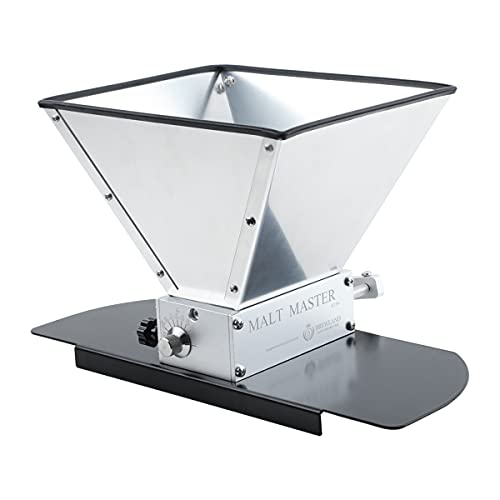
This Brewland model features a 7.7 lb hopper, a two-roller configuration, and compatibility with low-speed drills. It emphasizes compatibility with a broader range of grinds while maintaining hull integrity for sparging. It notes not for corn, coffee beans, soybeans, or sugarcane, and it does not mill grains to a powder.
Best for: Brewers seeking a mid-sized, drill-ready option that can handle repetitive batches without frequent refilling. Useful for those who prefer a simpler, two-roller solution with dependable performance.
Caution: The two-roller design may require more careful adjustment for very fine grinds; plan for space to access the adjustment knob during setup.
VEVOR Manual Grain Mill
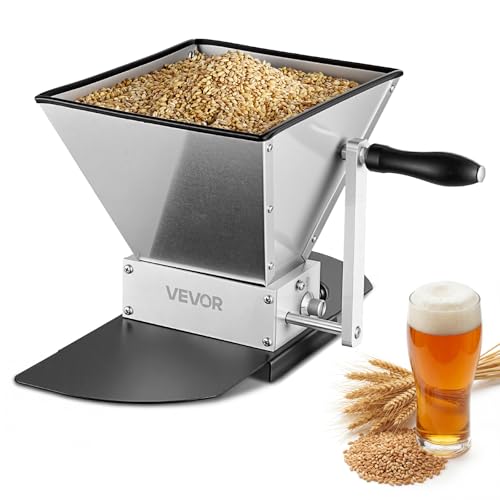
Designed as a homebrew‑focused grinder with a 1.06 gallon hopper and adjustable gap (0.025″–0.1″). It uses two stainless steel rollers and supports a practical, manual crank. Not recommended for corn; limited to grains and malt for beer brewing.
Best for: Budget-conscious brewers who want a sturdy manual mill with a generous hopper and straightforward operation. Choose this if you value a simple setup without extra base components.
Caution: Two-roller design means you may need slower, more deliberate milling at finer settings to avoid clumping or hull damage.
Buying Guide: Key Purchase Considerations
- Roller configuration: How important is a 3-roller design for your brews? Three rollers typically offer smoother feeding and more consistent particle size, which can improve mash efficiency. If you routinely brew large batches, a 3-roller model may provide noticeable benefits.
- Hopper capacity: Larger hoppers mean fewer refills during a milling run. If you brew in larger volumes, prioritize models with 7–15 lb capacity. For smaller experiments, a smaller hopper may suffice.
- Drill compatibility: If you plan to use powered milling, ensure the drive shaft accepts your drill’s chuck size and that safety features or guards are considered in setup.
- Material and durability: Stainless steel rollers and aluminum hoppers offer good longevity and corrosion resistance. Check whether screws, handles, and bases are designed for long-term use.
- Base and stability: A fixed base can improve stability and accuracy during milling. If space is limited, consider a model with a compact footprint or removable base.
- Grind fineness control: Adjustable gap ranges (commonly 0.025″ to 0.1″) let you tailor grind size for different mash schedules. A wider range supports versatile brewing styles.
- Limitations: Many mills are not suitable for non-grain materials or corn and soybeans. Confirm compatibility with your intended grains before purchasing.
FAQ
- What is the advantage of a 3-roller grain mill?
- A 3-roller design typically provides more consistent crush size and smoother feeding, which can improve mash efficiency and reduce husk damage compared to most 2-roller mills.
- Can I use a drill with these mills?
- Many mills support drill-powered grinding through a drive shaft with an 8 mm hex socket. Always follow safety guidance and use a low-speed drill to avoid overheating.
- Which hopper size is best for homebrewing?
- Hopper sizes around 7–15 lb are common for larger batches, reducing the need for frequent refills during extended milling sessions.
- Are these mills suitable for corn or soybeans?
- No. Most mills listed are designed for malt, barley, and other brewing grains. They are not recommended for corn or soybeans.
- Should I choose a base or base-less model?
- A base adds stability and can improve consistency, but base-less models are more portable. Choose based on your countertop space and setup flexibility.