Best Curing Chamber for Meat: Top Dry Aging and Drying Solutions for Home Kitchens
Answering the search for the best curing chamber for meat, this guide highlights practical options for home cooks and small-scale operations. The selections prioritize consistent air flow, precise temperature and humidity control, and enough capacity to handle common cuts like ribeye, brisket, and bacon. Ideal buyers include home enthusiasts wanting reliable dry aging, small caterers seeking portable curing cabinets, and chefs exploring jerky or biltong production. Below is a quick summary table of five suitable products, focusing on capacity and core features to help you compare at a glance.
| Product | Capacity | Best For | Key Benefit |
|---|---|---|---|
| Cobalance Dry Aging Fridge | Up to 33 lbs | Home cooks seeking adjustable aging | Adjustable temp 34–72°F, humidity 50–85% |
| Commercial Dry Curing Chamber Cabinet (7.5KG/15KG) | 7.5 kg or 15 kg options | Small pro or home use | Professional-grade dehydration with 360° rotation |
| JDINAAS 1000W Biltong Drying Box | 11.23 gal (approx. 42 L) with 20 hooks | Large-volume home/restaurant curing | High airflow, smart control, Celsius/Fahrenheit |
| Commercial Dry Curing Chamber Cabinet (15KG) | 15 kg | Medium-scale curing | Same professional features, larger capacity |
| Ostreemaner Dry AGER | 7.5 kg | Jerky and sausages at home | 360° rotation, LED control, precise temp |
Cobalance Dry Aging Fridge for Steaks

The Cobalance unit is designed for home aging of beef and game with a dedicated dry aging fridge system. It provides adjustable temperature from 34°F to 72°F and humidity from 50% to 85%, enabling users to customize aging profiles for steaks, roasts, or other cuts. It comes with 2 shelves and 2 detachable hooks, with a capacity up to 33 lbs. Best for dedicated home cooks who want controlled, repeatable dry aging in a compact footprint. A key limitation is that optimal aging requires careful monitoring of airflow; rely on the unit’s circulating air and carbon filtration to maintain a clean environment.
- Best for: Home cooks prioritizing precise aging profiles for beef and game.
- Why selected: Precise control, compact size, and built-in air circulation support consistent aging.
- Limitation: Requires attention to humidity balance for best results with different cuts.
Commercial Dry Curing Chamber Cabinet (7.5KG/15KG)

This professional-grade curing cabinet mimics natural air-drying with a precise, constant-temperature system that evenly circulates air to slowly remove moisture. It is suitable for jerky, biltong, dry-aged meats, bacon, and sausages from multiple proteins. The unit features a 360° rotating drying system with 14 stainless steel hooks for uniform heat and airflow. Its side ventilation helps maintain a stable internal environment, minimizing flavor cross-over and ensuring consistent results. Use this when you want large-batch drying with repeatable outcomes. A potential drawback is the system’s size, which may require a dedicated space.
- Best for: Small commercial setups or serious home enthusiasts needing even drying.
- Why selected: Uniform heat, efficient airflow, and robust construction.
- Limitation: Larger footprint than typical home-use models.
JDINAAS 1000W Biltong Drying Box
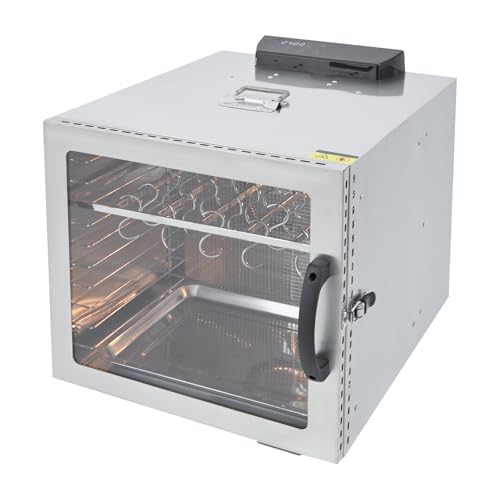
The JDINAAS model offers a substantial 11.23-gallon capacity with 20 hooks and an oil drip tray, making it suitable for larger batches in home or small restaurant settings. It uses 1000W power and a horizontal airflow design to achieve efficient drying with relatively low noise (around 55dB). An LED control panel lets you set temperature (86–194°F) and time (0–24 hours), with a convenient Celsius/Fahrenheit toggle. This is best for users who want large-volume curing with programmable timers. A caveat is that temperatures near the upper end of the range can affect delicate proteins; monitor closely during initial runs.
- Best for: High-capacity home curing or small-scale commercial use.
- Why selected: Large capacity, adjustable settings, and clear digital control.
- Limitation: Higher temperatures may not suit all meats; requires careful setting.
Commercial Dry Curing Chamber Cabinet (15KG)
The 15 kg version mirrors the professional-grade construction of the 7.5kg/15kg model with enhanced capacity for larger batches of cured meats. It features the same precise temperature control range (30–90°C) suitable for jerky, bacon, sausages, and dry-aged meats across beef, pork, chicken, fish, and duck. The 360° rotation, 14 stainless hooks, and side ventilation deliver even drying and block flavor cross-contamination. Best for operators needing more room while maintaining reliability. Limitation: greater space requirements and higher energy use than smaller units.
- Best for: Medium-scale curing and drying operations.
- Why selected: Same precise control with expanded capacity.
- Limitation: Requires more space and power provisioning.
16.4ft Meat Netting Roll

Meat netting is a practical accessory for curing and aging, helping to shape and secure roasts, primes, and hams during smoke, cure, or roast processes. This roll provides a stretchable, versatile solution with an elastic circumference around 6.3 inches and compatibility with weights around 2.6–3.8 pounds. It is made from food-grade polyester and natural rubber. Best for: home cooks who want consistent shaping and protection during curing. Limitation: Not a curing cabinet by itself; must be used with a separate chamber or oven.
- Best for: Securing meats during drying or smoking.
- Why selected: Flexible, food-safe, and long roll for multiple uses.
- Limitation: Not a standalone aging unit.
12 Hook Upgraded Commercial Dehydrator
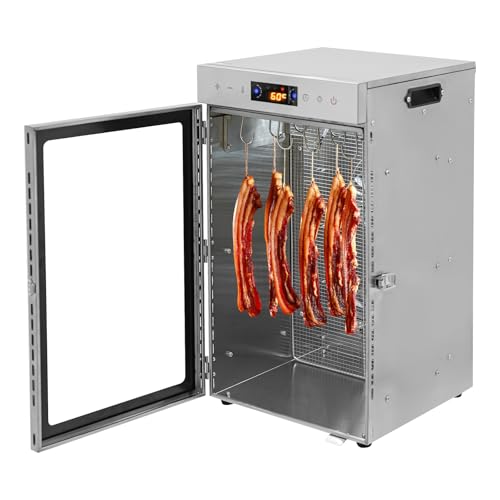
This dehydrator box is built with high-grade stainless steel and offers 800W of power with an 86–176 °F temperature range and timer up to 24 hours. Real-time LED displays show temperature and status, and a clear cabinet door with illumination makes monitoring straightforward. Best for: users needing a robust, mid-size dehydration solution with easy cleaning. Limitation: The data indicates a housing and controls orientation that may require careful placement in kitchens with limited space.
- Best for: Reliable dehydration with clear control displays.
- Why selected: Strong build and adjustable control accommodate various foods.
- Limitation: Larger units may require dedicated placement.
Buying Guide: Key Considerations for Choosing a Meat Curing Chamber
What size of unit do you need? Consider batch size, the number of racks, and whether you plan to cure bulk cuts or small portions. If you cure large roasts, a higher-capacity model with 14 or more hooks and robust airflow is advantageous.
How important is precise climate control? Look for units with adjustable temperature and humidity, plus a reliable air-circulation system. Consistency in airflow helps produce uniform results across all pieces.
Which features matter most? Features to consider include 360° rotation for even drying, activated carbon filtration for air quality, removable trays for easy cleanup, and a clear display panel for monitoring settings. Some models offer automatic timers and Celsius/Fahrenheit conversion for ease of use.
What are practical setup considerations? Check footprint, power requirements, and whether the unit ships with shelves or hooks. Ensure you have adequate space in the kitchen or basement, plus ventilation if needed.
What about accessories? Accessories like meat netting, oil drip trays, and extra hooks extend the usefulness of curing chambers and help you manage multiple types of meat and cured products simultaneously.
FAQ
- What is a curing chamber used for? It is used to dry age beef and other meats, or to cure and dry various cuts, by controlling temperature, humidity, and airflow for consistent results.
- Is dry aging safe at home? Yes, when you maintain proper temperature, humidity, and airflow, and clean the unit regularly to minimize pathogen growth.
- Do I need a commercial-grade unit for home use? Not necessarily; smaller, well-controlled home units can deliver excellent results for home cooks, while commercial models suit larger batches.
- What is the best setup for jerky or biltong? A dehydrator or curing cabinet with stable low-to-mid temperatures and adequate airflow is ideal, along with a timing protocol to avoid over-drying.
- Can I age different meats in the same unit? Yes, provided you manage humidity and airflow to avoid cross-contamination and flavor transfer between different pieces.
- How do I know which product to pick? Consider capacity, control range, and whether you need rotating racks, filtration, or a digital control panel for precise sessions.