Best 29 Bottle Wine Refrigerators for Home Bars and Kitchens
Find the right 29-bottle wine refrigerator for your space and collection. This guide compares five top models to help you choose the best fit for wine connoisseurs, casual collectors, or those who want a dual-zone setup for wine and beverages. Each option is evaluated for capacity, temperature control, noise, and practical use cases. Below, you’ll see a quick summary table and detailed product sections to match different buyer needs.
| Product | Best For | Key Strength |
|---|---|---|
| Tylza 30 Inch Dual Zone (TYBC200) | Wine lovers who want separate zones for wine and beverages | Dual-zone with 35-50°F for wine and 41-64°F for beverages |
| Upstreman 24 Bottle | Compact spaces needing flexible layout | Adjustable shelves and 41-68°F control |
| EUHOMY 25 Bottle | Budget-friendly compact display | Double-layer glass door with UV protection |
| EUHOMY 45 Bottle | Mid-sized collection with broader capacity | Wide temperature range 32-61°F |
| Koolatron 29 Bottle | Freestanding option with dual zones | Two-zone cooling with 46-64°F range |
| Whynter 29 Bottle | Under-counter or freestanding versatility | Front-venting, dual-zone, 40-65°F |
Buyer note: If you need a built-in or freestanding unit, consider dimensions and venting needs. For households with children, models with dual safety locks and secure doors offer added peace of mind. For collectors who store a mix of wine styles, dual-zone units prevent temperature cross-talk between wine and other beverages.
Tylza 30 Inch Dual Zone Wine And Beverage Fridge

Best for: Users who want a true 2-in-1 solution with separate wine and beverage zones. This unit handles up to 29 bottles and 110 cans, making it versatile for wine collectors who also entertain with beverages. The left zone cools wine at 35-50°F, the right zone 41-64°F, enabling precise temperature pairing by beverage type.
Why selected: The dual-zone design with a French-door aesthetic provides a premium look while delivering independent temperature control. The tempered glass doors with magnetic seals help maintain consistent temperatures and protect contents. A bottom door lock adds security in households with children or frequent guests.
Caution: Auto-defrost occurs every 6 hours, which helps maintenance but may briefly affect interior lighting during cycles.
Upstreman 24 Bottle Wine Cooler Refrigerator

Best for: Small spaces where a compact footprint still yields substantial bottle storage and flexible shelf configuration. Ideal for kitchens, living rooms, or home offices that require a freestanding unit with adjustable shelves.
Why selected: It stores up to 24 bottles with five wooden shelves and adjustable interior layout. The double-layer glass door helps reduce cold loss and UV exposure, while the digital touch control shows real-time readings for precise temperature settings from 41°F to 68°F.
Caution: Limited to 24 bottles, so expanding collections beyond that will require a larger model or a separate storage solution.
EUHOMY 25 Bottle Wine Cooler Refrigerator
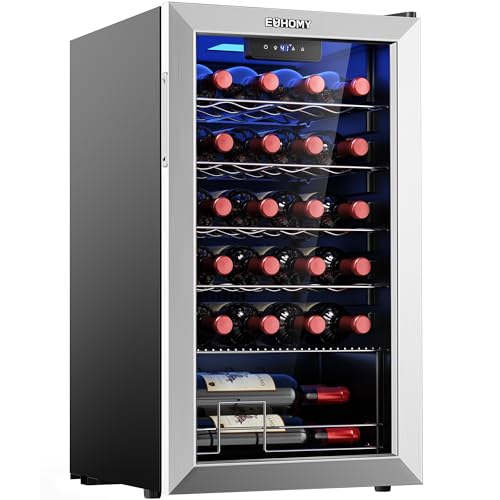
Best for: Small bars or desks in offices that want a stylish 25-bottle display with clear visibility. It suits users who value UV-protected display and a compact footprint.
Why selected: A compact 18.7″ D x 17.5″ W footprint with a double-layer glass door and internal LED lighting makes it a stylish, space-efficient option for showcasing wine while protecting it from temperature fluctuations. Temperature range 41-64°F supports both reds and whites.
Caution: With 25 bottles, the interior shelves may require careful arrangement to maximize capacity and access for larger bottles.
EUHOMY 45 Bottle Wine Cooler Refrigerator

Best for: Medium-size collections requiring greater capacity and flexible shelving, suitable for kitchens, basements, or home bars.
Why selected: The unit supports up to 45 bottles with a wide temperature range from 32°F to 61°F and UV-protected glass. The double-pane display helps maintain stable internal conditions while presenting the collection elegantly. Six removable shelves offer adaptable storage for bottle shapes.
Caution: Larger capacity may require more floor space and consider airflow around the unit when installed under counters or in tight niches.
Koolatron 29 Bottle Wine Fridge

Best for: Freestanding option with dual-zone cooling, especially for kitchens or dining spaces that need a flexible, stylish wine storage solution.
Why selected: This model uses freestanding compressor cooling with dual zones and a 46-64°F range, making it versatile for different wine types. It is proudly built in North America and combines design with dependable cooling performance at an accessible price point.
Caution: Capacity is listed as 29 bottles, but the upper zone only holds up to 10 bottles, which may limit larger collections needing uniform capacity across zones.
Whynter 29 Bottle Wine Fridge

Best for: Built-in or freestanding installation with seamless front-venting and dual-zone control for versatile placement in kitchens or bars.
Why selected: The 3.0 cu.ft interior accommodates up to 29 standard bottles. Temperature range 40-65°F with internal fan-forced distribution provides even cooling and a temperature-memory function to recover settings after power loss. The front-vent design supports built-in installations or freestanding use.
Caution: As a built-in friendly unit, ensure adequate clearance for airflow if you plan to install under counters or enclosures that restrict venting.
Buying Guide: How To Choose The Right 29-Bottle Wine Refrigerator
What size and capacity should I choose?
Most 29-bottle fridges are designed for standard 750 ml bottles. If you have a variety of bottle shapes or larger magnums, check interior shelving and bottle clearance. Consider whether you want a single-zone or dual-zone model based on your collection and entertaining habits.
Why is dual-zone important for wine storage?
Dual-zone units keep different drinks at different temperatures, which is ideal when you store both wine and beverages or different wine styles (reds and whites) that require distinct temperatures. This helps preserve flavor profiles and extends shelf life.
What design features matter most?
Important features include glass door quality (tempered and UV-protected), interior lighting (LED), ease of use (digital touch controls), noise level, and security locks. If children are present, magnetic seals and lockable doors can be beneficial.
Should I prioritize built-in or freestanding installation?
Built-in units require proper venting and space under counters. Freestanding models offer flexible placement and can be moved. If you have a dedicated wine cabinet niche, a front-venting design like Whynter helps with seamless built-in installation.
What maintenance or reliability considerations exist?
Look for auto-defrost features to minimize manual maintenance and ensure consistent humidity control to protect corks and labels. Consider the availability of replacement parts and warranty coverage when evaluating long-term reliability.
FAQ
- Can I use a 29-bottle fridge for larger bottles? Some models accommodate larger shapes with adjustable shelves, but most are designed for standard 750 ml bottles. Check interior dimensions before buying.
- Is dual-zone cooling worth it for a home bar? Yes, if you keep different wine types or beverages at separate temperatures. It prevents cross-temperature contamination and preserves taste.
- Do these units require professional installation? Freestanding units usually do not, while built-in models need proper venting clearance and sometimes professional installation.
- Will these fridges stay quiet in a living area? Most models aim for low noise (often under 40 dB). Verify the product’s noise specification if a quiet environment is important.
- How do I prevent UV damage to bottles? Look for double-layer or UV-protected glass doors to minimize light exposure that can affect wine over time.
- What maintenance tasks are essential? Regularly clean shelves, monitor seals, and ensure door locks function correctly. Some models offer auto-defrost to reduce manual maintenance.