Best Hanging Thermometer for Fridge: Top Picks for Food Safety and Easy Reading
If you’re seeking a reliable way to monitor fridge and freezer temps, these hanging or stand-alone thermometers deliver clear readings and simple installation. They’re ideal for apartment kitchens, small offices, and households that want precise temperature control for perishable foods. Below are five top picks that balance readability, range, and design. The table summarizes core details to compare at a glance.
| Product | Temperature Range | Best For |
|---|---|---|
| PECULA 2 Pack Refrigerator Thermometer | -30°C to 30°C / -20°F to 80°F | Simple fridge and freezer monitoring; no batteries |
| LinkDm 4 Pack Refrigerator Freezer Thermometer | -20°F to 80°F | Multi-zone storage checks in larger fridges |
| Taylor 5924 Large Dial Kitchen Refrigerator and Freezer Thermometer | -20°F to 80°F | Durable, high-visibility dial for easy reading |
| Relaxweex 30 Pack Refrigerator Freezer Thermometer | -40°F to 122°F | Bulk monitoring across multiple compartments |
| GERUSEA 12 Pack Fridge Refrigerator Freezer Thermometer | -40°F to 80°F | Value-packed set for households with many storage areas |
PECULA 2 Pack Refrigerator Thermometer

Best for small spaces and quick checks. This thermometer features a large dial with distinct blue and red zones, making it easy to read at a glance. It measures -30°C to 30°C (-20°F to 80°F) and supports both fridge and freezer readings. It uses a hook-style panel that can hang or sit on a shelf, so you don’t need batteries for operation. Choose this if you want a low-maintenance option with a clear display for home use.
Best for: apartment kitchens, dorm rooms, and households that prefer a battery-free thermometer. Limitation: large dial may take more space on crowded shelves.
LinkDm 4 Pack Refrigerator Freezer Thermometer

Best for larger refrigerators and multiple zones. This set covers four thermometers with a wide base and integrated hook, allowing placement throughout the fridge. The range -20°F to 80°F provides coverage for both fresh storage and freezer compartments. The stainless-steel construction offers durability for daily use. Choose this if you need a straightforward, multi-point monitoring solution in a single purchase.
Best for: larger families or kitchens with several storage zones. Limitation: some users may prefer digital readings for quick automation integration.
Taylor 5924 Large Dial Refrigerator And Freezer Thermometer

Best for durability and easy readability. The Taylor thermometer features an extra-large 3-inch dial with bright indicators for quick checks, housed in a stainless-steel casing for corrosion resistance. It supports hanging or standing placement in a fridge or freezer. This is a reliable choice for frequent temperature checks in busy kitchens or commercial-inspired home setups.
Best for: users who want a robust, readable option with long-term durability. Limitation: bulkier design may not fit tight shelves.
Relaxweex 30 Pack Refrigerator Freezer Thermometer

Best for bulk monitoring and cost efficiency. This set includes 30 long-strip thermometers with Fahrenheit and Celsius scales, spanning -40°F to 122°F (-40°C to 50°C). They’re ideal for tracking temperatures in multiple compartments or storage boxes. Made from plastic with non-toxic fluid, they meet common safety standards. Choose these for comprehensive temperature oversight across a kitchen or small business.
Best for: multi-zone monitoring and replacement coverage. Limitation: bulk strips may be less convenient for occasional use in small spaces.
GERUSEA 12 Pack Fridge Refrigerator Freezer Thermometer

Best for value-focused buyers who want a broad range coverage. The GERUSEA set measures -40°F to 80°F (-40°C to 27°C) with a combination of plastics and stainless steel construction. It emphasizes affordable, good-quality readings for refrigerators and freezers. This set is suitable for households that want several units without paying a premium per thermometer.
Best for: budget-conscious households with many storage zones. Limitation: basic design may lack some durability features of premium models.
LinkDm Fridge Refrigerator Freezer Thermometer (3pack)
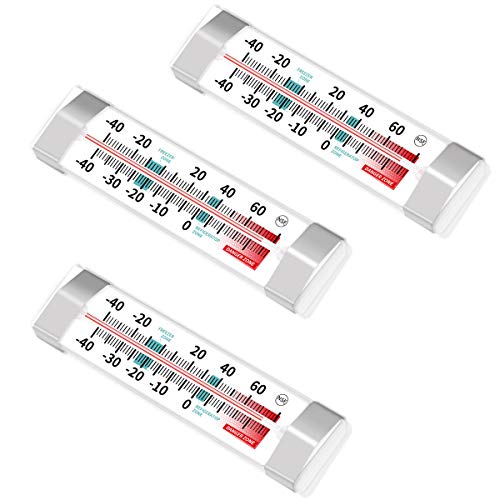
Best for small kitchens needing a three-unit set. This trio covers both fridge and freezer readings with a range of -40°F to 80°F (-40°C to 27°C). Constructed from plastics and stainless steel, the thermometers provide sturdy performance in everyday use. Choose this if you don’t need a large bundle but want dependable monitoring across a few zones.
Best for: compact kitchens or shared living spaces. Limitation: fewer units than bulk packs, which may require rotation or repositioning across zones.
LinkDm 2 Pack Refrigerator Freezer Thermometer
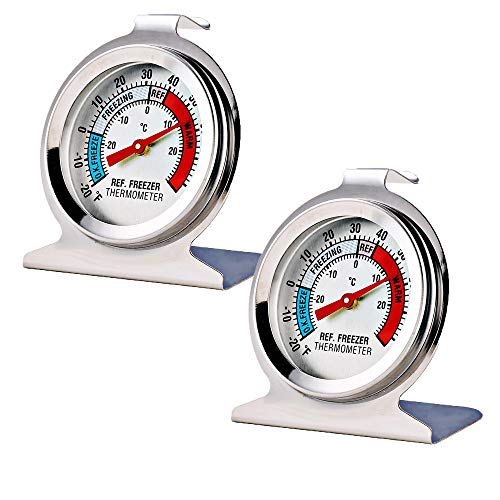
Best for compact spaces needing a backup or extra unit. This two-pack has a similar range (-20°F to 80°F) and stainless-steel construction with a wide base and integrated hook for flexible placement. It’s handy for apartments with limited shelf space or for households that want a backup thermometer for seasonal use.
Best for: small apartments or as an auxiliary set. Limitation: fewer units than larger packs; consider scheduling rotation if you monitor many compartments.
Buying Guide: Key Considerations For Selecting A Fridge Thermometer
What is your monitoring goal? If you want a simple readout for a single fridge, a large-dial unit with easy-to-read color zones may suffice. For busy households or multi-zone storage, a bulk pack or multi-unit set helps maintain temperature oversight across compartments.
What temperature range do you need? Refrigerators typically run near 35–40°F (2–4°C). Freezers are often 0°F (-18°C) or lower. Look for devices that cover at least -40°F to 80°F (-40°C to 27°C) to accommodate all sections and seasonal changes.
How will you place them? Hanging hooks, stand options, and base stability affect readability and placement. Battery-free designs reduce upkeep, but some users prefer quick digital or bimetallic readings for frequent adjustments.
Material and durability matter for longevity. Stainless steel casings resist corrosion in stainless interiors. Plastic-bodied units can be lighter and cheaper but may wear faster with daily use.
Safety and materials: ensure non-toxic fluids and safe plastics, especially in households with children or pets. Check for damaged units and replace promptly to maintain accurate readings.
FAQ
- What is the typical temperature range I should monitor in a home fridge?
Most home refrigerators aim for about 35–40°F (2–4°C). In freezers, 0°F (-18°C) or below is common.
- Do I need a thermometer with batteries?
Battery-free designs exist and require no power source, while some models use batteries for digital readouts.
- Can I use these thermometers in both fridge and freezer compartments?
Yes, most models are designed for both fridge and freezer use, with ranges suitable for each.
- Is a bulk pack better than a few individual thermometers?
Bulk packs are cost-efficient for monitoring multiple zones, while individual units save space in small kitchens.
- How should I place a thermometer for accurate readings?
Place in the middle of the air flow, away from door seals and heat sources to avoid false readings.