Best Digital Meat Thermometers for Smokers: Accurate, Wireless, and Easy to Use
If you’re smoking meat, you need precise, reliable temperature monitoring. This guide highlights five top digital meat thermometers tailored for smokers, grills, ovens, and kitchens. Each option is suited for different cooking styles—from hands-off wireless monitors for backyard barbecues to fast, dual-probe models for multi-meat cooks. Below, you’ll find quick summaries, clear pros and notable cautions, plus a practical buying guide and FAQs to help you choose confidently.
| Product | Best For | Key Benefit |
|---|---|---|
| TempPro TP16 Large LCD Digital Meat Thermometer | Smoker beginners | Preset USDA settings with a clear display |
| TempPro TP829 1000ft Wireless Meat Thermometer | Large outdoor grills | Long-range wireless monitoring |
| Govee Bluetooth Meat Thermometer | Smartphone-controlled grilling | App-based monitoring with alerts |
| ThermoMaven Smart Bluetooth G1 | High-precision cooks | Sub-1G stability with six sensors |
| TempPro Wireless Dual-Probe Thermometer | Multi-meat cooks | Two probes for simultaneous temps |
Note: The following five products are presented with neutral, factual descriptions to help you compare features, limits, and intended users. The selections emphasize reliability, ease of use, and coverage for smoking and outdoor grilling scenarios.
TempPro TP16 Large LCD Digital Meat Thermometer
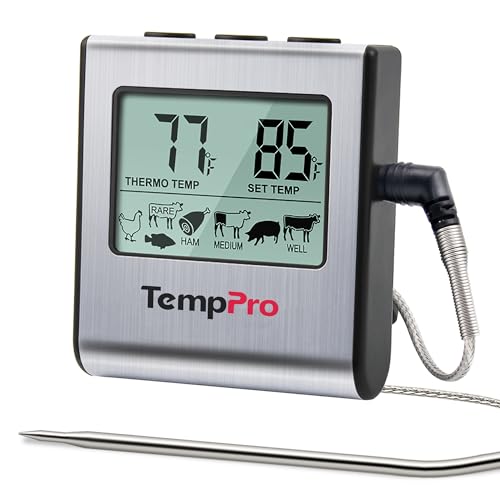
This thermometer is best for cooks who want USDA preset temperatures and a straightforward timer. It includes a programmable alert and a temperature probe that withstands up to 716°F. The temperature range spans 32°F to 572°F with 1° resolution, enabling precise monitoring for smoking meats as well as oven or stove-top use. It’s ideal for beginners who prefer a single-probe setup and simple, audible reminders when targets are reached. A potential limitation is the lack of multiple probes for complex multi-meat sessions.
TempPro TP829 1000ft Wireless Meat Thermometer

This model is best for outdoor grilling and smokers where range matters. It offers a wireless connection up to 1,000 feet and does not rely on apps for basic operation, appealing to users who want a simple, reliable setup. It provides four color-coded probes for tracking multiple meats, which helps reduce cross-contamination and confusion during busy cooks. A caution is that some users may prefer more advanced app features or voice notifications, which this unit minimizes in favor of straightforward operation.
Govee Bluetooth Meat Thermometer

The Govee option is best for cooks who want mobile monitoring and real-time alerts. It pairs with a mobile app that displays USDA-recommended temperatures for various proteins and provides notifications when temperatures drift outside presets. This is a strong choice for multitasking, as you can monitor doneness remotely. A potential limitation is reliance on Bluetooth, which may reduce range in larger outdoor spaces compared to dedicated wireless systems.
ThermoMaven Smart Bluetooth G1

This thermometer is best for cooks seeking high precision and long-range monitoring without heavy app dependence. It uses Sub-1G connectivity to extend range up to 3,000 feet in open spaces and 700 feet in obstructed areas. It features a six-sensor system with a stated accuracy of ±0.5°F, which supports precise doneness control for multiple proteins. The device includes a standalone display base, enabling direct temperature reads without a connected app in some scenarios. A caution is that setup may involve more steps than basic Bluetooth models.
TempPro Wireless Dual-Probe Thermometer

This two-probe model is best for multi-meat cooks who want simultaneous temperatures for two different proteins or zones. It supports easy app setup, custom target temps, and pre-alarms to keep meals on track without constant monitoring. Real-time dual readings help prevent overcooking while allowing flexible timing. A limitation includes reliance on a mobile app for full features, which may not suit users who prefer standalone operation at the grill.
TempPro TP17 Dual Probe Digital Cooking Thermometer

This model emphasizes dual-probe monitoring with USDA presets and a large, backlit display for easy reading in any light. It’s suitable for smokers and grills where two meat pieces or two zones require concurrent temperature checks. The backlight aids visibility in dim environments, and the dual probes help streamline workflow during long cooks. A caution is that the extended feature set may come with a steeper learning curve for first-time users.
Buying Guide: Key Purchase Considerations
What matters most when buying a digital meat thermometer for smoking and grilling?
- Number of probes: Choose 1- or 2-probe units for single or dual-zone monitoring; multi-probe models are helpful for variety meats.
- Connectivity: Bluetooth offers convenient phone alerts, while RF/wireless systems provide longer range without relying on apps.
- Temperature range and accuracy: Look for models that cover typical smoking temps (roughly 225–275°F) and offer ±0.5–1.8°F precision for consistent results.
- Probes and durability: Stainless steel probes, heat resistance, and wire durability matter for long smoking sessions.
- Alerts and display: Audible alarms, visual backlit displays, and easy-read interfaces help you respond quickly.
- Ease of use: Standalone displays or one-click setup reduce friction, especially for weekend cooks or gifts.
- App features vs. standalone: Apps offer guided cooking and preset temps, but some cooks prefer no-app setups for simplicity.
Frequently Asked Questions
- What is the best thermometer for long-range grilling?
Wireless RF models typically offer the longest range, up to 1,000 feet or more, without relying on a phone. - Do I need multiple probes for smoking?
Not always, but two probes help monitor different meats or zones simultaneously, improving timing accuracy. - Is app control necessary for good results?
No; many cooks rely on built-in alarms and display data. Apps add convenience but are optional. - How accurate should a meat thermometer be?
Accuracy within ±0.5°F to ±1.8°F is common; higher accuracy is beneficial for precise doneness. - Can I calibrate these thermometers?
Some models offer calibration with ice-water tests; others rely on factory calibration with user-visible calibration options.