Best Dry Aging Fridge for Beef: Top Home and Restaurant Options for Perfectly Aged Steaks
Answering the question “which refrigerator is best for dry aging beef?” this guide highlights five durable dry aging fridges designed for consistent, shop-quality aging. These models are suited for home cooks, small restaurants, or culinary hobbyists who want controlled temperature and humidity. The top picks vary by capacity, features, and price, so you can choose based on your aging goals, space, and workflow. The table below compares each model at a glance to help you decide quickly.
| Product | Capacity | Best For | Key Feature |
|---|---|---|---|
| VEVOR 232 LBS Dry Aging Fridge | 232 lbs | Commercial-style aging at home or small business | Wide temp range and humidity control |
| Jocisland Dry Age Fridge 110L | ~100 lbs | Built-in or freestanding with precise control | Advanced air circulation and UV light |
| VEVOR 99 LBS Dry Aging Fridge | 99 lbs | Compact, under-counter or freestanding setups | Lockable door for security |
| VEVOR 298 LBS Dry Aging Fridge | 298 lbs | Large-scale aging or menu-ready steaks | High capacity with solid aging environment |
| Ca’Lefort Dry Age Fridge | 209 lbs | Professional kitchen or bar/restaurant | 360° air circulation and UV glass for monitoring |
VEVOR 232 LBS Dry Aging Fridge
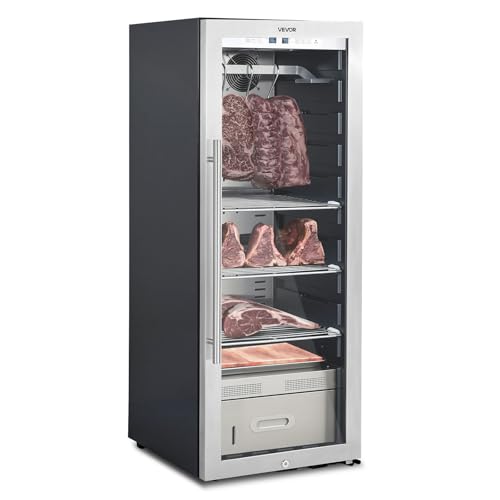
Best for enthusiasts who anticipate larger aging projects or small-cafeteria-style menus. This model offers a substantial capacity with removable hooks, shelves, and trays for organized aging. The digital control panel supports a broad range of temperatures from 34°F to 77°F and humidity from 60% to 85%, enabling aging of beef, pork, lamb, and even cheese. Best suited for those who want scalable aging with precise environmental control.
- Pros: High capacity, flexible loading, precise environmental control.
- Cons: Large footprint; requires ample space and ventilation.
Best for: Professionals or serious home crafters who age large batches of steak or multiple protein types at once. Choose this if you plan frequent, higher-volume aging and need robust organization.
Jocisland Dry Age Fridge 110L
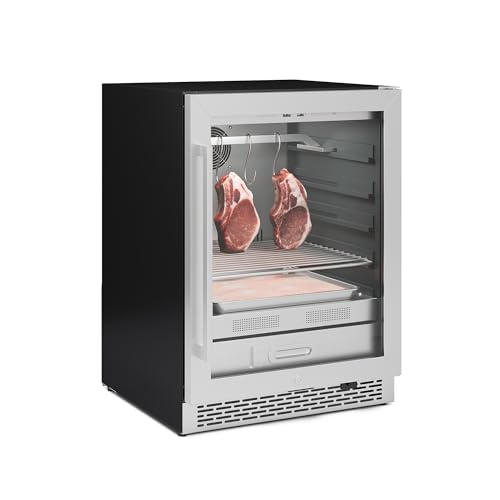
This unit is ideal for built-in or freestanding use in kitchens and dining areas that require precise aging with a compact footprint. It supports 34°F–77°F and 60%–85% humidity with an absorbent pad and water tank for steady conditions. An advanced air circulation system supports even aging, while the built-in UV light helps maintain a controlled chamber environment during aging.
- Best for: Small restaurants or serious home kitchens that want a dedicated aging chamber with monitoring features.
- Limitation: The compact size means slightly smaller batch capacity than larger models.
VEVOR 99 LBS Dry Aging Fridge

Best for compact spaces or under-counter setups where aging is desired without a large footprint. It provides a professional-grade aging environment with a reliable air system and a security lock. Note that Himalayan salt for aging needs to be purchased separately, which can influence setup considerations for first-time buyers.
- Pros: Compact, secure, suitable for tight spaces.
- Cons: Not as high capacity as larger models; requires separate salt purchase for aging process.
Best for: Small venues or households starting with dry aging who want a securable unit without sacrificing aging quality.
VEVOR 298 LBS Dry Aging Fridge
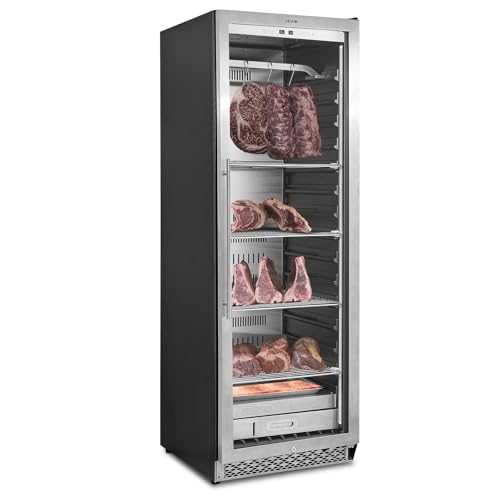
Best for high-volume aging needs, this large-capacity unit supports nearly 300 pounds of aging product. It uses a robust air circulation system to deliver uniform aging, with a 34°F–77°F range and 60%–85% humidity. Note the need for Himalayan salt; it is not included but required for the intended aging process. A lock provides security for commercial settings.
- Best for: Established kitchens or small food businesses planning frequent, large-scale aging.
- Limitation: Higher upfront cost and space requirements compared to smaller models.
UMAi Dry Aging Bag For Steaks (3 Pack)

Best for those who want to pursue dry aging without purchasing a full aging fridge. UMAi Dry bags enable aging in standard refrigerators or other controlled environments. They’re designed for ribeye and striploin cuts up to 18 pounds per bag, and the process typically yields tender, aged beef in 28–45 days. The bags are a practical option for home cooks starting to experiment with aging.
- Pros: Flexible aging without a dedicated aging chamber.
- Cons: Requires careful handling and longer aging times to reach optimal flavor.
Ca’Lefort Dry Age Fridge For Steaks

Best for professional environments or serious enthusiasts who want strong control and monitoring capabilities. This unit features a precise temperature control range (34°F–77°F), 60%–85% humidity, and a digital LED panel. It offers 360° air circulation, a triple protection system, a 304 stainless steel interior, and UV-blocking glass to monitor progress without opening the door. The secure lock adds peace of mind in busy spaces.
- Best for: Professionals seeking even aging, high build quality, and monitoring ease.
- Limitation: Higher complexity may require more setup time for new users.
Cobalance Dry Aging Fridge For Steaks

Best for compact, home kitchens that still want a dedicated aging chamber. It holds up to 33 pounds and offers adjustable temperature (34°F to 72°F) and humidity controls (50% to 85%). A high-performance air circulation system and an activated carbon filter contribute to a clean aging environment. The single-door, compact design makes it a practical choice for smaller spaces.
- Pros: Compact, adjustable, good airflow and air purification.
- Cons: Lower capacity than larger models; best suited for smaller crews or households.
SteakAger PRO 40 Ultimate Bundle

Best for serious hobbyists who want a dedicated solution with a defined capacity. The PRO 40 bundle includes a dry aging refrigerator capable of aging up to 40 pounds, with a stainless steel exterior and compact dimensions of 18.875″ x 18.25″ x 33.125″ (WxDxH). It emphasizes reliable dry aging performance and consistent flavor development for home kitchens or garages.
- Best for: Home chefs seeking a proven, compact aging unit with a 40-pound capacity.
- Limitation: Limited to 40 pounds, may not meet larger batch needs.
Buying Guide: Key Considerations For Choosing A Dry Aging Fridge
What capacity do you actually need? If you plan to age large quantities or run a small operation, prioritize higher capacity (200+ pounds) with robust air circulation. For beginners or limited space, a compact unit with reliable temperature and humidity control is better.
How important is uniform aging? Look for models with a 360° air circulation system and a clean, odor-free interior. An activated carbon filter can help maintain air quality in smaller cabinets.
What about monitoring and security? Digital controls, UV monitoring features, and a locking door add peace of mind in busy kitchens or commercial settings.
Do you need built-in versus freestanding? Built-in models save space and can be integrated into cabinetry, while freestanding units offer flexible placement and easier relocation.
What accessories matter? Removable hooks, shelves, and salt availability can influence use. Some models require Himalayan salt separately; confirm what’s included and what you’ll need to buy.
Practical Buying Tips
- Choose a unit with a temperature range that covers 34°F to 77°F for versatility across meats and cheeses.
- Humidity control within 60% to 85% helps prevent surface drying while promoting even aging.
- Confirm the interior is easy to sanitize and wipe down to maintain food safety standards.
Frequently Asked Questions
- What is the typical aging time for beef in a dry aging fridge?
Common ranges are 21–45 days, depending on cut, environment, and desired flavor intensity. - Do I need to use Himalayan salt with every unit?
Some models rely on Himalayan salt as part of the aging process; check product notes and compatibility for your chosen unit. - Can I age pork or lamb in these fridges?
Yes, these environments can be adjusted to age various meats, though aging times and humidity may differ by protein. - Is UV light necessary for aging?
UV helps control the environment in some models but is not always required; it’s a design feature to support stable conditions. - Do these fridges require professional installation?
Most are designed for home or small commercial use with straightforward setup; built-in models may need cabinet integration.