Best Electric Pizza Dough Roller Machines for Quick, Consistent Crusts
This guide helps buyers choose the right electric pizza dough roller for commercial, bakery, or home use. If you need fast, uniform dough sheets, these units are designed to press and shape dough with minimal effort. Best for small bakeries, pizzerias, or busy kitchens, they balance throughput, thickness control, and durability. Below are five top options, selected for practicality, build quality, and adjustable thickness ranges. A quick comparison table follows to help you decide at a glance.
| Product | Thickness Range | Throughput (pieces/hour) | Best For |
|---|---|---|---|
| Commercial Dough Roller (LXYIUTRW) | 1–5.5 mm | 240–260 | High-volume pizzerias seeking durable stainless steel |
| VEVOR 3–16 Inch Sheeter | 3–16 inches, 1–5.5 mm | 240–260 | Medium to large cafes needing variable dough sizes |
| VEVOR 3–14 Inch Automatic | 3–14 inches, 1–5.5 mm | 240–260 | Fully automatic operation with consistent results |
| HASANEN 4–16 Inch | 0.7–5.4 mm | Up to 260 | Versatile size range with sturdy stainless build |
| NKLOKSD 4–16 Inch | 0.7–5.4 mm | Up to 260 | Fast, efficient single-pass dough shaping |
Commercial Dough Roller Machine With Adjustable Thickness

The LXYIUTRW unit is built from 201 stainless steel with a food-grade resin roller and a polished finish for easy cleaning. It features a 450W copper motor that can produce approximately 240–260 dough portions per hour, supporting high-volume operations. Heat-dissipation holes help extend the machine’s life by reducing heat buildup during long shifts.
Best for: busy pizzerias and bakeries that need robust, durable construction and efficient throughput. The adjustable thickness (1–5.5 mm) allows thin crusts for classic Naples-style pies or thicker bases for hearty American-style crusts.
Limitation: The product data notes reference values (e.g., portions per hour) and heat dissipation features, but actual throughput depends on dough type and handling. Consider a test run with your dough recipe to gauge exact productivity.
VEVOR Pizza Dough Roller Sheeter, 3–16 Inch

This VEVOR model supports 3–16 inch dough pressing with thickness adjustable from 1–5.5 mm. It delivers up to 240–260 pieces per hour in semi-automatic operation, making it well suited for cafes, bakeries, and pizzerias that value quick turnaround. The design emphasizes even pressing and consistent dough shape through its dual-roller setup.
Best for: establishments needing versatile dough sizes and reliable semi-automatic shaping. The longer upper and lower rollers help produce uniform rounds with less manual flipping.
Caution: Semi-automatic operation requires proper dough handling to achieve the best uniformity; misalignment can affect roundness. Regular maintenance of rollers ensures ongoing even pressing.
VEVOR 3–14 Inch Automatic Pizza Roller

This fully automatic VEVOR model streamlines dough pressing with automatic feeding and a double-roller design. It handles 3–14 inch dough sheets and thickness from 1–5.5 mm. The unit is designed for high-output kitchens that want consistent rounds with minimal manual intervention.
Best for: restaurants seeking hands-off operation for repetitive dough shaping while maintaining consistent thickness. The automatic feed reduces labor and speeds up line production.
Limitation: Automation can introduce higher upfront costs and may require more routine maintenance to prevent downtime in busy periods.
HASANEN 4–16 Inch Dough Roller Sheeter

The HASANEN unit uses a dual-roller design with an 11.81-inch upper roller and a 16.53-inch lower roller. It supports 0.7–5.4 mm thickness and a wide 4–16 inch dough width. A 370W copper motor provides solid power for faster production. Rubber anti-slip feet improve stability on countertops.
Best for: operations needing a broad size range and robust construction for frequent dough rolling. The longer lower roller helps achieve uniform rounds with larger pizzas or flatbreads.
Caution: The wide roller system may require more space on the counter and careful setup to ensure level placement for even pressure across the dough.
NKLOKSD 4–16 Inch Electric Dough Roller

NKLOKSD offers a dual-roller design with a 11.81-inch upper and 16.53-inch lower roller. It uses a 370W copper-core motor and supports thickness control from 0.7 to 5.4 mm. The unit is designed for bakeries and pizza shops that require rapid dough shaping and durability in a stainless steel frame.
Best for: businesses needing efficient, one-pass shaping for a range of dough sizes. The dual-roller approach helps maintain even thickness across the sheet.
Limitation: Like other similar models, long-term performance relies on regular cleaning and timely maintenance of the rollers and motors to avoid jams or misalignment.
LTIGOAW 4–12 Inch Commercial Dough Roller
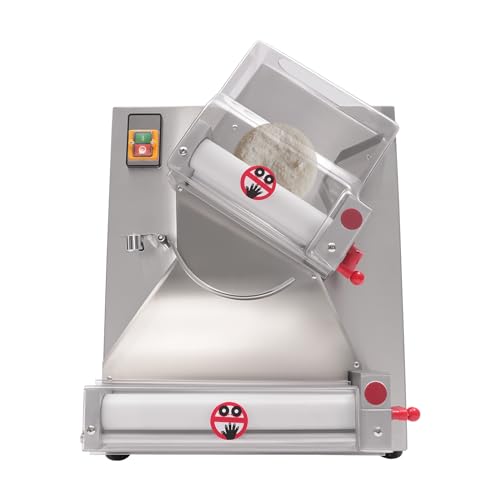
LTIGOAW provides a durable, home-and-business-friendly option with a 370W copper motor and 4–12 inch dough width. It adjusts from 0.7 to 5.4 mm thickness, suitable for thin crusts or thicker crusts depending on the recipe. The construction uses food-grade stainless steel and a polished finish for hygienic maintenance.
Best for: small to medium kitchens that need a compact but capable dough roller able to handle multiple dough sizes. It’s a good balance of price, size, and output for growing operations.
Limitation: Best used with standard dough formulations; extremely wet or sticky doughs may require pre-dusting or adjustments to thickness settings.
Buying Guide: Key Considerations For Electric Dough Rollers
What size and capacity do you need? Match the maximum dough width (3–16 inches) and the hourly piece rate (around 240–260) to your peak service times.
How important is automatic versus semi-automatic operation? Automatic models reduce labor but may involve higher maintenance and upfront cost; semi-automatic models offer more manual control and potentially lower costs.
What thickness range is essential? Most models cover 0.7–5.4 mm or 1–5.5 mm. Choose based on your crust preferences, from ultra-thin to thick crusts.
Is stainless steel and food-grade components important for you? Durable, easy-to-clean materials resist corrosion and meet food-safety expectations in busy environments.
What space and placement constraints apply? Consider counter depth, roller length, and the need for stability on your prep surface when selecting a model with larger rollers.
Maintenance needs and availability of parts matter. Look for models with straightforward access to rollers and a service-friendly design to minimize downtime.
Frequently Asked Questions
- What thickness should I aim for with a pizza dough roller? Aim for 0.7–5.4 mm for standard pizzas; adjust to 1–5.5 mm for a mix of crust styles.
- Can these machines handle thick-crust dough? Yes, within their adjustable thickness range, but very stiff dough may require additional kneading or a stronger dough consistency.
- Are automatic rollers better than manual ones? Automatic models improve consistency and speed, but manual controls can save cost and offer more tactile control.
- What maintenance is required? Regular cleaning of rollers, lubrication if specified, and periodic inspection of belts or drive components help prevent downtime.
- Which model is best for a high-volume pizzeria? Look for the highest throughput, durable stainless steel build, and reliable heat dissipation features; models with 240–260 pieces per hour are common benchmarks.
- Do these machines require special training? Basic operation is straightforward, but staff should be trained on safety protocols and dough handling to ensure consistent results.