Best Stainless Steel Soap Cutter for Precise Slicing and Clean Edges
Looking for a stainless steel soap cutter that delivers straight, uniform bars with minimal maintenance? This guide compares five top options for hobbyists, small shops, and makers who want durable, easy-to-clean cutters. Each product is evaluated for best use case, reliability, and practical limits. The table below summarizes key points to help you decide quickly.
| Product | ||
|---|---|---|
| KITCHENDAO Replaceable Wire Soap Cutter | KITCHENDAO | Home cooks and small-batch makers needing quick wire replacement and adjustable tension |
| SUZLAZYR Hand-Made Soap Cutter | SUZLAZYR | DIY crafters who want scale indicators and durable metal design |
| YRYUZEM Soap Cutter With Scale | YRYUZEM | Hobbyists and small shops seeking built‑in measurement guides and hygiene |
| ZYAXWN Soap Cutter Kit With Scale | ZYAXWN | Professional DIY makers needing a stable, scalable cutting tool |
| WAWLIVING Soap Cutting Tool Set | WAWLIVING | Beginners who want a straightforward wooden mold plus cutters |
KITCHENDAO Replaceable Wire Soap Cutter

This stainless steel cutter uses a 2nd‑gen wire fixing mechanism with three fixation points for higher wire stability. It offers adjustable tension via screws and quick wire replacement with the included screwdriver. Best for home crafters who value long-term wire durability and fast setup after changing batches.
- Best for users who prioritize quick wire changes and consistent cutting pressure.
- Better for small-batch makers needing reliable wire tension without frequent adjustments.
Limitation: If you rely on very thick or irregular bars, verify that the wire can handle the range without deformation.
SUZLAZYR Hand-Made Soap Cutter
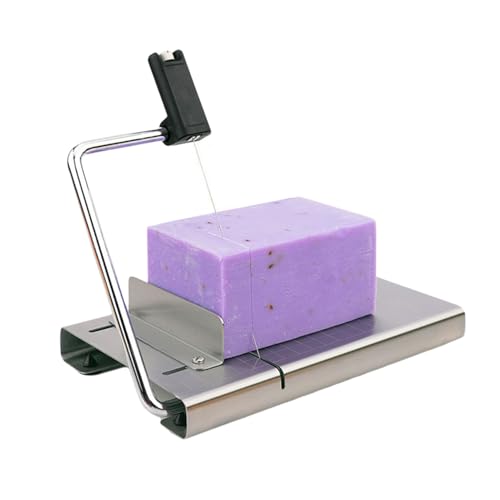
Durable stainless steel construction with scale lines for precise thickness measurement. Designed for soap making loaves, this cutter suits hobbyists who want repeatable cuts and easy measurement for consistent bar sizes. It’s also applicable to DIY craft projects beyond soap, such as candles.
- Best for: Makers who need a visible thickness guide and reliable metal durability.
- Better for: Those who prefer a simple, scale-based approach to portioning bars.
Limitation: The tool focuses on measurement accuracy; users cutting very large loaves may require a larger footprint or alternative setup.
YRYUZEM Soap Cutter With Scale

Includes a built‑in centimeter scale, designed for straight cuts and uniform bars. Constructed from food-grade stainless steel, it emphasizes hygiene and durability, ideal for small soap shops or ambitious hobbyists who require consistent batch quality.
- Best for: Users who want a hygienic, easy‑to‑clean cutter with precise sizing.
- Better for: Those who plan to scale production or avoid wire-related maintenance.
Limitation: The unit relies on precise alignment; ensure stable placement to prevent drift during cutting.
ZYAXWN Soap Cutter Kit With Scale

Sturdy stainless steel construction with a centimeter scale and a fixed blade design that reduces the need for frequent blade changes. Anti‑slip bottom supports stability during cutting. This kit is suited for serious DIY makers who want consistent results and long‑term durability.
- Best for: Professional‑style DIY makers needing stable performance and clear measurements.
- Better for: Projects requiring repeated, uniform cuts without wire maintenance.
Limitation: The fixed blade design may limit adaptability for very thick or irregular bars compared with adjustable wire systems.
WAWLIVING Soap Cutting Tool Set

This wooden loaf cutter set includes two stainless steel cutters, a straight and a wavy blade. It is designed for 1-inch slices and features reinforced board thickness to prevent breakage. Best for beginners seeking a straightforward, all‑in‑one cutting solution with two blade styles.
- Best for: Beginners who want a simple setup with matching cutters for different textures.
- Better for: Those who prefer a wooden frame for ease of use and a familiar feel.
Caution: Wooden frames may require more careful cleaning to prevent moisture damage over time.
Buying Guide: How To Choose The Right Stainless Steel Soap Cutter
- Materials and hygiene: Prioritize food-grade stainless steel for durability and easy cleaning. Look for blades and wires that resist rust and oil absorption.
- Cutting mechanism: Decide between wire cutters with adjustable tension and fixed blades. Wires are good for flexible batches; fixed blades offer stable cuts and less maintenance.
- Scale and measurement: If precise bar sizes matter, choose a model with a built-in scale or measurement guide to minimize manual marking.
- Stability and setup: A non-slip base or anti‑slip design reduces drift. Stable construction improves cut accuracy and safety.
- Maintenance: Consider ease of cleaning, whether parts are removable, and how quickly you can replace worn components like wires or blades.
- Batch size and space: For small spaces or hobby use, compact, lightweight units may be preferable. For small shops, prioritize durability and repeatability.
- Versatility: Some kits include multiple blade styles (straight and wavy) or combination tools that expand how you can shape bars and products.
- Price and longevity: A higher upfront investment can yield long-term savings through reduced maintenance and improved consistency.
Frequently Asked Questions
- What is the advantage of a stainless steel soap cutter?
Stainless steel resists rust and odors, is easy to clean, and provides durable performance for repeated cuts. - Should I choose a wire cutter or a fixed blade cutter?
Wire cutters are flexible for varied batch sizes, while fixed blades offer stable, repeatable cuts with less maintenance. - Do scale indicators help with soap making?
Yes. Scales help ensure consistent bar thickness, which is important for product uniformity and stacking. - Is a non-slip base essential?
For accuracy and safety, a stable base minimizes drift during cutting. - Can these tools be used for other crafts?
Many can cut other soft materials like candles or cheese; check each product’s design and tolerances before repurposing. - What maintenance is required?
Regular cleaning, keeping blades or wires dry, and replacing worn parts as needed will extend tool life.