Best Double Arm Dough Mixer Solutions for Home and Professional Kitchens
If you’re searching for a double arm dough mixer, you want reliable power, consistent kneading, and a bowl large enough to handle substantial batches. This guide highlights five options that best fit demanding bread, pizza, and pastry workflows while staying approachable for home bakers. Each pick targets different needs—from compact home use to small commercial workflows—so you can compare strengths side-by-side and choose confidently.
Summary of recommended products
| Product | Brand | Best For | Notes |
|---|---|---|---|
| WantJoin Commercial Dough Mixer | WantJoin | Small to mid-size commercial use | 10.5 Qt bowl, dual-rotating kneading system |
| AIZIYO DoughChief | AIZIYO | Home bakers seeking simulated hand-kneading | 7.4 Qt, ferment function, removable lid |
| Banfluxion Commercial Dough Mixer 30QT | Banfluxion | Large-batch professional use | Dual action, dual speed, 30L capacity |
| Ooni Halo Pro Spiral Mixer | ooni | Home bakers and hobbyists seeking bakery-quality dough | 58 speed settings, spiral technology |
| Rostbake Temperature-Controlled Stand Mixer | Rostbake | Consistent dough with temperature control | Double-wall cooling bowl, 11-speed |
WantJoin Commercial Dough Mixer — 10.5Qt, 750W Dual Rotation

The WantJoin mixer features a 10.5-quart food-grade stainless steel bowl with a 750W motor and a dual-rotating kneading system. The bowl turns at 30–50 RPM while the dough hook spins at 120–230 RPM to mimic professional hand-kneading. This design aims to develop stronger gluten structures for bread, pizza, bagels, and pastries. It includes a digital control panel and a 60-minute timer for precise batch management. Best for small bakeries or busy kitchens that need reliable, scalable dough preparation without manual kneading.
- Best for mid-sized commercial kitchens needing stronger gluten development.
- Better for batches up to about 11 lbs (5 kg) per cycle.
- Use with caution if you operate ultra-small spaces—compact footprint helps but plan for bowl access and cleaning.
AIZIYO DoughChief — 7.4Qt, Hand-Kneading Simulation
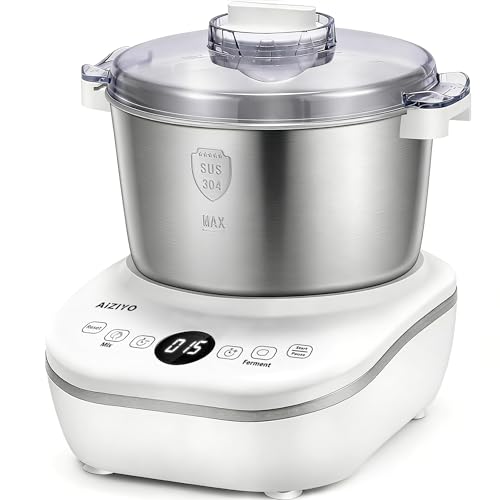
The AIZIYO DoughChief is designed for home bakers who want a more authentic kneading experience with light fermentation support. It uses a removable S-shaped dough blade and a mix-pause-mix program that simulates hands-on kneading, helping gluten development without continuous mixing. It also features a constant-temperature ferment function for dough proofing. This model is best for households or small studios focusing on bread, pizza, pasta dough, and sourdough, where automation complements traditional techniques.
- Best for home bakers who want a closer hand-knead feel and integrated fermentation.
- Better for smaller batches, around 3–5 loaves worth at a time.
- Avoid if you require ultra-large batch production or professional-grade speed consistency.
Banfluxion Commercial Dough Mixer 30QT — Dual Action

The Banfluxion 30QT mixer is built for large batches, featuring a 30L bowl and a 1.5 kW copper motor. It employs dual-action kneading with simultaneous bowl and spiral head rotation to deliver thorough, uniform mixing across varying dough types. Dual-speed settings let you adjust quickly for soft doughs or firmer doughs, making it suitable for pizza dough, bread dough, and large bakery batches. The heavy-duty all-stainless design is designed for daily commercial use.
- Best for large-volume bakeries or schools needing batch consistency.
- Better for uniform mixing across dough types with flexible speed control.
- Consider space and electricity needs due to 1500W motor size.
Ooni Halo Pro Spiral Mixer — 7.3 Quart

The Ooni Halo Pro uses professional spiral mixing technology in a home-friendly footprint. It features a rotating bowl, a spiral dough hook, and a patent-pending removable breaker bar, with 58 speed settings ranging from slow to high, allowing precise gluten development for bakery-quality dough. This is best for hobbyists or small studios seeking bakery-grade results with a wide speed range and flexible dough handling. It is not optimized for very large commercial batches but delivers exceptional dough structure for mid-sized projects.
- Best for home bakers who want bakery-quality dough at home.
- Better for delicate doughs where gluten development matters.
- Avoid if you need very large batch processing beyond 7–8 quarts regularly.
Rostbake Temperature-Controlled Stand Mixer — 7.4Qt

The Rostbake mixer combines a 7.4-quart bowl with a double-wall cooling design and a 500W copper motor. It features 11 speed settings and smart temperature management to keep doughs from overheating during long kneads. This makes it a practical choice for daily home baking or small kitchen operations that require stable dough temperature control for consistent results. It is best for steady, controlled kneading rather than ultra-high-intensity mixing.
- Best for households or small bakeries prioritizing dough temperature control.
- Better for slower, steadier kneading of medium batches.
- Avoid if you need the most powerful kneading on very large batches.
Buying Guide: Key Considerations For Double Arm Dough Mixers
Batch Size And Capacity
Consider how much dough you typically make per batch. Commercial models offer larger bowls (10–30 liters) for high-volume production, while home models usually cap at 5–7 quarts. Choose a size that matches your typical workflow to avoid over- or under-mixing.
Kneading Mechanism
Double arm or dual-action kneading systems generally provide more uniform development by working with both the bowl and the hook. Spiral mixers and dual-rotation machines can replicate hand-kneading effects more closely, which benefits gluten development in bread and pizza dough.
Power and Speed Range
Look for motors with ample wattage for the dough types you use. A broader speed range allows fine control for delicate doughs and heavy doughs alike. Copper motors are durable and quieter, but check overall build quality and heat dissipation features for long sessions.
Fermentation And Temperature Control
Some models incorporate fermentation modes or temperature control. If you bake sourdough or long-fermentation doughs, these features help maintain dough quality and predictability.
Maintenance And Cleaning
Food-contact components should be stainless steel and easy to disassemble for cleaning. Removable lids and accessible bowls simplify sanitation in busy kitchens or home spaces.
Footprint and Setup
Commercial units can be large and heavy. Consider counter space, electrical requirements, and stability features. Look for safety shields, splash guards, and non-slip bases to protect your workspace.
Use-Case Scenarios
• Small bakery or cafe: WantJoin or Ooni Halo Pro offer strong kneading with manageable size.
• Home baker seeking hands-free fermentation: AIZIYO DoughChief fits well.
• Large bakery or school: Banfluxion 30QT provides maximum batch throughput.
• Temperature-sensitive doughs: Rostbake adds temperature control for consistent results.
Frequently Asked Questions
- What is the main advantage of a double arm dough mixer over a standard mixer?
- Is a commercial-size mixer necessary for home bakers?
- Do these mixers require special cleaning or maintenance?
- Should I prioritize fermentation or speed in a dough mixer?
- What should I consider when choosing a mixer for pizza dough?
- Are copper motors better than standard motors?
Double arm or dual-action kneading systems achieve more uniform gluten development by engaging the dough with both the bowl and the hook, improving dough texture and consistency for bread and pizza.
Not typically. Home bakers benefit from smaller capacities with user-friendly controls, though a compact commercial unit can be useful for frequent large-batch baking.
Most models use metal bowls and hooks that are dishwasher-safe or easy to wash by hand. Look for removable parts and stainless steel components for easy cleaning and sanitation.
It depends on your recipes. Fermentation features help manage dough rise and temperature, while speed range impacts kneading intensity. For sourdough or long-fermentation doughs, fermentation control is valuable.
Pizza dough benefits from strong gluten development and consistent kneading. A mixer with dual-action kneading or spiral technology and a suitable batch capacity is ideal for pizza workflows.
Yes, copper motors are typically more durable and can run cooler and quieter under heavy use, though overall performance also depends on design, cooling, and load management.