Best Fridge and Freezer Door Locks to Keep Doors Closed
If you’re looking for a simple, tool-free way to keep a freezer or refrigerator door sealed, these magnetic-free locks use adhesive or self-locking mechanisms to prevent little hands from opening doors. They’re ideal for households with toddlers, pets, or anyone needing an extra layer of fridge security. The top picks below focus on ease of use, strong adhesion, and reliable keeping-power for a variety of fridge styles.
Buyer type overview:
– Parents of toddlers or curious pets who need quick, one-handed access for adults.
– Caretakers seeking non-invasive installs that won’t scar the appliance.
– Owners of multiple doors or compact fridges who want universal compatibility.
The following table highlights the five chosen products and their key strengths.
| Product | Best For | Why It’s Chosen |
|---|---|---|
| HomeBrella 2-Pack | Families with toddlers and pets | Auto-locking, easy disable option, tool-free install |
| Wilbeva 2 Pack | Homes with varied door types | Strong adhesive, wide applicability, no drilling |
| EUDEMON 1 Pack | Single-fridge setups needing child-safe one-handed use | Extended button spacing, normally open option |
| HFengQ 2 Pack | Two-door configurations, quick install | Sticky pads, durable ABS, easy removal |
| Blissleaf 2-Pack | Cabinets, drawers, and fridges | Adhesive pads included, simple long-term use |
HomeBrella 2-Pack Fridge Lock

Best for: households with kids and pets needing straightforward, automatic door security. Features include an auto-locking mechanism that secures the door when closed, and a simple disable option for adults when kids or pets aren’t around. The lock requires no tools to install and is easy to remove if necessary. A potential limitation is that reliability can depend on gasket condition; if a freezer door doesn’t latch firmly, the lock helps but won’t compensate for a severely worn seal.
Wilbeva 2 Pack Fridge Locks

Best for: families with multiple door setups and a need for versatile mounting. This lock uses strong adhesive to secure itself on refrigerators, freezers, microwaves, ovens, drawers, and cabinets. It’s well-suited for preventing children from accessing foods or snacks. The trade-off is a longer cure time—allow about 12 hours after installation for maximum adhesion before testing. Not ideal for extremely curved or textured surfaces where adhesive performance could be reduced.
EUDEMON 1 Pack Updated Fridge Lock
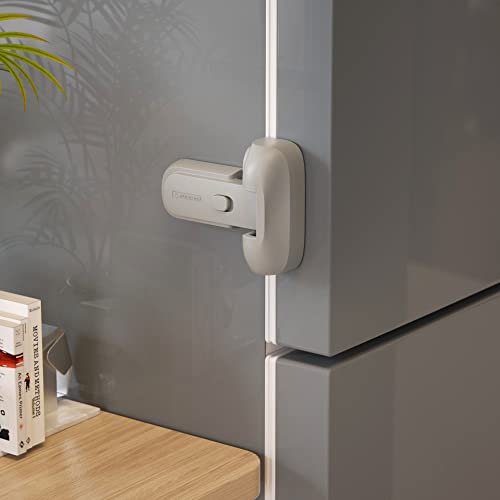
Best for: single-door fridges that benefit from a one-handed unlock and automatic re-lock. This model features a 40mm distance between double buttons for easier adult use while keeping toddlers at bay, and an adhesive bond designed to minimize residue after removal. A limitation is that adhesive strength improves with time; plan for full effectiveness after about 24 hours of curing before heavy door use.
HFengQ 2-Pack Refrigerator Locks

Best for: households needing simple, tool-free installation with strong adhesion. Each lock includes sticky adhesive pads, enabling quick setup on various surfaces without drilling. The product emphasizes durability and non-toxicity, making it a good option for families with small children. A caution is that adhesive pads may take longer to fully cure in high-humidity environments, potentially affecting initial hold.
Blissleaf 2-Pack Fridge Locks
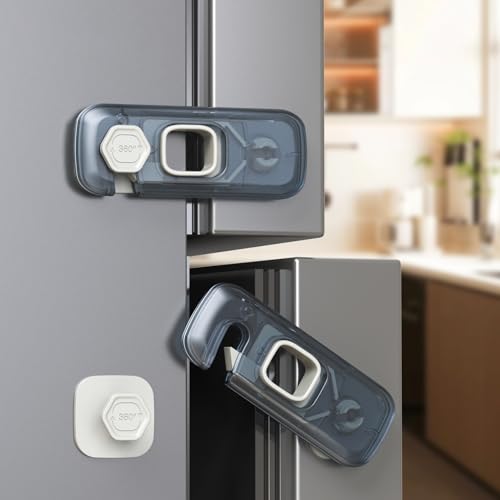
Best for: parents needing a compact, adhesive-based solution for fridges, drawers, and cabinets. The set includes adhesive pads and emphasizes ease of installation without tools. A potential limitation is that adhesive performance depends on surface cleanliness and temperature; ensure the surface is dry and smooth for best results.
Buying Guide
What type of fridge lock should you choose?
- Adhesive-only locks: Quick to install and non-invasive, suitable for most smooth surfaces. Best for renters or temporary needs but may require surface preparation and curing time.
- Self-locking (no manual latch) designs: Convenient for busy households; usually auto-secure when the door closes. Consider this if you want hands-free operation.
- Normally open vs locked-after-unlock: Normally open options allow occasional access by adults without pressing buttons; locked-after-unlock variants prioritize safety for persistent access control.
- Compatibility: Check whether the lock works with your fridge model, door width, and gasket condition. Some models claim universal compatibility but performance varies by door type.
- Durability and materials: Look for ABS or high-quality plastics, non-toxic adhesives, and clear instructions for removal without residue.
- Installation time and removal: If you move or want to reconfigure, consider whether removal leaves marks or requires heat tooling.
- Maintenance: Adhesives may degrade over time, especially in humidity. Plan for occasional re-application or cleaning to maintain hold.
Key comparison questions
- Do you need a lock that auto-secures the door when closed? If yes, prioritize auto-locking models like HomeBrella or Blissleaf.
- Is tool-free installation essential? All listed options meet this, but check surface suitability for best adhesion.
- Do you share access with others and require a quick open? Look for models with easy unlock mechanisms and, if possible, a normally open function.
- Are you securing multiple doors or cabinets? A two-pack or multi-pack design may save time and money while providing consistent performance.
FAQ
- Q: Will these locks damage my fridge? A: Most models use adhesive pads designed to remove with minimal residue and no tools; wash the surface before applying new pads if re-adhering.
- Q: How long should I wait after installation before testing the hold? A: Cure times vary; many adhesives perform best after 12 hours to 24 hours of curing.
- Q: Can these locks be used on freezers with thick or curved doors? A: Performance varies; some locks are universal, but highly curved surfaces may reduce adhesion.
- Q: Are these safe for toddlers with strong pulling? A: Locks are designed to resist typical toddler attempts while remaining easy for adults to operate, but no lock is completely childproof in all scenarios.
- Q: Can I remove and reuse the locks later? A: Most models allow tool-free removal, though adhesive integrity may limit reuse on the same surface.