Best Freezer Temperature Monitoring Devices for Safer Storage
If you need reliable freezer temperature monitoring, these devices help prevent food spoilage and protect sensitive items. This guide highlights top picks for home and small business use, focusing on alert reliability, ease of use, and remote monitoring options. Best for households, small restaurants, and anyone needing continuous temperature visibility without opening doors.
Summary of chosen products
| Product | Brand | Key Benefit | Best For |
|---|---|---|---|
| AcuRite Digital Wireless Fridge & Freezer Thermometer | AcuRite | Dual sensors with alarms; wall or countertop placement | Home use and small kitchens |
| MOCREO WiFi Thermometer Freezer Alarm | MOCREO | Remote monitoring with app alerts | Busy households with remote needs |
| YoLink Smart Freezer Thermometer (3-Pack) | YoLink | LoRa-based, long range; hub included | Areas with WiFi gaps |
| MOCREO WiFi Freezer Thermometer Alarm | MOCREO | Remote monitoring with hub; instant alerts | Power outages and door-miss scenarios |
| LSNDRG Freezer Thermometer with Alarm | LSNDRG | Dual-probe monitoring with 330 ft range | Two-location tracking |
AcuRite Digital Wireless Fridge and Freezer Thermometer with Alarm

This kit includes two digital thermometers—one for the refrigerator and one for the freezer—that transmit readings to a single display. It features an easy-to-read LCD, magnetic backing for fridge attachment, a wall keyhole mount, and a foldout stand for countertop placement. It is best for users who want a straightforward, non-networked solution with audible or visual alarms when temperatures stray. Suitable for home kitchens and small cafe setups where simple, local monitoring is enough. A modest limitation is the lack of remote alerts, which means you must be nearby to check readings.
MOCREO WiFi Thermometer Freezer Alarm

This system provides 24/7 remote monitoring with app-based alerts, email notifications, and loud audible alerts from a dedicated hub. It supports two remote temperature sensors and requires Wi-Fi (2.4 GHz). It is best for users who want real-time remote access and multiple notification channels. A caveat is that the data relies on a functioning home network and hub, so outages can affect alerts.
YoLink Smart Freezer Thermometer (3-Pack)

This three-pack uses LoRa wireless technology instead of Wi-Fi, enabling long-range coverage up to 1/4 mile in open air. It provides app and SMS alerts, plus hub inclusion for centralized monitoring. Best for locations with poor Wi-Fi or signal barriers where a traditional Wi-Fi thermometer would struggle. A limitation is that SMS alerts are capped in monthly usage, which may require planning for frequent monitoring in busy facilities.
MOCREO WiFi Freezer Thermometer Alarm with Digital Monitor Hub
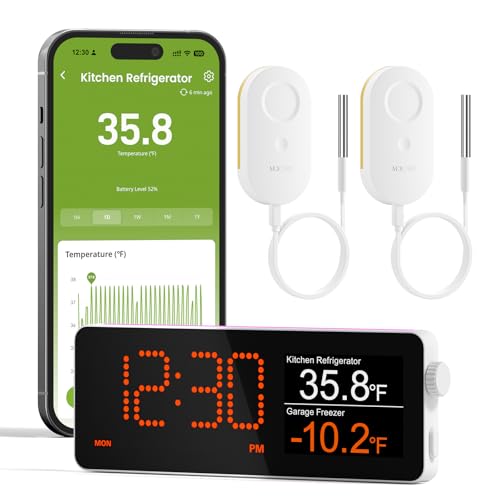
This setup adds a multifunctional digital hub that displays temperatures, trends, calendars, and weather, plus 24/7 remote monitoring. It is ideal for households or small offices seeking an integrated dashboard and reliable remote alerts. A potential drawback is that it requires a stable Wi-Fi connection and compatible 2.4 GHz network settings for best performance.
LSNDRG Freezer Thermometer with Alarm

LSNDRG offers dual-probe monitoring with a 330-foot range, enabling simultaneous tracking of two locations. Its backlit display shows indoor and outdoor probe readings with max/min history. It is best for users who must monitor two zones (e.g., separate freezers) from a distance. A limitation is that outdoor temperature readings can be affected by sun exposure or placement near heat sources, so proper probe positioning is essential.
Buying Guide: Key Considerations for Freezer Temperature Monitoring
- Connectivity: Choose between Wi-Fi, Bluetooth, or LoRa based on your environment. Wi-Fi enables remote access via apps; Bluetooth is device-local; LoRa offers long-range coverage without Wi-Fi.
- Number of probes: If you need to monitor multiple locations, pick models with dual or multiple probes. This helps track both fridge and freezer or two freezers simultaneously.
- Alert options: Look for audible alarms, SMS, and push notifications. Some systems support email alerts, Do Not Disturb bypass, or critical alerts for immediate action.
- Display and readability: A backlit or large digital display improves readability in cold environments. Ensure the display is easy to read without opening doors.
- Power sources: USB-powered units may offer continuous display lighting, while battery-powered units provide flexibility but require battery management.
- Data export and history: If you need to review trends, select devices with data export or long-term storage of max/min values.
- Setup and compatibility: Check whether a hub or gateway is required and ensure your network supports the device’s frequency (2.4 GHz Wi‑Fi, if applicable).
FAQ
- What is the typical temperature range you should monitor in a freezer?
The typical safe range for most freezers is around -10°F to 0°F (-23°C to -18°C). Some foods require specific ranges, so use recommended targets for items stored in your unit. - Do these devices require a subscription?
Most devices shown here do not require ongoing subscription fees for basic monitoring. Some models offer optional cloud features or enhanced alerts with paid tiers. - Can I monitor multiple freezers with one device?
Yes, devices with dual or multiple probes can monitor two locations. If you need more than two locations, consider a system with additional sensors or a hub that supports expansion. - What happens during a power outage?
Many systems include hub offline alerts or power-failure notifications and can continue monitoring when power returns, depending on battery backup provisions. - Is LoRa or Wi-Fi better for a large house or building?
LoRa is advantageous where Wi-Fi is unreliable or congested. Wi-Fi is simpler for homes with stable networks and offers easy app access from anywhere. - Are these devices easy to install?
Most units are simple to place—magnetic backs, stands, or wall mounts are common. Dual-probe models require proper sensor placement to ensure accurate readings.