Best Weighing Machines for Kitchen: Accurate Scales for Cooking, Baking, and Meal Prep
Answer: A kitchen scale helps you measure ingredients precisely for better cooking results and portion control. This guide highlights five reliable options, suitable for home cooks, bakers, dieters, and anyone who needs accurate ingredient measurements. Each pick is explained with who it’s best for, potential drawbacks, and why it stands out.
Summary of featured products (quick reference):
- Amazon Basics Digital Kitchen Scale with LCD Display
- Nicewell Food Scale, 22lb
- Escali Primo Digital Food Scale
- BakFee Food Scale, 33lb
- Greater Goods Food Scale with Nutrition Calculator
Amazon Basics Digital Kitchen Scale

The Amazon Basics Digital Kitchen Scale is a compact, food-safe option with a stainless steel platform and a wide LCD display. It weighs up to 11 pounds with 2-gram minimum precision and supports multiple units, including pounds, ounces, grams, milliliters, and fluid ounces. This scale is best for cooks who want a straightforward, affordable tool for precise ingredient measurements and easy unit switching during daily meal prep.
Best for: Budget-minded home cooks who want a reliable, easy-to-use scale for baking and cooking with simple unit conversion. It is also suitable for small kitchen spaces due to its compact footprint.
Caution: The unit uses plastic components that are BPA-free, which is common in this price tier but may feel less premium than full metal designs.
Nicewell Food Scale, 22lb
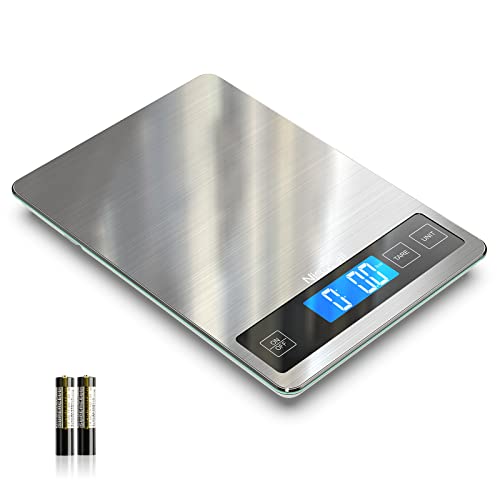
Nicewell offers a high-capacity digital kitchen scale with four precision load sensors and a large 9″x6.3″ platform. It provides precise 1-gram or 0.1-ounce graduations, with multiple readouts in g, kg, lb:oz, fl:oz, and ml. The tempered glass top helps with easy cleaning and fingerprint resistance, making this a practical pick for frequent bakers and those tracking portions or nutrition.
Best for: Serious home chefs and dieters who need accurate readings over a broad range, plus a generous weighing surface for larger bowls or containers.
Limited by: The larger platform may feel bulky on very small countertops, and readings depend on stable placement of the container and items.
Escali Primo Digital Food Scale
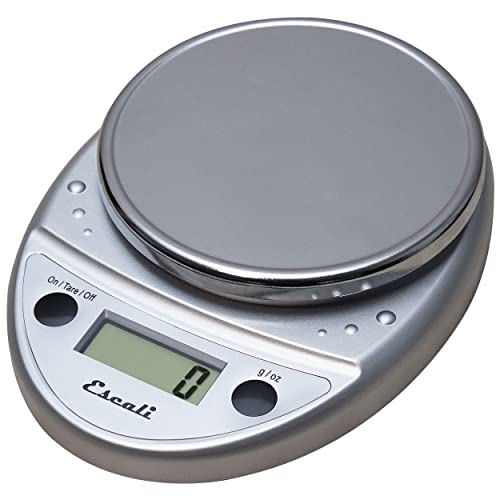
The Escali Primo is a compact, multi-use scale with a sealed control panel for easy cleaning. It features a simple two-button operation and a tare function to reset weight with each addition. Its durable design and quick, reliable readings make it a strong choice for precise portion control and recipe development, particularly when you need a straightforward tool without extra bells and whistles.
Best for: Cooks who want a durable, easy-to-clean scale with reliable tare functionality and straightforward operation. Ideal for quick meal prep and recipe testing.
Limitation: The two-button interface is minimal, which means fewer advanced features for those seeking timers or temperature sensors.
BakFee Food Scale, 33lb

The BakFee model combines a stainless steel and tempered glass surface with a 33-pound capacity and precise 1-gram / 0.05-ounce increments. It supports five units (g/kg/lb:oz/ml) and offers a USB-rechargeable power option, plus a practical splash-resistant design. This scale is well-suited for regular bakers and meal-prep enthusiasts who want a robust, high-capacity option with flexible power options.
Best for: People who frequently bake with larger quantities or who prefer a rechargeable battery and USB charging for convenience in the kitchen.
Caution: The more feature-rich design might be slightly heavier to store, and USB charging adds one more step in setup compared to simpler models.
Greater Goods Food Scale with Nutrition Calculator
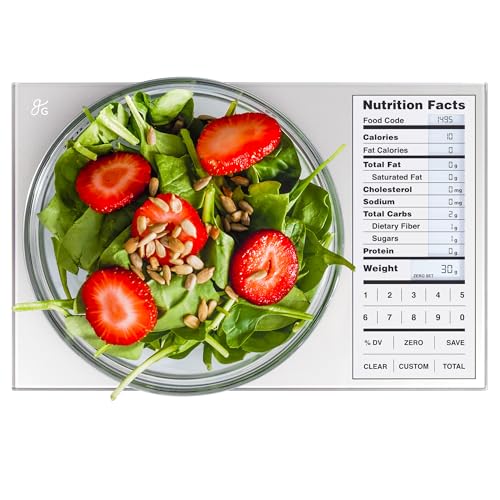
The Greater Goods scale includes a built-in nutrition calculator with data for 2,000 foods, enabling calorie, macronutrient, and sodium tracking without a separate app. It offers a tare function and stores up to 99 custom foods, making it ideal for private use and simple meal planning. The scale operates on batteries and emphasizes straightforward, app-free nutrition tracking for everyday meals.
Best for: Individuals focusing on calories and macros who want quick, private nutrition data without syncing to a phone or online account.
Limitation: The built-in database may not cover every new or brand-specific item, and some users may prefer cloud-based tracking for expansive food catalogs.
Buying Guide: Key Considerations For Choosing A Kitchen Scale
- Capacity and precision: Determine the maximum weight you’ll measure and the smallest increment you need. Bakers often prefer 1 g or 0.1 oz precision; general cooking may be comfortable with 2 g / 0.05 oz.
- Platform and build: Stainless steel platforms resist staining and are easy to wipe clean. Tempered glass tops look sleek but may feel slippery with wet ingredients.
- Units and conversions: Look for scales that support multiple units (g, kg, lb:oz, ml, fl:oz) to simplify different recipes and liquid measurements.
- Tare function: Essential for weighing multiple ingredients in a bowl. A reliable tare function saves time and ensures accuracy.
- Power options: USB rechargeables are convenient, but replaceable batteries matter if you move the scale around the kitchen.
- Cleaning and maintenance: Sealed control panels and smooth surfaces reduce hassle when cleaning, especially after messy tasks like dough work or sauce prep.
- Extra features: Some scales add timers, temperature sensors, or nutrition databases. Choose based on your needs—simplified use vs. extended functionality.
- Storage and footprint: If counter space is limited, consider compact designs with simple storage options or slim profiles.
Frequently Asked Questions
- What is a tare function and why is it important? A tare function resets the scale to zero, allowing you to measure added ingredients without removing the container weight.
- Which scale is best for dieting and nutrition tracking? Scales with built-in nutrition databases or easy export options help track calories and macros efficiently. Greater Goods is a solid option for private use without apps, while Nicewell offers precise measurements suitable for diet planning.
- Can I use a kitchen scale for liquids? Yes, many scales support ml and fluid ounces, making it easy to measure liquids accurately when following recipes.
- Is a higher capacity always better? Not necessarily. If you frequently measure small ingredients, a scale with high precision and a moderate capacity is often more convenient and accurate for daily tasks.
- Do I need a rechargeable scale? Rechargeable units are convenient on a busy counter; if you’re often unplugged or prefer fewer battery changes, choose models with USB charging.
- What should I consider for easy cleaning? Look for sealed controls and a flat, smooth platform to wipe clean quickly, especially after handling flour, dough, or oil.