Best Apple Cider Fruit Presses for Home Harvests and Small Batches
If you’re seeking an efficient, user-friendly way to press apples for cider, juice, or wine at home, these presses deliver reliable juice extraction with minimal waste. The pickups below are suited for hobbyists, small backyard orchards, and casual brewery setups. The top picks emphasize durable wood or stainless steel construction, straightforward operation, and good capacity for frequent use.
| Product | Capacity | Best For | Note |
|---|---|---|---|
| EJWOX 4.75 Gallon | 4.75 gal | Family use; apples, grapes, berries | Solid beech basket; built-in pour spout |
| VEVOR 3.69 Gal | 3.69 gal | Small gatherings; home brewing | Stainless steel basket; cross-beam |
| Mosakar 10.6 Gal | 40 L | Large batches; frequent juice | Hydraulic press; high pressure |
| CAELUM 1.6 Gal | 1.6 gal | Compact space; quick batches | Solid wood basket; 6 pressing blocks |
| SQUEEZE master 4.75 Gal | 4.75 gal | Vintage-style presses; small farms | Solid wood basket; T-handle |
EJWOX 4.75 Gallon Fruit and Wine Press

Best for: small families and hobby winemakers who want a sturdy, wood-based press with convenient juice collection. This model features a heavy-duty stand and a solid beech wood basket designed to minimize foaming and produce a drier pulp. The built-in pour spout simplifies juice collection, while screw-in feet offer secure mounting for steady use. Choose this if you value a traditional wood basket with reliable performance for regular, moderate batches. Caution: ensure stable placement to avoid tipping on uneven surfaces.
VEVOR 3.69 Gal Fruit Wine Press

Best for: households looking for a large-capacity press with a robust frame. It uses a cast-iron crossbeam and a triangular base for stability, plus a T-shaped handle and progressive pressing mechanism to extract juice efficiently. The included filter bags support hygienic operation. Choose this if you want a strong, open-loading design that accommodates larger fruit loads. Limitation: assembly and storage may require more space due to its size.
Mosakar 10.6 Gallon Hydraulic Press

Best for: users needing high pressure and large batches. This hydraulic press delivers up to 5 tons of force, with all juice-contact parts in stainless steel for durability against acidity. The leg height adjusts for different containers, and the basket is open for easy fruit loading. Choose this if you regularly press multiple kilos at once. Caution: hydraulic systems require careful maintenance to avoid leaks.
CAELUM 1.6 Gallon Fruit Wine Press

Best for: space-constrained kitchens or beginners who want a solid wood design with efficient juice extraction. The press uses a beech wood basket and a stable base with eight blocks to apply even pressure. It includes a filter bag to separate pulp for cleaner juice. Choose this if you prefer a traditional wooden press with straightforward cleaning. Limitation: smaller capacity means you’ll press in smaller batches.
SQUEEZE master Fruit Wine Cider Press
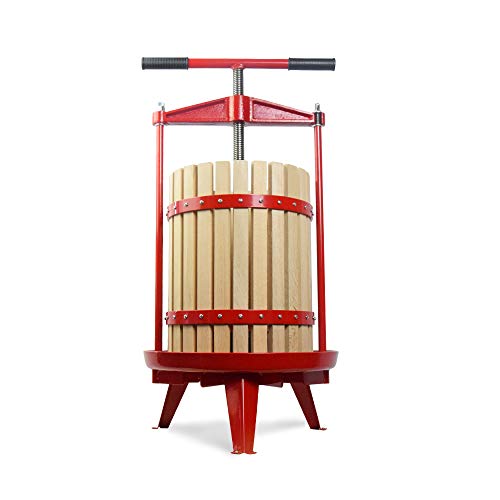
Best for: those who prefer a vintage-inspired design with strong pressing performance. This press features a solid wood basket and a large-caliber pressing area to improve juice yield. It ships with a free filter bag, making setup quick. Choose this if you want a traditional look with reliable output for small to mid-sized batches. Limitation: may require more manual effort compared to hydraulic options.
Buying Guide: Key Purchase Considerations
- Capacity needs: Consider how much juice you plan to produce per pressing and how often you’ll press. Hydraulics offer higher efficiency for big batches, while smaller, wood-basket presses suit occasional batches.
- Material and durability: Wood baskets provide classic appeal and good juice yield, while stainless steel baskets are easier to clean and resist corrosion with acidic juices.
- Ease of use: Look for features like built-in pour spouts, stable bases, and simple handles. A T-handle is common, but hydraulic presses reduce manual effort for lengthy sessions.
- Maintenance: Check whether the press comes with filter bags and whether the basket and pressing blocks are easy to disassemble and clean.
- Space and storage: Larger hydraulic models require more room. If space is limited, a compact wooden press with a small footprint may be ideal.
- Intended outputs: For cider, ensure the press supports thorough extraction with minimal oxidation and foaming. For wine, you may prioritize clean juice with less pulp.
Frequently Asked Questions
- What capacity is best for home use? Generally, 3–4 gallons is ideal for regular home batches, while 10–40 liters suits larger gatherings.
- Are wooden presses better than stainless steel? Wooden presses offer a traditional aesthetic and solid juice yield; stainless steel parts are easier to sanitize and resist corrosion.
- Do I need a hydraulic press? Hydraulic presses reduce manual effort and are better for large volumes; manual presses are sufficient for smaller, occasional batches.
- What kind of fruit prep is required? Pre-cut or crushed fruits improve extraction. Using filter bags helps separate pulp and yields cleaner juice.
- How should I maintain a fruit press? Clean after each use, inspect seals and handles, and dry baskets to prevent mold or rust on metal parts.
- Can these presses press not just apples but other fruits? Yes, most presses work for apples, grapes, berries, pears, and similar fruits when prepared properly.