Best Food Grade Lubricant for Espresso Machines
For espresso gear systems that mingle with coffee, a food-grade lubricant preserves performance without risking contamination. This guide highlights five reliable options and explains who each is best for, along with practical usage tips. Ideal buyers include cafe operators, home baristas, and kitchen technicians seeking safe, long-lasting lubrication for brew groups, grinders, O-rings, and seals.
Quick comparison table of chosen products
| Product | Best For | Typical Use | Notes |
|---|---|---|---|
| Keze Food Grade Lubricant Grease (1 oz, 1-Pack) | Home and small commercial espresso machines | Gears, seals, O-rings | Food-safe, reduces friction |
| Nayrmaer Espresso Machine Grease (2 x 10g) | Maintenance-focused users | Gear drives, rails, drive shafts | Food-grade silicone; NFC H1 SG certified |
| Horex Espresso Machine Grease (50g) | Professional and hobbyist espresso setups | Brewing gears, conical burrs, transmission | NSF H1 certified; includes set |
| BX Food Grade Grease (1.7 oz) | All-in-one lubrication | Brewer groups, burrs, bearings, valves | NSF-compliant; long-lasting |
| ZDBB Food Grade Grease (1 oz) | Quiet operation and protection | Stand mixers, mixers, grinders, and more | PTFE-enhanced; odorless |
Keze Food Grade Lubricant Grease Espresso Machine Grease

Best for small to mid-size kitchen appliances, including espresso machines. This white-labeled synthetic base oil with a silica thickener is designed for safe incidental contact with food. It lubricates gears, seals, and O-rings, reducing friction and wear to extend service life. Use on grinder gears or brew group components where metal-to-metal contact occurs. One caveat: ensure clean, dry surfaces before application to prevent dilution of performance.
Nayrmaer Espresso Machine Grease Kit

Best for users who want a bundled silicone grease solution. The two 10g tubes are formulated with high-quality silicone fluids and food-grade additives, designed to protect gears in espresso grinders and brew mechanisms. It’s NFC H1 SG certified, making it suitable for food-contact equipment. Choose this if you value easy handling and a ready-to-use maintenance kit. Limitation: apply sparingly and evenly to rails and drive shafts to avoid over-lubrication.
Horex Espresso Machine Grease (50g)

Best for gear-heavy espresso machines and conical burr systems. This NSF H1 certified grease is designed to protect integrated grinding gears and improve transmission efficiency. Non-toxic and odorless, it reduces noise and wear on critical components. It arrives as a value set with brushes and tools for convenient application. Better for users who want an all-in-one maintenance package. Caution: ensure proper cleaning before application to avoid trapping debris.
BX Food Grade Grease 1.7 oz
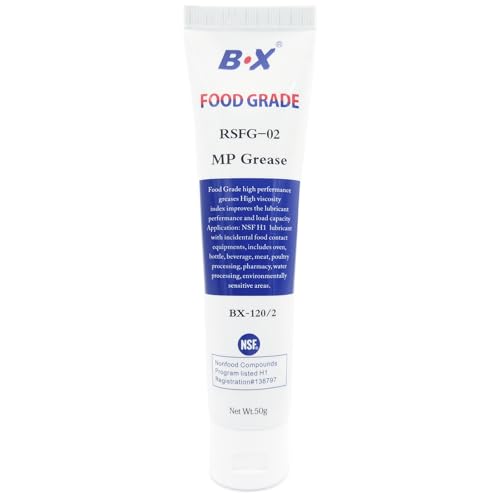
Best for long-lasting lubrication across multiple coffee components. This NFC H1 certified grease is designed for espresso machine brew groups, grinders, bearings, and gaskets. It provides a thick, creamy formula for extended protection and reduced wear, helping maintain peak performance. Choose this if you want a versatile option that suits both commercial and home setups. Limitation: verify compatibility with any plastic parts in older machines before use.
ZDBB Food Grade Grease for Kitchenaid Stand Mixer

Best for odorless operation and broad compatibility with kitchen devices, including stand mixers and grinders. The PTFE enhancement provides a low friction coefficient, supporting quiet operation and stable lubrication across high and low temperatures. It is water-resistant and designed for incidental food contact. Use this when you need a reliable, odor-free option that performs well in diverse conditions. Caution: avoid over-application on gear assemblies with limited space.
Buying Guide
What to consider when choosing a food-grade lubricant for espresso equipment
- Certification and safety: Seek NFC H1 or NSF-certified options to ensure food-contact safety and regulatory compliance.
- Compatibility: Confirm the grease is suitable for metal gears, plastic components, seals, and O-rings in your specific machines.
- Lubrication points: Identify brew groups, grinders, rails, drive shafts, and gaskets where lubrication will be applied.
- Temperature and water exposure: Choose formulas with good high/low-temperature performance and water resistance for wet kitchen environments.
- Application method: Some products come with brushes, scrapers, or easy-to-use tubes; select based on your maintenance routine.
- One- or multi-use: Bundled sets offer convenience for multiple parts, while single-use tubes may suit targeted lubrication.
Practical usage tips
- Clean surfaces before applying to prevent contaminants from embedding in the grease.
- Apply a thin, even layer to gears, rails, and drive shafts; avoid pooling in small cavities.
- Reapply on a maintenance schedule aligned with usage intensity and machine hours.
- Dispose of excess product responsibly; avoid cross-contamination between different equipment parts.
Buyer perspectives
- Home users: A compact tube or small set is often sufficient for occasional maintenance on a single espresso machine.
- Small cafés: A multi-pack or kit with brushes can streamline routine service across multiple devices.
- Service technicians: Higher-volume selections with OEM-typical specifications help standardize parts across models.
FAQ
- Is food-grade grease safe for coffee to touch? Yes. Food-grade greases are formulated to minimize risk from incidental contact with consumables.
- Can I use regular silicone grease for espresso machines? Not always. Food-grade silicone greases are preferred for gear transmissions in contact with food-contact zones.
- How often should I lubricate espresso equipment? Lubrication frequency depends on usage and manufacturer guidelines; practical intervals are based on wear indicators and noise levels.
- What parts should I lubricate on a grinder? Gears, bearings, drive shafts, and rails near the grinding mechanism are common lubrication points.
- Are these lubricants safe for water exposure? Many are water-resistant, but always follow product directions to prevent dilution or wash-out.
- What should I do if the equipment becomes excessively noisy after lubrication? Reduce application amount, clean the area, and reapply a thinner layer in the affected zones.