Best Gas Water Heaters for Fast, Reliable Hot Water
This guide highlights five top-rated gas-powered water heaters that deliver instant hot water for busy homes. Each model offers strong flow, efficient performance, and user-friendly controls. Below you’ll find a quick product snapshot and detailed sections to help you compare capacity, fuel type, installation options, and features across popular brands.
| Product | Brand | Approx. Flow (GPM) | BTU | |
|---|---|---|---|---|
| NOVIEEX Tankless On-Demand | NOVIEEX | 4.3 | 100,000 | Indoor, precise temp control |
| Rinnai RX199iN Condensing | Rinnai | Up to 11.1 | 199,000 | Indoor/Outdoor, Smart Sense compatible |
| FOGATTI 170S Series | FOGATTI | 7.5 | 170,000 | Indoor, high output, compact |
| Rheem RTG-95DVLN-3 | Rheem | Up to 9.5 | 199,900 | Indoor, high efficiency |
| APUS 190,000 BTU Outdoor | APUS | 8.1 | 190,000 | Outdoor, WiFi & remote control |
Novieex On-Demand Gas Tankless Water Heater

The NOVIEEX on-demand gas water heater provides up to 4.3 GPM of instant hot water with a 100,000 BTU burner. It supports simultaneous use across a shower, kitchen faucet, and bathroom sink without noticeable temperature drops. The device includes a built-in digital thermostat with an adjustable range from 95°F to 149°F, offering precise ±1°F temperature control for consistent comfort and safety. Designed for indoor installation, it is suitable for compact spaces where reliable hot water is essential.
Rinnai RX199iN Condensing Tankless Water Heater

The Rinnai RX199iN is a versatile, condensing tankless water heater that can be installed indoors or outdoors with Versa Vent. It supports propane or natural gas and delivers up to 11.1 GPM, enough for 7 fixtures simultaneously. Its high-efficiency design (UEF up to 0.98) and quick flush capability simplify maintenance, while a user-friendly interface enhances control. Optional control modules enable WiFi integration for remote management (module sold separately).
FOGATTI Natural Gas Tankless Water Heater – 170S

FOGATTI’s indoor 170S tankless unit handles 170,000 BTU with a 7.5 GPM flow, delivering instant hot water for multiple outlets. It emphasizes precision temperature control using a four-stage combustion system and advanced sensor technology to maintain a tight ±1°F range. Its compact design makes it suitable for smaller homes while still supporting 3–5 outlet points when needed.
Rheem RTG-95DVLN-3 Gas Tankless Water Heater

The Rheem RTG-95DVLN-3 offers high efficiency with up to 9.5 GPM and 199,900 BTU output. It’s designed for indoor installation and features a compact cabinet that facilitates wall mounting. This model aims to balance strong hot water delivery with reliable performance during peak demand, making it a solid choice for mid-sized homes with multiple hot water needs.
APUS 190,000 BTU Outdoor Tankless Water Heater
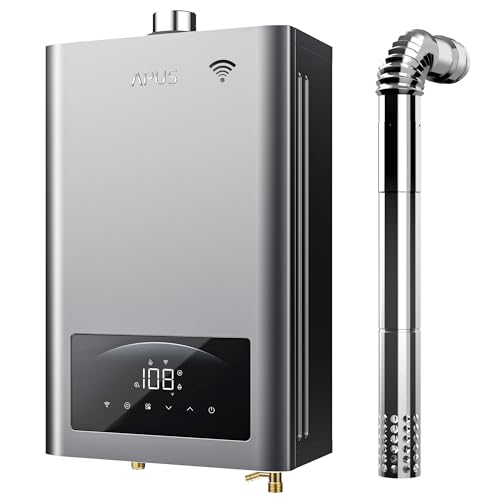
This outdoor unit delivers 8.1 GPM at up to 190,000 BTU, designed for whole-home use. It supports up to 3 showers and 2 faucets concurrently, with a built-in booster option and remote/app control via Tuya-compatible software. The unit is rated for outdoor installation and provides reliable performance with a precise ±1°F temperature control, making it suitable for exposed environments where indoor space is limited.
Buying Guide: Key Considerations For Gas Tankless Water Heaters
- Flow capacity and simultaneous use: Match the GPM rating to your household’s hot water demands. Larger homes or multiple bathrooms require higher flow ratings to prevent temperature fluctuations during peak usage.
- Fuel flexibility and venting: Choose models that support your available gas type (natural gas or propane) and note whether outdoor or indoor installation is preferred. Condensing models generally offer higher efficiency but may have more complex venting requirements.
- Energy efficiency: Look for high UEF (uniform energy factor) ratings and features like silent operation, quick flush, and smart controls. Efficiency can reduce operating costs over time.
- Temperature stability: Precise digital thermostats and sensors help maintain steady temperatures, reducing the risk of cold water shocks during rapid flow changes.
- Installation and space: Indoor units typically require venting and space for servicing. Outdoor units reduce indoor footprint but must withstand weather and require appropriate enclosure protections.
- Smart controls and remote access: Some models offer WiFi or app-based control for adjusting temperatures, commissioning, and monitoring energy use remotely. Consider compatibility with your home automation ecosystem.
- Maintenance and serviceability: Features such as quick flush and accessible service ports simplify routine maintenance and extend the unit’s life.
- Warranty and support: Review manufacturer warranties and the availability of local service technicians, which can influence reliability and total cost of ownership.