Best 100 Lb Grease Trap Picks for Commercial Kitchens in 2026
Finding the right 100 lb grease trap means balancing capacity, durability, and compatibility with your facility’s waste system. This guide highlights five solid options for American kitchens, from restaurants to hotels, intended for high-volume grease management. Each product suits different needs: large-capacity, durable steel units for busy kitchens; economical thermoplastic options for cost-conscious facilities; and stainless or rated models for corrosion resistance and long-term reliability.
| Product | Best For | Key Benefit |
|---|---|---|
| John Boos GT-100 Carbon Steel Grease Interceptor | High-demand restaurants | Heavy-duty carbon steel with corrosion-resistant coating |
| Canplas 3950A03 Thermoplastic Interceptor | Budget-friendly kitchens | Thermoplastic construction, easy maintenance |
| Endura Interceptor 3950A04-1 | Canadian installations; durable standard | Manufactured in Canada; reliable steel frame |
| Krollen Industrial 100 LB Grease Interceptor | Medium to large kitchens | Removable baffle and dual lid handles |
| Zedfire 100 lb / 50 GPM Grease Trap | High-flow prep areas | PDI-certified; strong flow control |
John Boos GT-100 Carbon Steel Grease Interceptor

The John Boos GT-100 offers a 100-pound grease capacity and large dimensions (30.5″ L x 21.5″ H x 22.25″ W). It features a TIG-welded 11-gauge carbon steel shell with a corrosion-resistant coating and a non-skid deck plate with a locking cover. Best for high-volume kitchens where robust construction and long-term durability are priorities. Choose this if you operate a busy restaurant or hotel kitchen needing a sturdy, serviceable interceptor. A potential limitation is its heavier weight, which may affect installation and service handling.
Canplas 3950A03 Thermoplastic Interceptor
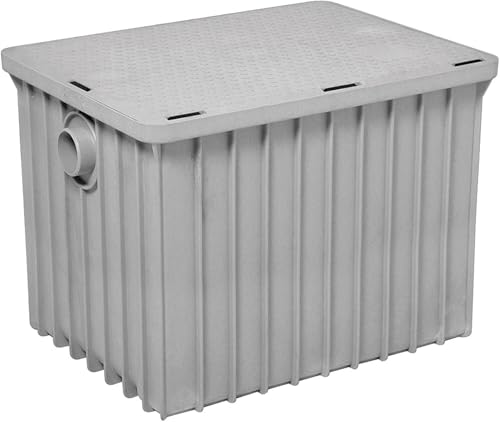
The Canplas 3950A03 model offers a 100 lb grease capacity with a 50 GPM flow design. It uses thermoplastic construction and includes a grease-intercepting screen to block fats and oils while allowing wastewater passage, reducing clogs. Best suited for installations where corrosion resistance and a lower upfront cost are important. Better for smaller, mid-size kitchens or facilities seeking easy maintenance. Note that thermoplastic units may have different long-term mechanical limits than steel in very high-heat or highly demanding environments.
Endura Interceptor 3950A04-1

The Endura 3950A04-1 is a 100 lb capacity interceptor, noted as manufactured in Canada. This option is a practical choice for facilities prioritizing regional manufacturing and straightforward design. Best for venues needing reliable, solid construction with predictable maintenance cycles. If your project demands bilingual documentation or Canadian compliance specifics, this model may align well. A limitation is that product details are succinct, so confirm fit with your piping and drain layout before purchase.
Krollen Industrial 100 LB Grease Interceptor

The 100 LB model from Krollen Industrial provides a 50 GPM flow design and features a durable steel construction with a removable baffle for easier cleaning and a lid with dual pull handles for quick access. Best for mid to large kitchens requiring straightforward maintenance and robust access for cleaning. Choose this if you want a practical balance of capacity and maintenance ease. A caution is that non-threaded connections may require compatible piping adapters.
Zedfire 100 lb / 50 GPM Grease Trap

The Zedfire model is a PDI-certified 100 lb grease trap designed for 50 GPM flow. It targets large, high-demand commercial kitchens, prep sinks, and dishwashers, keeping fats, oils, and grease from entering the sewer system. Best for facilities that require compliance with PDI standards and strong flow control. A potential limitation is that certification wording may require verification for local code compatibility; always check local plumbing requirements prior to installation.
Buying Guide: Choosing The Right 100 Lb Grease Trap
- Capacity vs. Flow: Confirm both grease capacity (pounds) and flow rate (GPM). Higher flow is essential for busy kitchens during peak hours, while capacity matters for cumulative grease buildup.
- Material and Durability: Stainless steel offers corrosion resistance; carbon steel with a corrosion-resistant coating provides strength at a lower cost; thermoplastic offers a lightweight, maintenance-friendly option.
- Access for Cleaning: Interceptors with dual lids or easy-to-remove baffles simplify routine cleaning, reducing downtime.
- Installation Considerations: Check pipe size, non-threaded versus threaded connections, and space for service access. Width, height, and deck plate clearance matter for retrofit projects.
- Certification and Compliance: PDI-certified units align with industry standards for potable water and wastewater. Local codes may require specific certifications or flow controls.
- Maintenance and Parts: Availability of replacement baffles, gaskets, and screens influences long-term upkeep. Consider brands with readily available service parts.
- Best For: Use “best for” language when planning purchases: high-demand kitchens may favor heavy-duty steel; cost-conscious facilities may opt for thermoplastics; large campuses may prefer units with robust flow control.
Frequently Asked Questions
- What does 100 lb grease capacity mean? It refers to the maximum amount of grease the interceptor can hold before it needs to be cleaned or serviced.
- Are thermoplastic interceptors as durable as steel? They are generally lighter and corrosion-resistant but may have different long-term wear characteristics in very hot or aggressive environments.
- Do I need a PDI-certified grease trap? Certification helps ensure adherence to industry standards; check local plumbing requirements to confirm necessity.
- How do I know which size I need? Consider kitchen flow (GPM), peak usage, and available install space. A higher GPM capacity reduces risk during peak times, while larger physical size requires more space.
- Can I install a grease trap under a sink? Many models are designed for under-sink or floor installation; ensure there is proper clearance and access for maintenance.
- What maintenance schedule is typical? Most units require periodic cleaning based on grease buildup, typically every 1–6 months depending on usage and local codes.