Best 120 Bottle Wine Refrigerators for Home and Bar Use
Find the right 120-bottle wine refrigerator to protect and display your collection. This guide compares top options by capacity, cooling performance, and versatility. Best for home wine collectors, small bars, and built-in kitchen spaces, these models balance capacity with quiet operation and energy efficiency. The featured picks include freestanding and built-in styles to fit different layouts and installation needs. Below, you’ll see a quick summary table to help you compare at a glance.
| Product | |||
|---|---|---|---|
| Whynter FWC-1201BB | 124 standard bottles | Freestanding | Large collections seeking a sleek black cabinet |
| Tylza Wine & Beverage Refrigerator | 120 bottles + 160 cans | Built-in or freestanding | Dual-zone storage for mixed wine and beverages |
| Velivi 24″ Wine Cooler | Up to 154 bottles | Freestanding or built-in | Large collection with quiet operation |
| Whynter BWR-1002SD | 100 standard bottles | Built-in or freestanding | Open-bar environments with display lighting |
| Wine Enthusiast 32-Bottle Dual Zone | 32 bottles | Freestanding | Compact spaces needing dual-zone control |
Note: Each model has distinct features such as dual-zone controls, LED lighting, and vibration reduction. Review the product sections to see which best fits your space and wine storage needs.
Whynter FWC-1201BB 120 Bottle Freestanding Wine Cabinet Refrigerator

Capacity and design: This freestanding unit measures 22.5″ L x 23.5″ W x 55.5″ H and holds 124 standard 750ml bottles. It features a sleek black cabinet and interior with a reversible door swing for flexible placement. Best for: collectors who need a tall, single-zone storage solution with a clean look. Limitation: standard capacity is around 124 bottles, not a full 120-bottle rounded metric on some listings.
Tylza Wine And Beverage Refrigerator
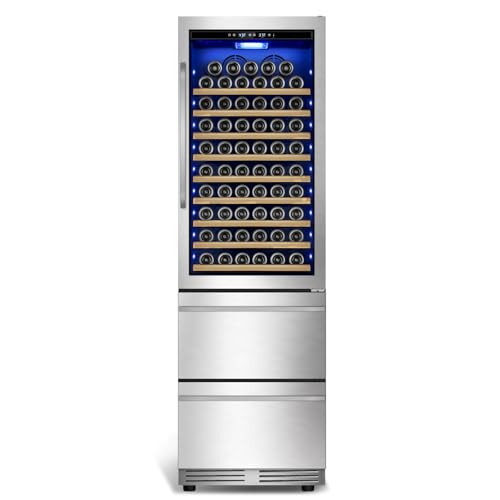
Capacity and zones: Holds up to 120 standard 750ml wine bottles plus 160 cans, with dual independent temperature zones (Lower: 37°F–64°F; Upper: 41°F–72°F). Best for: households or small businesses storing separate wine and beverage inventories. Why chosen: robust cooling with memory backup and carbon filtration improves storage stability. Caution: high-capacity units may require more floor space and power.
hOmeLabs Beverage Refrigerator and Cooler

Capacity and use: Mini fridge with 120 cans capacity and 3.2 cubic feet. Best for: small spaces like offices, dorms, or kitchens needing a compact beverage center. This model is better for cans and mixed beverages rather than a wine-focused collection. Limitation: not designed for large wine bottle storage, which may matter for serious wine collectors.
Velivi 24″ Single-Zone Wine Cooler

Capacity and performance: Stores up to 154 bottles in a 24″ footprint, with a single-zone temperature range of 41°F-65°F. Best for: serious wine collectors who want maximum capacity in a compact footprint. Why chosen: quiet compressors and solid air circulation preserve wine quality. Caution: single-zone design may limit ability to store wines at different temperatures simultaneously.
Wine Enthusiast 32-Bottle Dual Zone MAX Compressor Cooler

Capacity and features: Supports up to 32 bottles with dual zones and MAX compressor cooling for consistent performance. Best for: small collections that require separate red and white storage in a compact footprint. Why chosen: dual-zone flexibility in a sleek freestanding unit. Limitation: smaller capacity compared to other 120-bottle options.
Buying Guide
What should you consider when choosing a 120-bottle wine refrigerator?
Capacity alignment matters. Choose a model that reliably stores at least 120 standard bottles, with room to spare for varying bottle sizes. Dual-zone controls benefit mixed collections. Consider freestanding versus built-in installation based on your kitchen or bar layout.
How important is cooling performance and noise?
Look for a unit with a quiet compressor and stable temperature control. Vibration reduction helps preserve sediment and aromas. A front-venting design supports both built-in and freestanding setups in tight spaces.
What about energy use and maintenance?
Energy efficiency reduces operating costs. Features like carbon odor filters and LED lighting add convenience without increasing energy draw. Regular door seal checks help maintain optimal cooling.
Which features maximize value for a wine collector?
Interior organization options (adjustable shelves, bottle racks), glass doors with UV protection, and display lighting enhance usability. A reversible door adds placement flexibility, especially in tight floor plans.
Keys to long-term storage success
- Keep a stable environment around 37°F–64°F depending on zone configuration.
- Avoid frequent door openings to maintain consistent temperatures.
- Store bottles with labels facing outward for easy cataloging.
- Choose models with good insulation and multiple cooling zones if you have diverse wine types.
FAQ
- Q: Do 120-bottle fridges support both red and white wine at different temperatures?
A: Yes, many models offer dual-zone cooling to manage different wines simultaneously. - Q: Is built-in installation better than freestanding?
A: Built-in saves space and can integrate with cabinetry; freestanding offers flexibility and easier relocation. - Q: How important is a UV-protected glass door?
A: UV protection helps preserve wine quality by limiting light exposure on a display model. - Q: Can a 24″ or 25″ model hold 120 bottles?
A: Some models use compact footprints with higher bottle-density; check actual bottle dimensions and shelf configurations. - Q: Are these units energy efficient?
A: Most modern compressors are designed for efficiency, but confirm energy usage per day in the product specs.