Best 40 Amp Range Plug Solutions for High-Power Appliances in the Home
Looking for a reliable 40 amp range plug to power high-demand appliances safely? This guide highlights top 40 amp range cords that fit common NEMA configurations and harsh outdoor environments. Each product is evaluated for suitability by buyer type—DIY homeowners, RV or off-grid users, and busy kitchens needing quick, secure connections. The following table summarizes the highlighted options to help you compare at a glance.
| Product | Prong Type | Length | Best For |
|---|---|---|---|
| HiFind 4-Prong Replacement 40 Amp Range Power Cord 4 Ft | NEMA 14-50P | 4 ft | Outdoor or DIY repairs needing a compact, flexible extension |
| Eastman 3-Prong Electric Range Cord, 40 Amps, 5 Foot | 3-prong | 5 ft | Older ranges or universal compatibility with many brands |
| Eastman 6 Feet Electric Range Cord, 40 Amps 4-Prong | 4-prong | 6 ft | Longer runs and versatile kitchen installations |
| Eastman 4 Feet Electric Range Cord, 40 Amps 4-Prong | 4-prong | 4 ft | Compact spaces and tight installations |
| HiFind 4-Prong Replacement 40 Amp Range Power Cord 6 Ft | NEMA 14-50P | 6 ft | Mid-length outdoor or workshop setups requiring flexibility |
HiFind 4-Prong Replacement 40 Amp Range Power Cord 4 Ft

The HiFind cord is a heavy-duty extension designed for high-power needs with a 40-amp, 125/250V rating and NEMA 14-50P plug. It uses 8/10 AWG conductors and features a moisture-proof, high-temperature resistant insulation jacket rated for -40°F to +140°F. Best for outdoor use or DIY installations where weather resistance and flexibility matter. It includes molded ring terminals for quick connections and a flat plug with a right-angle connector to sit flush against walls. A potential limitation is that some installations require careful color-coding during wiring (black/red for hot, white for neutral, green for ground) to ensure safe connections.
Who it’s best for: DIYers doing outdoor wiring or repairs that need a robust, flexible cord. Why chosen: Strong insulation, outdoor-rated, and ETL-listed for safety.
Limitations: Requires proper color-coded wiring during installation to avoid miswiring.
Eastman 3-Prong Electric Range Cord, 40 Amps, 5 Foot
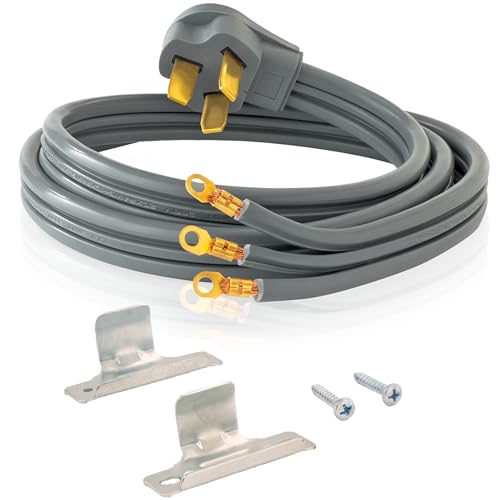
This 40-amp, 3-prong cord is designed to connect electric ranges to a three-conductor power source. It uses two hot wires and a neutral wire, with a neutral in the middle and two hots on the outside. The included configuration suits older or more common range setups and is compatible with many major brands. It’s a practical pick for users who require a straightforward, universal option. The main limitation is its 3-prong design, which may not fit newer four-prong outlets if your appliance requires one.
Who it’s best for: Homes with older range connections or appliances that still use a 3-prong plug. Why chosen: Simple, reliable compatibility across many brands.
Eastman 6 Feet Electric Range Cord, 40 Amps 4-Prong

This 6-foot Eastman cord provides a 4-prong connection for 40-amp ranges, featuring two 8-gauge and two 10-gauge conductors. It is positioned as a universal option compatible with many brands, making it a flexible choice for kitchens and workshops. The longer length helps accommodate longer outlet-to-appliance distances. A potential drawback is the extra length if space is constrained, which can complicate routing in tight kitchens.
Who it’s best for: Kitchens or workspaces needing extra reach between outlet and appliance. Why chosen: Balanced conductor sizing for power delivery and broad brand compatibility.
Eastman 4 Feet Electric Range Cord, 40 Amps 4-Prong
This 4-foot Eastman cord is compact and designed for tight spaces, offering a four-conductor 40-amp connection. It is compatible with most major electric ranges and includes two 8-gauge and two 10-gauge wires. The shorter length minimizes clutter in small kitchens or utility areas. A limitation is that shorter cords may not accommodate all outlet placements, requiring careful measurement before purchase.
Who it’s best for: Small kitchens or installations with limited space. Why chosen: Ideal balance of length and universal compatibility.
HiFind 4-Prong Replacement 40 Amp Range Power Cord 6 Ft
The 6-foot HiFind cord extends the same 40-amp, 125/250V capacity with NEMA 14-50P and 8/10 AWG conductors. It is designed for outdoor or long-run contexts and emphasizes moisture resistance, high-temperature tolerance, and flexibility for routing. It uses molded ring terminals for straightforward mounting. A consideration is ensuring adequate outlet spacing for the longer run in compact kitchens or RV setups.
Who it’s best for: Users needing a longer, weather-resistant extension for outdoor or workshop use. Why chosen: Durable construction and flexible routing along longer distances.
Buying Guide: Key Considerations For 40 Amp Range Cords
- Connector configuration: Choose based on your appliance’s outlet (4-prong vs 3-prong). If your range supports a 4-prong connection, a 4-prong cord is typically preferred for safety and compatibility.
- Conductor gauge: For 40 amps, 8-gauge conductors are common, with 10-gauge as a secondary option in some cords. thicker gauges help reduce overheating over long runs.
- Length needs: Measure the distance between outlet and appliance. Longer cords improve flexibility but can create clutter in tight spaces.
- Outdoor and moisture resistance: If cords will be exposed to weather, look for moisture-proof insulation and outdoor-rated jackets, plus ETL or equivalent safety listings.
- Safety and installation: Follow color coding (hot, neutral, ground) and ensure proper connections, especially with molded ring terminals and terminations.
Frequently Asked Questions
- What is a 40 amp range cord best used for? – It powers high-demand appliances like ranges and some EV charging setups, where a higher current draw is needed.
- Do I need a 4-prong or 3-prong cord? – Modern ranges typically use a 4-prong connection for better safety through separate neutral and ground conductors. Check your appliance outlet configuration.
- Are outdoor-rated cords necessary indoors? – Not always, but for outdoor use or damp environments, outdoor-rated jackets and moisture resistance are important to prevent damage.
- Can I substitute a longer cord for a shorter one? – Yes, but ensure the cord length does not create tripping hazards and that the lead distance matches the appliance’s outlet position.
- What should I check before buying? – Confirm amperage rating, conductor gauge, prong configurations, length, and whether the cord is ETL-listed or equivalent for safety.
- Are these cords easy to install myself? – Cords with molded ring terminals support DIY connections, but wiring must follow color codes and appliance manuals for correct, safe setup.