Best 40 Amp Stove Plug Options for Safe, Reliable Range Power
Finding the right 40 amp stove plug ensures your electric range or oven receives steady power with proper safety. This guide highlights five well-matched cords, including universal four-prong and three-prong configurations, to fit common American ranges. Suitable buyers include homeowners upgrading cords, DIY installers, and professionals seeking durable, weather-resistant options for indoor or outdoor use. Use the quick reference table to compare key details at a glance.
Product Comparison Table
| Product | Cord Type | Length | Prong/Outlet | Best For |
|---|---|---|---|---|
| Eastman 6 Feet Electric Range Cord, 40 Amps 4-Prong | 4-prong | 6 ft | NEMA 14-50P to 4-wire | Most major brands; longer reach |
| Eastman 3-Prong Electric Range Cord, 40 Amps, 5 Foot | 3-prong | 5 ft | NEMA 10-50P to 3-wire | Older 3-wire outlets; compact spaces |
| HiFind 4-Prong Replacement 40 Amp Range Power Cord, 4 Ft | 4-prong | 4 ft | NEMA 14-50P to 4-wire | Outdoor or tight spaces; moisture and heat resistance |
| Certified Appliance Accessories 40-Amp Cord, 4 Feet | 4-prong | 4 ft | 4-wire | Budget-conscious replacements |
| GE WX09X10035 4′ 40 Amp 4-Wire Range Cord | 4-prong | 4 ft | 4-wire | UL Listed, copper wiring, compact setup |
Eastman 6 Feet Electric Range Cord, 40 Amps 4-Prong

The Eastman 6 Feet Electric Range Cord uses a four-conductor design to connect ranges to a standard four-prong outlet. It is labeled universal for compatibility with most major brands and includes two 8-gauge wires and two 10-gauge wires. Best for new installations or replacements needing a longer reach and safe four-wire power delivery. A potential limitation is the longer length may be less convenient in compact kitchens unless wall clearance is sufficient. Choose this if you want a long, universal cord for a broad range of stoves.
Eastman 3-Prong Electric Range Cord, 40 Amps, 5 Foot
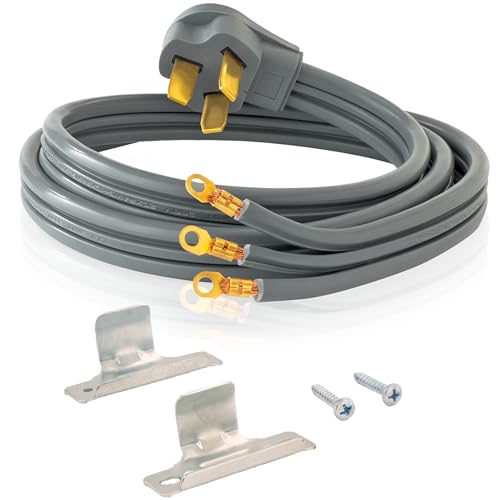
This Eastman 3-prong option is designed for three-conductor power sources, with a neutral wire in the center and two hot outside wires. It remains universal across many major brands and provides a compact 5-foot length. Best for older installations or where a three-wire outlet is standard. It’s important to note that three-prong cords lack a separate ground conductor, which affects modern safety expectations; avoid this if a four-wire connection is feasible.
HiFind 4-Prong Replacement 40 Amp Range Power Cord, 4 Ft

This HiFind cord is built for high-power appliances with 8/10 AWG conductors and a NEMA 14-50P plug, color-coded for straightforward wiring. It emphasizes moisture-proof and high-temperature-resistant insulation, making it suitable for outdoor or challenging environments. Best for DIY installations where outdoor exposure or long-term flexibility matters. A limitation is the 4-foot length may require careful routing in smaller kitchens; consider longer HiFind options if space is tight.
Certified Appliance Accessories 40-Amp Cord, 4 Feet

Certified Appliance Accessories offers a straightforward 4-foot, four-wire power cord that meets industry standards for 250V operation with two 8-gauge and two 10-gauge wires. This option is a practical choice for standard replacements and ensures reliable conductivity. Best for budget-minded buyers who want a dependable, no-frills cord. A potential limitation is fewer length options if your installation requires more reach.
GE WX09X10035 4′ 40 Amp 4-Wire Range Cord

The GE WX09X10035 4-foot range cord emphasizes UL listing and copper wiring for reliable power delivery. Its right-angle plug design helps save wall space, and the 4-wire configuration aligns with modern safety standards. Best for installations requiring a compact footprint and proven copper conductors. Note that the 4-foot length may limit placement flexibility in tight spaces.
Buying Guide: Key Purchase Considerations
- Cord configuration: Choose 4-prong for newer ranges and 4-wire outlets, or 3-prong if you have an older setup and cannot upgrade the outlet.
- Conductor size: Look for 8/10 AWG wires for robust current handling; larger gauges reduce heat under load.
- Length: Match cord length to your space. Longer cords provide flexibility but can add clutter; shorter cords minimize tripping hazards in small kitchens.
- Insulation and weather resistance: For outdoor or damp areas, prefer moisture-proof and high-temperature resistant insulation.
- Safety certifications: UL listing or ETL certification indicate adherence to safety standards; copper wiring improves conductivity and longevity.
- Compatibility: Verify outlet type (NEMA), plug orientation, and appliance brand compatibility to ensure a seamless fit.
- Installation considerations: Some cords include eyelet connectors for easier mounting; wire color coding assists safe, correct connections.
Frequently Asked Questions
- What is the difference between a 3-prong and 4-prong range cord?
A: A 3-prong cord uses a single neutral wire with two hot wires and no separate ground. A 4-prong cord adds a dedicated ground wire for improved safety and is compatible with newer ranges and outlets. - Can I use a 4-prong cord with a 3-prong outlet?
A: No. A 4-prong cord requires a corresponding 4-prong outlet or a properly installed adapter that maintains safety standards. Always follow local electrical codes. - Is copper wiring necessary for a range cord?
A: Copper wiring offers better conductivity and durability, which is the standard for UL-listed cords. Avoid cords with questionable conductor materials. - How long should a stove plug cord be?
A: It depends on your kitchen layout. Typical lengths range from 4 to 6 feet; choose the minimum length that safely reaches the outlet to reduce clutter. - What safety features should I look for?
A: Look for moisture resistance, high-temperature insulation, ETL/UL listings, and molded connectors that resist loosening under load. - Are these cords suitable for outdoor use?
A: Some cords advertise outdoor suitability due to moisture resistance and robust insulation. Check product notes to confirm outdoor compatibility.