Best Automatic Pizza Dough Rollers for Efficient Pizzerias
Answering the buyer’s search for an automatic dough roller, this guide highlights machines that automate pressing, shape dough consistently, and boost throughput. Ideal for cafes, bakeries, pizzerias, and culinary startups, these options are best for operators needing reliable, hands-free dough preparation. The following table summarizes the top five picks and their key strengths for quick comparison.
| Product | Best For | Thickness Range | Throughput (approx.) | Notes |
|---|---|---|---|---|
| VEVOR Pizza Dough Roller Sheeter, 3-16 In | High-volume pizzerias, multi-size pizzas | 1–5.5 mm | 260/hr | Semi-automatic, versatile width |
| Commercial Pizza Dough Roller Machine, 450W | Bakery-counter service, large batch prep | 1–5.5 mm | 260/hr | 450W motor, copper build |
| VEVOR Pizza Dough Roller Sheeter, 3-14 In Automatic | Quick-service kitchens needing automation | 1–5.5 mm | 260/hr | Fully automatic pressing |
| Bepritm Pizza Dough Roller Sheeter, 370W | Small to medium shops, diversified sizes | 4–12 in (diameter range varies) | Varies by size | Dual roller design for efficiency |
| Pizza Dough Roller Sheeter, 4-16″ 110V | Restaurants needing robust stainless design | 0.7–5.4 mm | ~260/hr | Copper motor, sturdy build |
VEVOR Pizza Dough Roller Sheeter, 3-16 Inch

Best for high-volume pizzerias or bakeries needing adjustable width and thickness. This semi-automatic model presses up to 260 pieces per hour and handles dough from 3 to 16 inches in diameter with adjustable thickness from 1 to 5.5 mm. The dual-roller design supports even shaping as dough passes from the upper to the lower roller. Best for shops that want a controllable, semi-automatic workflow. Caution: Operation requires manual transfer between rollers, which may slow down throughput slightly during peak times.
Commercial Pizza Dough Roller Machine, 450W

Best for bakery counters and larger kitchens needing robust copper-motor performance. It presses 260 portions per hour, with a dough range of 3–18 inches and thickness adjustable from 1 to 5.5 mm. The 450W copper motor supports steady throughput and durability. Best for operators prioritizing full automation and high productivity. Limitation: A larger footprint and heavier weight may require dedicated space and installation considerations.
VEVOR Pizza Dough Roller Sheeter, 3-14 Inch Automatic

This fully automatic model is ideal for fast-service environments seeking minimal manual handling. It automatically rotates the dough during pressing for even results, with a 3–14 inch pressing range and 1–5.5 mm thickness control. Best for outlets needing consistent bases with reduced staff involvement. Caution: May require additional spacing for auto-feeding workflows.
Bepritm Pizza Dough Roller Sheeter, 370W

Best for mid-sized shops needing a dual-roller configuration for efficiency. The dual roller design reduces rework and supports adjustable thickness from roughly 0.03–0.21 inches. Suitable for standardized production of various pizza sizes (4–12 inches). Limitations include a broader diameter range that may require precise dough handling to maximize consistency.
Pizza Dough Roller Sheeter, 4-16″ 110V

Best for robust, stainless steel builds with a reliable 370W copper motor. It handles 0.7–5.4 mm thickness and 4–16 inch dough sizes. The dual-roller design improves efficiency and consistency for busy kitchens. Choose this if you need durability and a strong, long-lasting machine. Caution: Ensure adequate clearance for the conveyor and rollers during operation.
Pizza Dough Roller Sheeter, 4-16″ 370W

Best for professional kitchens needing precise thickness control and high throughput. It supports 0.7–5.4 mm thickness and 4–16 inch dough sizes with a 370W motor. The stainless construction and adjustable thickness make it suitable for a range of pizza styles. Limitation: The precise thickness control may require familiarization for first-time users.
Commercial and Home Electric Dough Sheeter
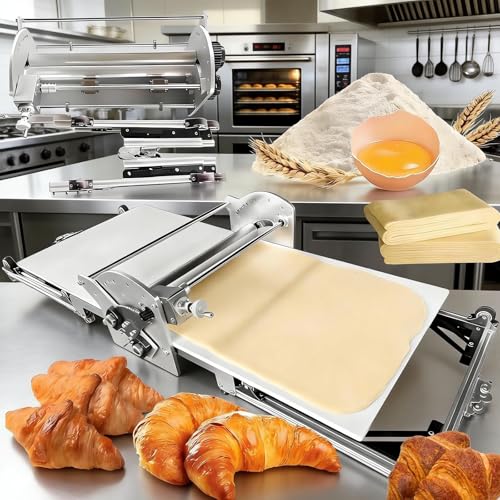
Best for bakeries and pastry shops needing a reversible conveyor for consistent sheet rolling. It features a 40 x 17.7 inch table, adjustable thickness from 2 mm to 30 mm, and 304 stainless steel contact surfaces for easy cleaning. Choose this if you require broad sheet capabilities and a reverse feature for precise dough handling. Caution: Larger footprint may require dedicated workspace.
Buying Guide
What to consider when choosing an automatic pizza dough roller:
- Throughput needs: Look for machines advertised around 240–260 pieces per hour if you operate a busy pizzeria or bakery.
- Diameter and thickness range: Confirm the maximum dough diameter and adjustable thickness to fit your menu (thin crust vs. thick crust).
- Power and build quality: Copper motors and stainless steel construction indicate durability in commercial settings.
- Automation level: Semi-automatic vs fully automatic affects labor needs and workflow integration.
- Safety and footprint: Pay attention to safety features (overload protection, foot switches) and the machine’s size for your kitchen.
- Maintenance needs: Machines with simple disassembly and easy-to-clean rollers reduce downtime.
Frequently Asked Questions
- What is the typical dough thickness range for these machines? Answer: Most models offer around 0.7–5.5 mm, with some variants able to reach 1–5.5 mm depending on the design.
- Are automatic roller machines suitable for all dough types? Answer: They work best with standard pizza dough and pastry dough; very sticky or highly hydrated dough may require adjustments or pre-conditioning.
- Do these machines require special installation? Answer: Some models are compact and plug-in, while larger units may need space planning and electrical considerations in a commercial kitchen.
- Is automatic operation safer than manual rolling? Answer: Automated rollers reduce repetitive strain but still require attention to safety protocols and training for operators.
- What maintenance helps extend life? Answer: Regular cleaning, proper lubrication of moving parts, and periodic inspection of rollers and guards help maintain performance.
- Which model is best for small bakeries? Answer: Models with adjustable thickness, compact footprint, and lower throughput are often ideal for smaller setups seeking efficiency gains without excessive space use.