Best Ceiling Island Range Hood Solutions for Modern Kitchens
Looking for a ceiling-mounted island vent hood that delivers strong suction, versatile installation, and bright lighting? This guide reviews five top island ceiling mount hoods and explains who each is best for. Each option adapts to ducted or ductless configurations, making them suitable for different kitchen layouts and noise preferences. The selections emphasize high CFM for open layouts, durable stainless steel construction, and user-friendly controls.
Buyer profile snapshot:
– Best for large open-plan kitchens needing high airflow (1000+ CFM): FIREGAS 36″ and RAPSUAR 36″ models.
– Best for compact islands with quiet operation: 30″ JOEAONZ and JOEAONZ Gesture models.
– Best for balanced performance and easy maintenance: FIREGAS 30″ island hood and JOEAONZ 30″ with 700 CFM.
Summary of top picks
| Product | Best For | CFM / Power | |
|---|---|---|---|
| FIREGAS Island Range Hood 30 inch | Mid-size island with strong filtration | 700 CFM | |
| JOEAONZ 30 inch Island Range Hood | Quiet operation with solid airflow | 700 CFM | |
| JOEAONZ Island Range Hood 30 Inch Gesture & Touch | Hands-free control lovers | 700 CFM | |
| FIREGAS Island Range Hood 36 inch | Large kitchen islands | 700 CFM | |
| RAPSUAR 36 inch Island Range Hood | Maximum airflow with modern controls | 1200 CFM |
FIREGAS Island Range Hood 30 Inch

This 30-inch FIREGAS island hood offers 700 CFM with a three-speed fan and four LED lights. It supports both ducted and ductless configurations, making it flexible for various kitchen layouts. The appliance includes two baffle filters and oil cups for grease capture plus charcoal filters for odors. Best for mid-sized islands where strong ventilation and bright, even lighting are priorities. A limitation is that higher speeds may produce noticeable fan noise for extremely open spaces.
JOEAONZ 30 Inch Island Range Hood
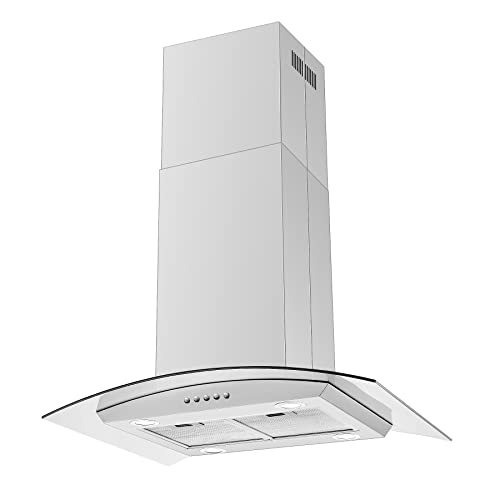
JOEAONZ’s 30-inch model delivers 700 CFM with a ducted design and a 5-layer filter system. It features durable 430 stainless steel and a curved tempered glass canopy for a clean, modern look. Best for cooks who value strong airflow with straightforward maintenance via dishwasher-safe filters. Best for medium-sized islands where discreet noise levels at high speed are important. A potential limitation is that the top hood design may require careful ceiling clearance during installation.
JOEAONZ 30 Inch Gesture & Touch Control Hood

JOEAONZ’s gesture and touch control model provides intuitive operation with 700 CFM, a three-speed fan, and two dishwasher-safe filters. Best for tech-forward kitchens where convenience and sleek controls matter. Choose this if you want touchless or simple manual control. A minor caveat is that advanced controls may require a short adjustment period for new users.
FIREGAS Island Range Hood 36 Inch

This 36-inch FIREGAS hood uses 700 CFM with three speeds and four LED lights. It includes stainless steel baffle filters and the option for either ducted or ductless installation, suitable for larger islands or open-plan kitchens. Best for homeowners needing high airflow across a wider cooking surface. Limitation: installation may require more ceiling clearance and ducting planning due to size.
RAPSUAR 36 Inch Island Range Hood

RAPSUAR delivers a high-end 36-inch ceiling-hung hood with 1200 CFM and dual motors for maximum suction. Four-speed control and four LED lights illuminate the cooking area while delivering robust ventilation. Best for large kitchens with heavy cooking loads or households that prioritize rapid odor clearance. A caution is potential higher energy use at peak speed and slightly louder operation at maximum CFM.
Buying Guide: Key Considerations For Island Ceiling Hoods
What size hood should you choose? For most island setups, match the hood width to the island width: 30-inch hoods fit smaller islands; 36-inch hoods suit larger islands and open-plan kitchens. Consider ceiling height and ducting options: ducted systems offer stronger performance and odor removal, while ductless recirculation is easier to install in spaces without exterior ducting.
Airflow and noise
Higher CFM provides faster removal of smoke and odors, but can increase noise. Look for models with insulated housings, multi-speed controls, and low-noise operation at higher speeds if your space is open and living areas are nearby.
Filtration and maintenance
Grease filters should be easy to remove and dishwasher-safe when possible. Charcoal filters help with odors in ductless setups. Check whether filters are reusable and how easy they are to replace.
Controls and usability
Gesture and touch controls provide modern convenience, while traditional push-button controls remain reliable. Consider the ease of use with cooking gloves, hand movements, and whether the hood supports delay-off timers for post-cooking ventilation.
Lighting and aesthetics
LED lighting enhances visibility around the cooking area. Ensure the lighting is bright and evenly distributed. Aesthetics should align with kitchen design, including stainless steel finishes and glass canopies.
Installation considerations
Verify ceiling height, duct run length, and mounting options. Some models offer both ducted and ductless configurations, but you may need additional components (like recirculation kits) for ductless operation.
FAQ
- What is a good CFM for an island hood? A range between 700 and 1200 CFM covers most residential islands; larger kitchens or frequent high-heat cooking benefit from higher CFM like 1200.
- ducted vs. ductless which is better? Ducted eliminates odors more effectively and offers higher performance; ductless is easier to install in spaces without exterior venting but relies on filters to recirculate air.
- Are LED lights standard on island hoods? Yes, most models include LED lighting to illuminate the cooking area; check lumen output and dimming options.
- How important are filters? Filters prevent grease buildup and odors. Dishwasher-safe filters save maintenance time; ensure replacement filters are readily available.
- Can I install a ceiling island hood myself? Installation often requires ceiling mounting, ducting, and electrical connections. A professional installer is recommended for safety and proper function.
- What maintenance is required? Regularly clean filters, wipe the canopy, and inspect ducting for blockages or buildup to maintain optimal performance.