Best Ceramic Stick Knife Sharpener for Everyday Kitchen Needs
When choosing a ceramic stick knife sharpener, focus on edge control, safety, and suitability for your blade types. This guide highlights five top picks that cover different uses—from compact travel sets to long-hone options for professional kitchens. The best choice depends on your knives, skill level, and storage needs. Below, you’ll find a quick product summary and practical buying tips to help you pick the right ceramic sharpening rod system or honing rod.
Summary Table of Selected Products
| Product | Best For | Key Benefit | Angle/Grain Details |
|---|---|---|---|
| Feekoon 9.8″ Ceramic Crock Knife Sharpener | Home cooks with limited space | Two preset angles in a compact bamboo turn box | 30° and 40° |
| Arkansas Sharpeners Ceramic Sharpening AC46 | Traditionalists seeking US-made | Wood handle, sturdy setup | Standard honing geometry |
| Shenzhen Knives Ceramic Honing Rod 12 Inch | Full-blade coverage for hard steels | Long 12″ rod with built-in guard | 1000 grit |
| Kimura Professional Ceramic Honing Rod, 10 Inch | Versatile chef use | 1200 grit finish, ergonomic handle | 1200 grit |
| Lansky Master’s Edge Kitchen Knife Sharpener | Guided angle sharpening | Multiple fixed angles for different blades | 17°, 20°, 25° presets |
Feekoon 9.8″ Ceramic Crock Knife Sharpener

This compact sharpening set sits in a bamboo turn box, designed for quick maintenance with minimal clutter. It contains two 1500 grit ceramic rods and a built-in angle guide, preset at 30° and 40°. Best for home cooks who want a simple, space-saving sharpener that can handle kitchen blades and some utility knives. The dual-angle design means you can sharpen larger blades at the 30° setting and switch to the obtuse 40° for smaller or pocket knives. A potential limitation is the fixed angles, which may not fit specialty blades. Ideal for: daily kitchen knives, fillet knives, and utility blades.
Arkansas Sharpeners Ceramic Sharpening AC46
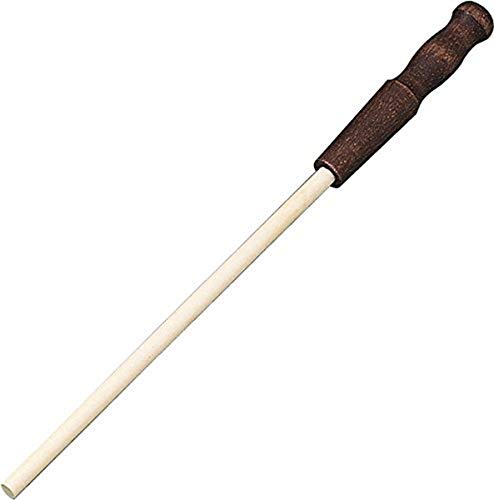
With a classic wood-handled design and US-based production, this option emphasizes durability and traditional setup. It’s best for users who prefer a solid handfeel and straightforward honing. The product highlights a bulk-pack style that suits kitchens needing multiple sharpeners for different knife families. The main limitation is that it emphasizes general purpose sharpening rather than advanced ceramic rod micro-honing. Best for: professional kitchens or home cooks seeking a reliable, rustic tool for routine blade maintenance.
Shenzhen Knives Ceramic Honing Rod 12 Inch
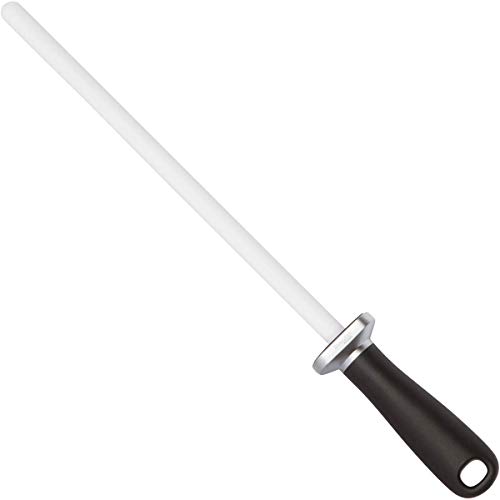
This long 12-inch ceramic rod covers full-length blades with a built-in rectangular guard to protect your hand and counter. It uses 1000 grit ceramic alumina, which realigns the edge without excessive metal removal. It’s best for straight-edged stainless and harder steels and for cooks who want confident control while honing large knives. A caveat is that the rod requires a flat surface and stable placement to prevent slips. Choose this if you regularly sharpen long chef, carving, or hunting knives.
Kimura Professional Ceramic Honing Rod, 10 Inch

Kimura’s 10-inch honing rod uses a pure white ceramic with a 1200 grit finish. The handle is an ergonomic, non-slip polypropylene design for comfortable, steady honing. This rod is versatile for a range of kitchen knives, from chef to paring blades, and includes a hanging loop for easy storage. Best for cooks who want a fine, polished edge with reliable handling. Limitation: the 1200 grit finish may not remove heavy burrs as quickly as coarser options, so consider initial sharpening if blades are very dull.
Lansky Master’s Edge Kitchen Knife Sharpener

The Lansky system offers fixed-angle sharpening options with multiple presets: 17°, 20°, and 25°. This makes it a strong choice for knives that benefit from precise geometry and repeatable results across many blade types. It’s best for aspiring sharpeners who want guided accuracy and a scalable approach to maintaining edges. A possible limitation is that fixed-angle systems can be less forgiving for irregular blades or very soft steel, where micro-adjustments would be desirable.
Buying Guide: Ceramic Knife Sharpening Essentials
- What is your primary knife type? For long chef blades, a 12″ rod or longer is advantageous; for paring knives, shorter or boxed systems with preset angles work well.
- What edge do you want to maintain? 1000–1500 grit rods are common; finer grits refine edges, while coarser grits remove burrs and restore dull blades.
- Angles and compatibility: Fixed-angle sharpeners are easiest for consistent results; adjustable or dual-angle designs offer flexibility for different blades.
- Maintenance and safety: Look for built-in guards or non-slip handles. Ceramic rods resist corrosion and rust, but require stable placement to avoid slips.
- Portability vs. durability: Compact, bamboo turn boxes save space for home use; heavier, US-made designs might suit professional kitchens better.
Frequently Asked Questions
- What is the difference between a honing rod and a sharpener? A honing rod realigns the edge, while a sharpener actually removes material to create a new edge.
- Can ceramic rods sharpen all knives? Ceramic rods work best on straight-edged blades and can improve edge durability, but some knives may require metal abrasives for heavy re-shaping.
- Are preset angles enough for most home cooks? For most kitchen knives, 15–25 degrees per side is typical; fixed-angle devices simplify routine maintenance.
- Is a longer rod better for larger knives? Yes, longer rods cover more surface area and enable a consistent stroke from heel to tip.
- Do ceramic rods dull quickly? Ceramic is hard and durable, but grit and proper use determine longevity; avoid excessive pressure and use light strokes.