Best Chicken Egg Hatching Machines for Home Use
Answering a buyer’s search for reliable hatching equipment, these incubators cover a range of capacities from 12 to 48 eggs and include features like automatic turning, humidity control, built-in candlers, and 360° visibility. They’re best for beginners seeking ease of use, educators building STEM demonstrations, and hobbyists aiming to improve hatch rates. The following top picks reflect a balance of capacity, automation, and user-friendly design to suit different poultry-raising goals.
| Product | Egg Capacity | Key Feature | Best For |
|---|---|---|---|
| MATICOOPX 20 Egg Incubator | 20 | External water refill, built-in egg candler | Small family projects |
| Onsju 18 Egg Incubator | 18 | Smart turning, precise temperature & auto humidity | First-time users |
| MATICOOPX 30 Egg Incubator | 30 | Humidity display, egg candler | Mid-size hobbyists |
| MYMULIKE Incubator | 12 | 360° viewing window, integrated LED candler | Education & family projects |
| Dovnis 48 Egg Incubator | 48 | External water refill, auto turn, digital display | Advanced home setups |
MATICOOPX 20 Egg Incubator With Humidity Display

Best For: Small households and new hatchers seeking a compact, automated unit with observation features. Features include a stable temperature via a circulating airflow system, external water refilling to prevent temperature drops, and a built-in egg candler for embryo observation. This model supports easier monitoring and consistent hatch conditions. A potential limitation is the smaller capacity, which may require more frequent cycles for larger flocks.
Onsju 18 Egg Incubator

Best For: Beginners and classrooms needing smart turning and tight humidity control. It offers precision temperature control, an auto-regulated humidity system, and customizable turning intervals. The unit helps maximize hatch rates with audible and visual alerts for abnormal conditions. Choose this if you want robust automation without manual interventions, but be mindful of the need for occasional refills as eggs age.
MATICOOPX 30 Egg Incubator

Best For: Mid-size hobbyists needing more capacity while preserving automation. It includes stable temperature control, external water refilling, and a built-in candler for embryo observation. This model is a step up in capacity without sacrificing ease of use. Limitation: larger units may require more space and power while operating continuously.
MYMULIKE Incubator With 12 Eggs

Best For: Educational use and family projects, thanks to a 360° clear window and an integrated egg candler. It emphasizes real-time visibility and safe observation without opening the lid. A caveat is the smaller capacity for larger hatchery plans, making it ideal for learning or small-scale experiments.
Dovnis 48 Egg Incubator
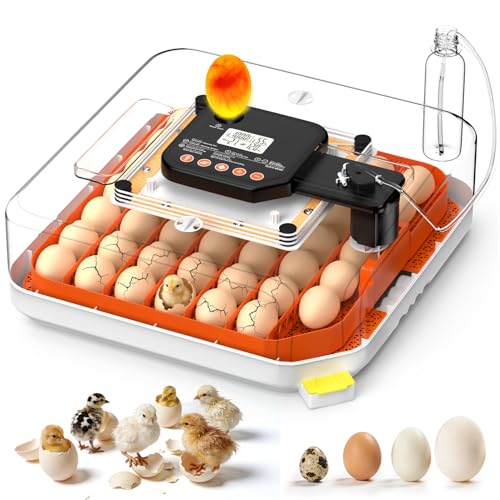
Best For: Users seeking higher capacity with strong automation. Features include auto turning, digital temperature and humidity control, external water refill, and a built-in egg candler with 360° view. The larger footprint is best for steady, ongoing hatch projects, but the complexity might require a longer setup and monitoring period.
Buying Guide
- Capacity and growth: Choose capacity based on flock size and available space. Start small if new to incubation, or opt for 30–48 eggs for ongoing projects.
- Automation level: Automatic turning and humidity control reduce hands-on work and improve consistency. Consider models with automatic stop-before-hatch to protect embryos.
- Monitoring features: Built-in candlers and 360° visibility help observe development without opening the lid, preserving stable conditions.
- Temperature and humidity control: Look for digital displays, PID or precise regulation, and external water refill to minimize temperature swings.
- Ease of use and maintenance: External refill ports, removable trays, and simple cleaning processes reduce maintenance time and error.
- Educational value: If the unit is for classrooms or kids, prioritize transparent lids and safe observation features.
Frequently Asked Questions
- What is the most important feature in a chicken egg incubator?
– Consistent temperature and humidity control to maximize hatch rates. - Why is external water refill useful?
– It prevents temperature drops when adding water, maintaining stable incubation conditions. - Do incubators automatically stop turning before hatch?
– Many models include a programmed stop to protect embryos in the final stage. - Is 360° visibility necessary?
– It helps monitor development without opening the lid, reducing disturbance. - What capacity should a beginner choose?
– A smaller unit (12–20 eggs) minimizes risk while learning basic incubation steps. - Can incubators be used for other birds?
– Some models support chicken, duck, quail, pigeon, and goose eggs with adjustable presets.