Best Commercial Grade Panini Presses for Pro Kitchen Needs
Direct answer: For high-volume, durable, restaurant-ready performance, a commercial-grade panini press with generous cooking surfaces, strong temperature control, and easy cleanup is essential. This guide highlights five top options and explains who each product is best for, including potential limits to consider. Ideal buyers include cafe owners, catering services, hotel kitchens, and any operation needing fast, consistent panini and grilled sandwiches. Below is a quick at-a-glance table of the chosen models to compare core specs and use cases.
| Product | Best For | ||
|---|---|---|---|
| HTTSICHI Commercial Panini Press | High-volume cafés | Fast heating, large 14×9 inch surface | Cast-iron plates require careful seasoning |
| Kratos Commercial Electric Panini Grill | Restaurants needing reliability | Heavy-duty build, 18.7×9 inch surface | Higher power draw |
| EGGKITPO Commercial Panini Press | Home-based commercial setups | Two large ribbed plates, adjustable temp | Enamel plates need careful care to avoid scratching |
| Waring Commercial Panini Press | Small to medium kitchens | Compact stainless build, good heat spread | Smaller cooking area than full-size models |
| POPFOODEX Commercial Panini Press | Catering and high-volume kitchens | Very large 19×9 inch surface, dual-zone temp | Higher energy usage |
HTTSICHI Commercial Panini Press Overview
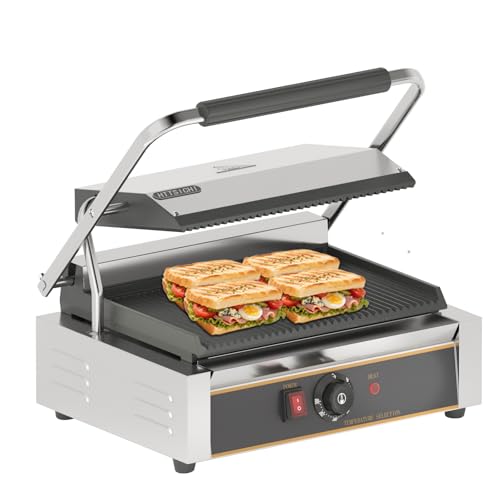
This 2200W unit targets high output with a 14×9 inch cooking area. It heats quickly to a set temperature and maintains consistent upper and lower heat for even browning. The nonstick, cast-iron griddles support heavy use and easier cleaning due to a removable drip tray. Best for: cafes or kitchens that need to produce multiple sandwiches quickly with reliable heat control. Caution: cast-iron plates require proper season and care to prevent sticking over time.
Kratos Commercial Electric Panini Grill

Kratos offers heavy-duty stainless-steel construction with two grooved cast-iron plates on a sizeable 18.7″ x 9″ cooking area. It’s designed for true commercial use, with a dedicated heat indicator, easy-to-use dial controls, and a removable grease tray. Best for: busy kitchens that need reliable, high-output grilling with distinct grill marks. Caution: only suitable for commercial settings; improper non-commercial use may void warranties.
EGGKITPO Commercial Panini Press

EGGKITPO combines two large ribbed enamel plates with dual 110–120V operation and 1700W power for quick, even heating. It’s designed for both home kitchens that require commercial-like throughput and smaller food service setups. Best for: operations needing robust dual plates and adjustable temps to handle a variety of sandwiches and breakfasts. Caution: enamel plates require careful cleaning to prevent surface damage and food sticking if not seasoned properly.
Waring Commercial Panini Press
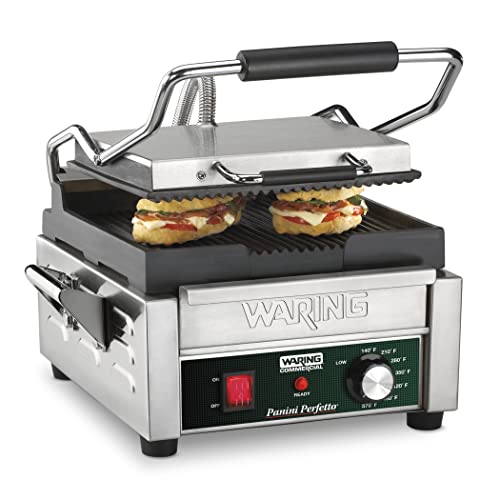
Waring’s Panini Press emphasizes a compact stainless-steel build with ribbed cast-iron plates for even heat distribution. It suits small to medium kitchens that need dependable performance and a removable drip tray for easier cleanup. Best for: kitchens prioritizing space efficiency without sacrificing grill quality. Caution: cooking surface area is smaller than some full-size commercial models, limiting batch size per cycle.
POPFOODEX Commercial Panini Press

POPFOODEX delivers a massive 19″ x 9″ cooking surface with dual-zone temperature control, enabling parallel cooking of different items. Its deep grooved top and flat bottom provide authentic grill marks and a large flat griddle area. Best for: catering or high-volume kitchens needing maximum batch capacity and flexible multi-temperature cooking. Caution: higher energy draw due to the large surface and dual-zone controls.
Buying Guide: Key Considerations For Commercial Panini Presses
Capacity and footprint matter. Choose a model with a cooking surface that fits your typical batch size and kitchen space. A larger surface increases output but takes up more counter or requires a cart setup for mobility.
- Power and heat-Up Time: Look for high-wattage units (1800W–3600W) for fast preheat and consistent performance during busy periods.
- Temperature Range and Control: A broad, accurate temperature range (roughly 122°F–572°F or 50°C–300°C) with precise dial or digital controls helps handle a variety of sandwiches, paninis, and grilled items.
- Plate Material and Coating: Cast-iron plates with nonstick coatings provide durability and easy cleanup. Enamel-coated plates offer low maintenance but require proper care to avoid scratches.
- Grease Management: Removable grease trays or drip pans simplify cleaning and reduce buildup that could affect performance.
- Build Quality: Stainless steel exteriors resist corrosion and are easier to sanitize in commercial environments. Check for heavy-duty hinges, safe handles, and stability features.
- Certification and Use Case: Some models are explicitly designed for commercial use and require professional-grade installation or electrical supply. Ensure compatibility with your venue’s electrical system.
FAQs
- What is the typical cooking surface size I should look for in a commercial unit?
Most high-volume units offer at least 14″ x 9″ to 19″ x 9″ surfaces; larger surfaces boost batch output but require more space.
- Are commercial panini presses easy to clean?
Systems with removable drip trays and enamel or nonstick coatings simplify cleaning. Regular maintenance prevents sticking and prolongs plate life.
- Can these presses handle non-sandwich items?
Yes, many models can grill vegetables, burgers, and small fish; always follow manufacturer temperature recommendations for different foods.
- Is a dual-zone temperature control beneficial?
Yes for catering or varied menus, enabling simultaneous cooking of different items at different temps to optimize throughput.
- Do commercial models require professional installation?
Some do, especially higher-wattage units; verify electrical requirements before purchase.