Best Commercial Induction Cooktops for 6-Burner-Style Stations (Portable Options)
If you’re equipping a busy kitchen with multiple induction zones, these commercial-grade options help simulate a 6-burner setup in a compact footprint. This guide focuses on high-output, durable units suitable for restaurants, catering, or large-home kitchens. The top picks below are chosen for reliability, ease of use, and strong heat control. Best for operators needing scalable, energy-efficient heat with precise timing and robust construction.
| Product | Power (W) | Key Feature | |
|---|---|---|---|
| VEVOR Induction Cooktop | 3500 | 11-level temp control; 3-hour timer; stainless steel | High-output portable unit for busy prep lines |
| ChangBERT Induction Cooktop NSF Pro Edition | 1800 | NSF certified; Schott glass; large heating coil | High-traffic kitchens needing NSF-grade durability |
| ChangBERT NSF Professional Chef Edition | 1800 | Schott glass; NSF certified; expanded heating zone | Restaurants and food stations needing reliable power |
| TERUISI Induction Cooktop Commercial | 1800 | 6 presets; 8 temp levels; 4-hour timer | Compact, durable counter-top option for small stations |
| Duxtop Professional Portable Induction Cooktop | 1800 | 20 power levels; LCD sensor touch | Portable but capable backup or supplementary burner |
Note: All products listed are portable or countertop units that can be combined to approximate a 6-zone setup in a compact environment. When selecting, consider exact power needs, cookware compatibility, and safety features for continuous commercial use.
VEVOR Induction Cooktop With 11-Level Temp Control

Best for: Small commercial kitchens and prep areas needing a high-power portable burner. The 3500W output enables rapid heating for soups, beans, meats, and pasta. The 11 temperature levels provide precise control for searing and simmering. A 3-hour timer helps manage plate timing in busy service windows. Limitations: As a single burner, it won’t replace a multi-station induction setup, but it serves as a reliable core unit for a larger station plan.
ChangBERT Induction Cooktop NSF Certified Portable Cooker
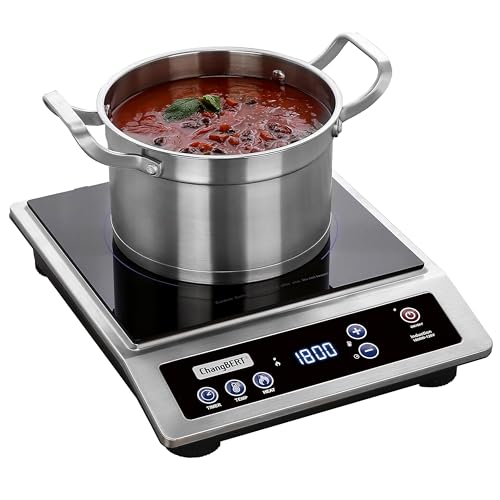
Best for: NSF-certified environments requiring reliable, consistent performance. This unit emphasizes energy efficiency (up to 83%) and a large cooking area with an expanded coil. It’s designed for constant use in professional settings, with a robust stainless steel build. Limitation: 1800W power means it’s best paired with other burners for higher-volume service rather than serving as a single main station.
ChangBERT Induction Cooktop NSF Professional Chef Edition

Best for: High-demand service lines where guests expect visible, fast cooking stations. The polished stainless steel and Schott ceramic surface are designed for heavy-duty use and easy cleaning. The 1800W output with an expanded heating zone improves heat distribution. Caution: The 83% energy efficiency means more cookware accuracy is needed for maximum performance across large pots.
TERUISI Induction Cooktop Commercial

Best for: Restaurants or hotels needing a robust, compact counter-top burner. It offers strong safety features with overcurrent protection and auto shut-off on overheating, plus a 4-hour timer. The unit’s stainless steel body supports aggressive cleaning schedules. Limitation: At 1800W, it may require parallel burners for high-volume cooking lines to maintain throughput.
Duxtop Professional Portable Induction Cooktop
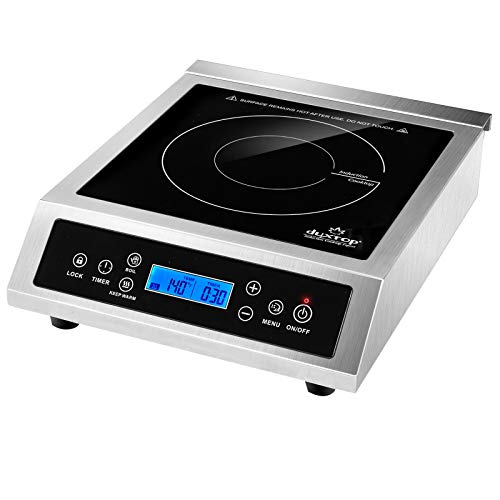
Best for: Backups or supplementary zones in a busy kitchen due to its portability and 20 preset levels. It’s ETL listed and designed for standard North American outlets, making it a practical addition to an existing multi-station setup. Caution: Portable units may require careful cord management in crowded kitchens and should be used alongside more permanent burners to handle peak demand.
Buying Guide: Key Purchase Considerations
Temperature range and power density: Higher wattage accelerates boil times and allows more demanding preparations. Look for units with 1800–3500W output for better performance in commercial settings.
Durability and surface: NSF certification, Schott glass, and corrosion-resistant stainless steel are indicators of long-term suitability in busy kitchens.
Control and timers: Precise temperature control (multiple presets) and programmable timers help manage cooking windows and plating timelines.
Portability vs. fixed installation: Portable induction burners are flexible for staging, back-up lines, and mobile stations, while countertop units with robust construction suit permanent lines.
Safety features: Look for auto shut-off, overcurrent/overvoltage protection, and cookware recognition to prevent accidents in fast-paced environments.
Frequently Asked Questions
- Can I run multiple induction burners to simulate a 6-burner setup? Yes, using several compatible units in a station layout can approximate a six-zone system, providing scalable heat control.
- Are NSF-certified models better for commercial use? NSF certification signals compliance with safety and sanitation standards, which is valuable for high-traffic kitchens.
- What cookware is required for best performance? Magnetic-based cookware (cast iron, certain stainless steel) works with induction; ensure pots and pans are compatible.
- Is 1800W enough for heavy restaurant use? For high-volume service, pairing multiple 1800W units with higher-w power burners is advisable to maintain throughput.
- How important is a built-in timer? A timer helps manage cooking stages and plate timing in busy services, reducing order handling delays.
- Do these units require special electrical circuits? Some units use standard 120V outlets, while higher-power models may require dedicated 20A or higher circuits; verify electrical requirements before purchase.