Best Cutting Edge Knife Sharpener for Home Cooks and Pros
Direct answer: For sharpening knives with reliability and variety, choose a multi‑stage or angle‑guided sharpener that matches your blades and skill level. This guide covers five top options that balance safety, precision, and ease of use for everyday cooks, hobbyists, and professional kitchens. Each pick is evaluated by what it excels at, who benefits most, and any practical limitations you should know before buying.
Summary table of chosen products:
- SHARPAL 191H Knife Scissors Sharpener — Best all‑around versatility for blades and scissors.
- EDOVEN Knife Sharpener Tool — Best for beginners seeking simple, predictable 15°/20° angles.
- Kitchellence 4‑in‑1 Knife Sharpener — Best for safety with a cut‑resistant glove and 3‑stage restoration.
- Wicked Edge Venture WE20 — Best for portability and precise fixed angles in a compact form.
- Longzon 5‑in‑1 Knife Sharpener — Best for comprehensive stage options and safety features.
SHARPAL 191H Knife Scissors Sharpener

The SHARPAL 191H is a 3‑stage sharpening tool designed for versatility. It uses tungsten carbide blades for quick edge setting, ceramic blades for precise honing, and a dedicated tungsten carbide slot for sharpening scissors. It also features an enhanced suction base for stability on smooth surfaces and a user‑friendly design that accommodates both right and left‑handed users. Best for: home cooks who want a single device to handle kitchen knives and scissors with dependable stability. Limitation: the suction base works best on perfectly smooth countertops.
EDOVEN Rolling Knife Sharpener Kit

The EDOVEN sharpener uses a rolling, two‑stage system with a 15° and 20° magnetic angle guide. It combines a 400‑grit diamond disc for edge repair with a 6000‑grit ceramic disc for polishing, delivering a razor‑sharp finish. Best for: beginners and professionals who want consistent results with minimal technique. Limitation: fixed angles may be less adaptable for specialized blades or unusual edge shapes.
Kitchellence 4‑in‑1 Knife Sharpener
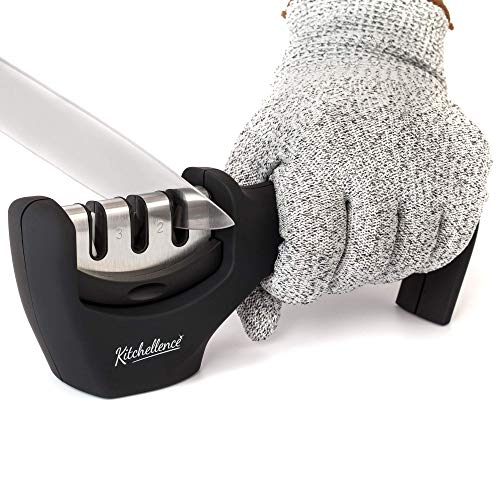
The Kitchellence 4‑in‑1 sharpener offers a 3‑step sharpener plus a solid base and a cut‑resistant glove. Its three stages (diamond repair, coarse sharpening to rebuild the V‑edge, and fine polish) provide a quick restoration for a range of blades. Best for: cooks who want a safe, all‑in‑one solution with included protective gear. Limitation: may require extra passes for very dull or severely damaged blades.
Wicked Edge Venture WE20 Hand Guided Sharpener

The Wicked Edge Venture WE20 features a patent‑pending angle guide that delivers consistent 20° sharpening with a compact, ultra‑portable design. It includes a dual‑sided sharpening system (500‑grit diamond stone and fine ceramic hone) and offers potential to expand angles with separate knife guides. Best for: outdoor cooks or travelers who need precise sharpening on the go. Limitation: expands with optional accessories rather than built‑in multiple stages.
Longzon 5‑in‑1 Knife Sharpener

The Longzon 5‑in‑1 sharpener offers four stages plus a safety feature: a deck with a dedicated slot sequence for damaged blades, regular sharping, fine polishing, plus a cut‑resistant glove. It is designed to sharpen blades, kitchen scissors, and other edge tools. Best for: households needing a comprehensive, safe sharpening workflow in a single tool. Limitation: four or more stages can require more time per blade compared to simpler units.
Buying Guide
What to consider before buying a knife sharpener:
- Sharpening style: Do you prefer pull‑through, fixed angle, or freehand blade guides? Fixed angles provide consistency, while pull‑through devices are faster for casual use.
- Blade compatibility: Ensure the sharpener handles kitchen and serrated blades, or that it includes a dedicated slot for scissors if needed.
- Stages and grit: More stages help with damaged blades and long‑term maintenance. Diamond abrasives excel at edge setting; ceramic helps polish.
- Safety features: A secure base, non‑slip footing, and optional cut‑resistant gloves reduce risk during sharpening.
- Portability and space: Compact models are ideal for small kitchens or travel; larger units suit stationary home setups.
- Maintenance: Look for easy cleaning and minimal parts that can wear out. Compatibility with common blade types matters for longevity.
FAQ
- What is the difference between diamond and ceramic sharpening stages?
– Diamond stages reshape and repair dull edges quickly, while ceramic stages fine‑tune and polish for a razor‑sharp finish. - Should I sharpen serrated knives with a standard sharpener?
– Some sharpeners include serrated slots; if not, avoid forcing blades through unsuitable guides to prevent damage. - Is a cut‑resistant glove necessary?
– It adds safety when handling sharp blades, especially for beginners or households with kids. - Can I carry a handheld sharpener when traveling?
– Yes, portable models like the WE20 are designed for on‑the‑go use, though check airline rules for metal tools in carry‑ons. - How many passes does a blade typically need?
– Most blades require 2–4 passes per stage, depending on dullness and blade type. Follow the device’s guidance for best results. - Do these sharpeners fix chipped blades?
– Some devices repair minor chips by reshaping the edge; extremely damaged blades may require professional repair or replacement.
All products listed are aimed at helping buyers select a cutter edge sharpener that matches their needs—from quick edge setting to precise, guided honing. Each option is designed to balance safety, ease of use, and edge quality across a variety of blade types.