Best Digital Freezer Thermometer With Alarm for Secure Food Storage
If you need precise, ongoing temperature monitoring for fridges and freezers, a digital thermometer with alarm is essential. This guide highlights five reliable models ideal for homes, small businesses, and restaurants. Each product offers real-time readings, alarm notifications, and easy mounting options. The selections prioritize accuracy, ease of use, and remote monitoring capabilities. The buyer-suitable notes indicate who benefits most from each option. A quick comparison table follows to help you decide at a glance.
| Product | Key Benefit | Best For |
|---|---|---|
| AcuRite 00515M | Two-sensor display for fridge and freezer | Home cooks and small cafes |
| GoveeLife 2-Pack B0CLB358BJ | WiFi-enabled with remote alerts | Busy households and offices |
| ORIA B0FBRC7T8J | Color LCD, dual sensors, smart alerts | Multi-room monitoring |
| MOCREO B0CZ8ZSP67 | App alerts, no subscription, 2 sensors | Tech-forward homes |
| U UNNI B0DR29WR1Y | Backlit display, USB or battery power | Versatile mounting options |
AcuRite Digital Wireless Thermometer with Alarm

The AcuRite 00515M offers two sensors and transmits readings to a single digital display. It includes a refrigerator thermometer and a freezer thermometer, with an easy-to-read LCD display and mounting options for magnetic backs, wall mounting, or countertop use. The device supports customizable temperature alarms to alert you to door-open events or equipment failure. Best for homeowners and small kitchens needing simple, reliable dual-sensor monitoring.
Who it’s best for: households or small restaurants needing two-sensor coverage without complex setup. Limitations: may require periodic battery changes; no advanced remote monitoring beyond the built-in display.
GoveeLife WiFi Refrigerator Thermometer, 2-Pack

This 2-pack from GoveeLife supports 24/7 alarms and real-time remote monitoring via an app. It’s designed for homes and small offices, with a gateway capable of handling multiple sensors and remote notifications when temperatures drift outside preset ranges. Best for users who want remote access and alerting without standing by a display. Consider potential compatibility limits to 2.4 GHz Wi‑Fi.
Best for: users seeking wireless, app-based alerts across multiple devices. Caution: requires a compatible 2.4 GHz Wi‑Fi network and gateway setup.
GoveeLife 2-Year Data Export Refrigerator Thermometer

Another GoveeLife option emphasizes data export, enabling longer-term record keeping for audits or seasonal tracking. It provides smart alerts, a high-precision sensor, and remote monitoring, suitable for households that want data analytics alongside live monitoring. Best for users who value historical data along with ongoing temperature monitoring.
Best for: households or small businesses that log temperature trends over time. Limitation: 2.4 GHz Wi‑Fi requirement may restrict some environments.
ORIA Wireless Dual-Sensor Thermometer

The ORIA model displays two temps on a color LCD and supports min/max history with smart alerts and a delay function to avoid false alarms from brief door openings. It’s well-suited for homes or small kitchens needing simultaneous fridge/freezer monitoring and trend awareness. Best for those wanting clear visual cues and simple historical data at a glance.
Best for: users who want quick dual-sensor visibility and customizable alerts. Limitation: alarms may be sensitive if delay settings are not tuned to door-opening habits.
MOCREO WiFi Freezer Thermometer Alarm
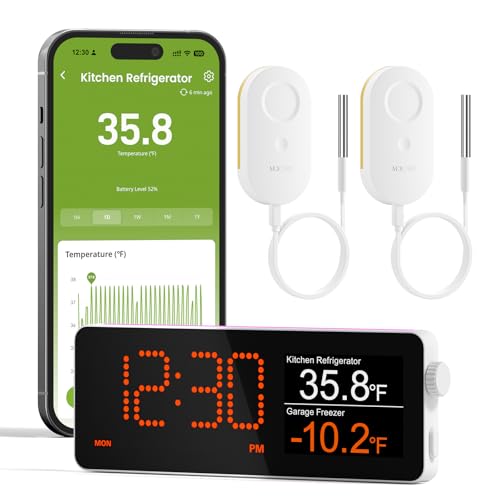
The MOCREO hub-centric thermometer offers a digital display, app alerts, and 2 remote sensors without a subscription. The H5Lite hub can show clocks, readings, and weather alongside temperature data. This setup is ideal for tech-forward households or small facilities needing central monitoring with mobile alerts. Best for those who want a dedicated hub for temperature and broader smart-home integration.
Best for: tech-savvy buyers who want a centralized information hub and remote access. Limitation: requires 2.4 GHz Wi‑Fi for full remote features.
U UNNI Refrigerator Thermometer With Alarm

U UNNI provides a wireless fridge/freezer thermometer with two alert methods and a 4.5-inch display. It supports USB power or battery operation and includes backlight with adjustable brightness. The product emphasizes strong mounting options and a robust alarm system. Best for flexible installation and environments where visibility is critical. A good choice when you need both wall mounting and magnetic mounting options.
Best for: users who want flexible power options and strong visibility. Limitation: alarm responsiveness depends on battery life and USB connection status.
Buying Guide: Key Purchase Considerations
- Sensor count and placement: Decide if you need one or two sensors and whether you want simultaneous fridge/freezer monitoring or multi-room coverage.
- Connectivity: Choose between standalone displays, Bluetooth/app-based systems, or WiFi-enabled hubs for remote monitoring.
- Alarm behavior: Look for configurable high/low alarms, delay options to avoid false alarms, and audible/muted alert modes.
- Display and readability: A large, backlit LCD helps read temperatures at a glance, especially in busy kitchens.
- Power options: USB-powered, battery-powered, or a mix. Consider placement needs and backup power scenarios.
- Data history: Some models offer 24-hour or all-time min/max history and easy export to track long-term trends.
- Network requirements: If you choose a WiFi model, confirm 2.4 GHz compatibility and gateway needs for remote alerts.
- Ease of use: Look for straightforward setup, clear labeling, and intuitive alarm management to minimize false alarms.
Frequently Asked Questions
- What makes a digital freezer thermometer with alarm essential?
It provides real-time temperature data and immediate alerts to prevent food safety issues. - Do these devices require WiFi to work?
Some models use standalone displays, while others rely on WiFi or a gateway for remote monitoring. - How many sensors should I choose?
Two-sensor units are common for fridge and freezer monitoring; more sensors are available in multi-room setups. - Can I rely on battery power for alarms?
Battery-powered units work, but you’ll want to monitor battery life and have a backup plan for alarms. - What is the difference between high/low alarm and delay functionality?
High/low alarms trigger when temps cross set thresholds; a delay prevents false alarms from brief door openings. - Is historical data export important?
Data export helps track temperature trends over time, useful for audits and quality control.