Best Digital Oven Thermostat Control for Precise Temperature Management
Finding reliable digital oven thermostat controls helps maintain consistent temperatures for baking, incubation, fermentation, and climate control. This article highlights five top-rated options, pairing each device’s features with practical applications. Readers will learn how to choose the right controller for heating or cooling tasks, including load handling, input types, and installation considerations. Explore devices ranging from simple on/off relays to advanced PID controllers with SSRs and thermocouples to suit different oven and process needs.
| Product | Brand | Best For | Key Feature |
|---|---|---|---|
| KETOTEK KT8230 Digital Temperature Controller | KETOTEK | Incubators, ovens, refrigerators, and greenhouses | 30A relay, wide range, delay start |
| Jaybva PID Temperature Controller | Jaybva | Industrial and food processing, precise control | 40A SSR, universal inputs, auto-tune |
| Hyuduo PID Digital Temperature Controller | Hyuduo | Stoves, ovens, furnaces, lab heating | Versatile PID with broad range |
| uxcell Capillary Temperature Control Switch | uxcell | Ovens, heaters, refrigerators, boilers | 250V, 16A, 50–300°C range |
| Inkbird ITC-308 Digital Temperature Controller | Inkbird | Homebrewing, incubators, greenhouses, terrariums | Dual relay, Celsius/Fahrenheit display |
KETOTEK KT8230 Digital Temperature Controller

The KT8230 offers a wide temperature span from -22 to 572°F (-30 to 300°C) with a 30A relay output suitable for high-power equipment such as incubators, brooders, refrigerators, fermenters, or greenhouses. It uses a relay-based control, so users connect a separate power load and manage the target temperature via differential control (1–80°C / 1–120°F). Features include a delay start to synchronize heating or cooling and a calibration option to correct temperature error. This model suits applications requiring robust load handling and precise on/off switching.
Jaybva PID Temperature Controller

This PID controller provides a comprehensive heating and cooling solution with a 40A SSR output and a K-type thermocouple sensor. It features power-off memory, multiple input compatibility (TC/RTD options), and dual display for set and actual temperatures. The kit includes a heat sink for improved thermal stability and supports Fahrenheit or Celsius readouts. Ideal for automated control in oven-like environments, lab heating, food processing, and fermentation, it enables fast auto-tuning and stable temperature regulation.
Hyuduo Digital Temperature Controller
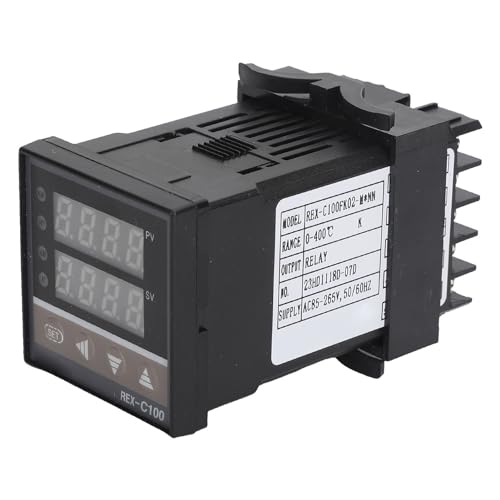
This fully adjustable PID temperature controller is designed for stoves and ovens, providing precise monitoring and control to achieve consistent thermal performance. Its broad range supports various heating tasks and process requirements, making it suitable for industrial ovens, lab furnaces, food processing equipment, and hobby projects. The device emphasizes intuitive digital display and reliable regulation, allowing operators to set exact parameters for stable results in diverse applications.
uxcell Capillary Temperature Control Switch

This capillary thermostat offers a compact, reliable control option for ovens and heaters with a 0.7 m probe length and a 50–300°C operating range. It is designed for straightforward integration into home appliances and small equipment, providing a dependable switch-based approach to maintaining target temperatures. The device supports direct wiring with two terminals, making it suitable for simple on/off control in cooking setups or warming applications.
Inkbird ITC-308 Digital Temperature Controller

The Inkbird ITC-308 is a popular dual-relay controller suitable for heating and cooling tasks. It features a clear °C/°F display and supports both heating and cooling modes to accommodate changing conditions. The unit displays measured temperature alongside the set temperature, aiding real-time monitoring. Its compact form and straightforward operation make it ideal for homebrewing, incubators, greenhouses, terrariums, and small processing setups requiring reliable temperature regulation.
Buying Guide: Key Purchase Considerations
- Load Type and Output: Decide between relay outputs for simple on/off control or solid-state relays (SSR) for smoother, faster switching and longer life in humid or high-cycle environments.
- Temperature Range and Resolution: Ensure the device covers your target range (many units span from subzero to well above freezing). Look for 0.5–1°F (0.3–0.6°C) accuracy if precise control matters.
- Sensor Type and Placement: Thermocouples (K-type common) or RTD sensors affect response time and accuracy. Consider probe length and where it will be placed in relation to the load.
- Control Mode: On/off (relay) vs. PID control with heating/cooling, which can maintain stable temperatures with less fluctuation in ovens and incubators.
- Installation and Wiring: Some units include built-in relays, heatsinks, and wiring harnesses, simplifying installation. Check local safety standards and electrical ratings (voltage, amperage).
- Calibration and Features: Look for temperature calibration (offset corrections), delay start, auto-tune, and power-loss memory to protect settings during outages.
- Display and Ease of Use: Clear digital displays, dual readouts, and simple control interfaces save setup time and reduce errors in busy environments.
- Application Fit: Match the controller to your application—food processing, incubation, greenhouse climate, or hobby projects—to ensure durability and compatibility with your heater or cooler.
How to choose among the options
- For high-power ovens or industrial tasks, consider units with 30–40A relays or SSR support and robust sensor options (K-type thermocouples).
- If you need both heating and cooling with automatic regulation, PID controllers with dual outputs are preferable to maintain tight tolerances.
- For simple on/off heating in smaller projects, a capillary switch or a basic digital controller can be sufficient and cost-effective.
- Ensure the device supports your preferred display units (Fahrenheit or Celsius) and offers easy calibration if your process drifts from the target.