Best Dryers for Fruit: Top Dehydrator Machines for Home Use
Answering the common buyer question: which fruit dehydrator offers reliable drying, ample space, and simple operation? This guide highlights five versatile dehydrators best for drying fruit, herbs, jerky, and more. Each option suits different needs, from large-batch, quiet operation to compact, budget-friendly models. Use the quick reference table to compare primary specs at a glance.
Buying table will render for screen readers.
| Product | Tray Count | Power | Best For | Notes |
|---|---|---|---|---|
| Cosori Food Dehydrator, 7+ Trays | 6 trays (6.5 ft²) | 600 W | Large batches, quiet operation | 27% larger than 7-tray standard; brushless motor, < 48 dB |
| Cosori Dehydrator (5 Trays) | 5 trays | 350 W | Compact, beginner friendly | Expandable with extra trays |
| Cercker 8 Trays Dehydrator | 8 trays | 500 W | Thick-cut foods, robust build | Wide stainless steel trays, strong airflow |
| Konfintos 5 Trays Dehydrator | 5 trays | 250 W | Space-saving, budget option | Transparent trays, up to 72 H operation |
| OSTBA 5-Tray Dehydrator | 5 trays | 240 W | Easy setup, even drying | Adjustable temp 95–158°F, 360° airflow |
Cosori Food Dehydrator, Bigger Than 7 Trays

The Cosori model with 6 stainless steel trays provides 6.5 ft² of drying space and a 600 W motor. It uses rear-mounted airflow and an upgraded design for faster, even drying. The motor is brushless for quieter operation, typically below 48 dB. Best for: households needing a large capacity without loud noise. Limitation: not expandable beyond its 6 trays unless adding compatible accessories.
Cosori Dehydrator Machine for Jerky, 5 Trays

This model offers 5 BPA-free trays, adjustable 95–165°F, and a 48-hour timer. It supports thicker cuts and longer runs for jerky, fruits, and herbs. Best for: those who want precise temperature control and an extended drying window. Limitation: power is 350 W, which may be slower for very large batches compared to higher-wattage units.
Cercker 8-Trays Food-Dehydrator
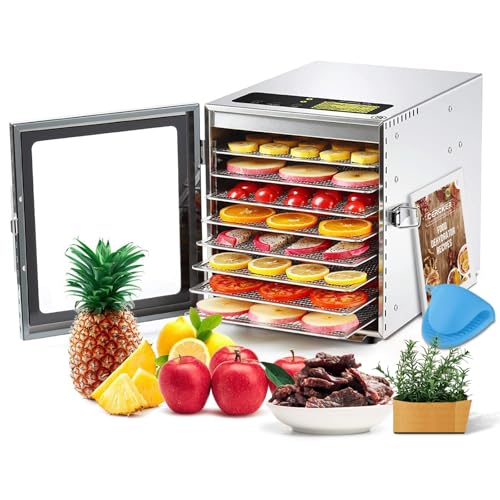
Cercker’s 8-tray design uses a 1600 rpm exhaust fan to promote even heat distribution. It is built with food-grade, BPA-free stainless steel trays. Best for: thick-cut foods and bulk drying with robust airflow. Limitation: data notes venting and stainless steel design but not user-replaceable parts; ensure proper ventilation during long runs.
Konfintos Compact 5-Tray Dehydrator
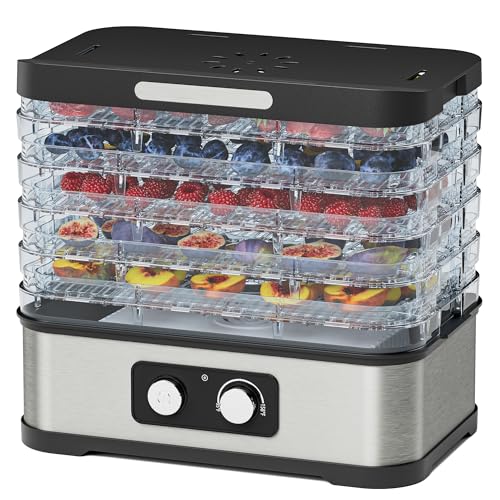
Konfintos emphasizes space-saving with five height-adjustable, BPA-free transparent trays. It supports up to 72 hours of operation and a temperature range from drying-friendly to jerky-ready. Best for: small batches or kitchens with limited counter space. Limitation: lower wattage (250 W) means slower drying for large batches.
OSTBA 5-Tray Dehydrator
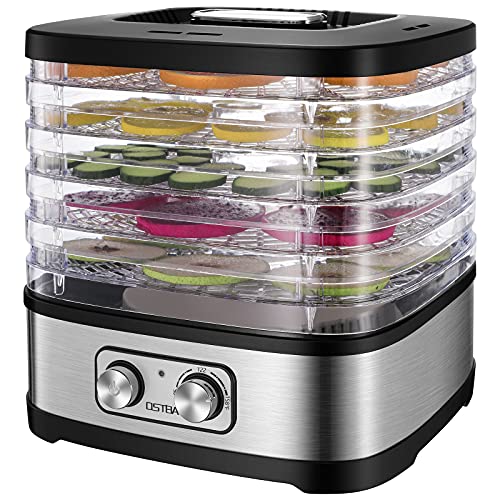
OSTBA uses 360° airflow with adjustable temperature from 95–158°F and five BPA-free trays. A transparent cover helps monitor progress, and height-adjustable tray spacing accommodates different food sizes. Best for: straightforward, dependable fruit and herb drying. Limitation: fewer trays compared to larger models, which can limit batch size.
Buying Guide: How to Choose The Right Fruit Dehydrator
- If you routinely dry large batches of fruit, prioritize models with more trays or larger total space. Consider expandable trays if available.
- Temperature control: Look for a wide range and precise increments (ideally 1°F steps). Higher range helps with jerky; moderate range suits fruit and herbs.
- Airflow and construction: Front- or rear-mounted fans and stainless steel trays distribute heat evenly and resist corrosion. BPA-free trays improve food safety.
- Noise and operation: Brushless or quality motors reduce noise, enabling overnight drying. Check decibel levels if possible.
- Timer features: Longer timers (24–48 hours) support steady drying for fruits and jerky. Auto shut-off adds convenience and safety.
- Ease of cleaning: Dishwasher-safe trays and simple disassembly save time between batches.
- Space and footprint: For small kitchens, compact units with stackable trays save counter space without sacrificing performance.
With What To Start: Quick Decision Scenarios
- Big batches, quiet operation: Choose a larger Cosori with 6 trays and a quiet, brushless motor.
- Budget-friendly, compact: Konfintos or OSTBA offer space-saving designs with essential features.
- Best for thick cuts or jerky: Cercker or Cosori 5-tray with higher temperature capability can handle jerky and dense slices.
Frequently Asked Questions
- How many trays should I need for fruit? For frequent fruit drying, aim for at least 5 trays or more to handle multiple batches without waiting.
- Is BPA-free important? Yes. BPA-free trays reduce potential chemical exposure and ensure safer storage of dried fruit.
- Can you dry herbs and spices in a dehydrator? Yes. Most units support low-temperature settings ideal for delicate herbs and leafy greens.
- Do dehydrators require rotation of trays? Some models claim even airflow without rotation; others may benefit from occasional rearrangement for uniform drying.
- What’s the best temperature for drying fruit? A typical range is 135–158°F (57–70°C) to preserve nutrients and texture without over-drying.
- Is expansion possible if I run out of trays? Some brands offer accessory trays to expand capacity; check compatibility before purchasing.