Best Energy Efficient Food Dehydrators for Home Canning and Snack Prep
Answering the need for low-energy, high-output drying at home, these energy-efficient food dehydrators help you preserve herbs, fruit, jerky, and more without wasting electricity. The top picks are best for home cooks, busy families, or hobbyists who want large capacities, quiet operation, and reliable temperature control. If you routinely batch-dry fresh produce or jerky, these models balance power, space, and ease of use.
Overview of selected products:
| Product | Tray Count | Approximate Power | Key Benefit |
|---|---|---|---|
| Cosori Food Dehydrator, Bigger Than 7 Trays | 6 trays | 600 W | Largest drying area among 7-tray class; fast, even drying |
| Magic Mill Pro Food Dehydrator | 7 trays | 600 W | All-stainless build; precise 95–176°F control |
| Elite Gourmet EFD319 | 5 trays | 350 W | Low energy, horizontal airflow for even dehydration |
| Cercker Food-Dehydrator Machine | 8 trays | 500 W | High capacity with 8 stainless trays |
| PSIIDAN Food Dehydrator Machine | 8 trays | 650 W | Powerful motor with adjustable temperature |
Cosori Food Dehydrator, 6 Trays, 600W, Quiet Operation

Best for households needing more drying space without adding noise. This Cosori model features 6 stainless steel trays, a 6.5 ft² drying area, a rear-mounted 600 W motor, and upgraded airflow for faster drying. The brushless motor maintains quiet operation below 48 dB, making overnight batches feasible. Ideal for jerky, meat, fruit, and herbs. Caution: larger trays require careful loading to avoid crowding and uneven drying.
Who it’s best for: large batch cooks and families who dry many items at once and value quiet operation.
Magic Mill Pro Food Dehydrator Machine

Best for stainless-steel durability and precise control. The Magic Mill Pro uses a 600 W rear fan for even drying across 7 full-size stainless steel trays. It offers a precise digital control range from 95–176°F in 1° increments, plus a 48-hour timer and an auto shutoff option. This setup helps with consistent results for jerky, fruits, herbs, and vegetables. Caution: contains all-metal interior; ensure proper cleaning to prevent residue buildup.
Who it’s best for: serious home preservers who want repeatable results and a robust, all-stainless build.
Elite Gourmet EFD319 Dehydrator
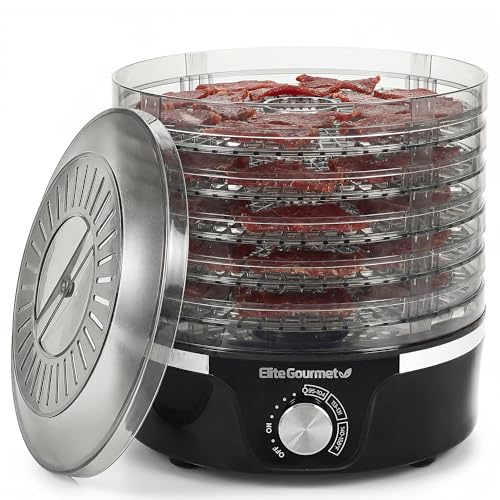
Best for energy-conscious users who want straightforward operation. The Elite Gourmet EFD319 provides 5 expandable BPA-free trays with a 350 W heating system and horizontal airflow for even drying without requiring tray rotation. Temperature spans 95°F–158°F, suitable for fruits, vegetables, herbs, and jerky. Caution: smaller footprint and fewer trays than higher-capacity models, which may slow large batch processing.
Who it’s best for: small to medium batches and homes prioritizing efficiency and simple, reliable performance.
Cercker Food-Dehydrator Machine, 8 Trays
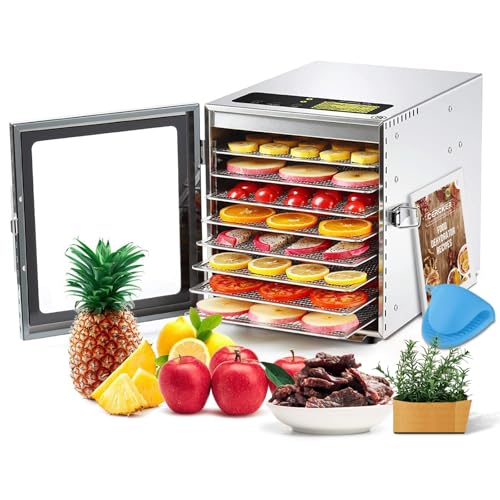
Best for high-capacity drying with durable stainless construction. Cercker’s 8-tray dehydrator uses a 1600 rpm exhaust-fan-based circulation system for uniform heat and drying efficiency. The device emphasizes food-grade stainless steel, an edge-wrapped tray design, and a 24-hour timer for timed batches. Caution: higher power draw than some compact models; ensure circuit capacity supports longer runs.
Who it’s best for: families or kitchens needing larger batches and robust build quality.
Food Dehydrator Machine with 8 Trays, 650W

Best for powerful home drying with broad temperature control. The PSIIDAN dehydrator offers 8 stainless steel trays, a high-performance 650 W motor, and adjustable temperatures up to 167°F with a timer up to 48 hours. It includes a mesh tray and a drip tray for easy cleanup. Caution: higher wattage may increase energy use if used long sessions; plan batch sizes accordingly.
Who it’s best for: power users who want fast, thorough drying and flexible timing options.
Buying Guide: Key Considerations For An Energy Efficient Dehydrator
- Capacity vs. counter space: How many trays do you need, and will your kitchen have room for expansion?
- Power and airflow: Is there a rear or top-mounted fan, and what is the wattage? Higher wattage can offer faster drying but may use more energy; look for efficient airflow and even heat distribution.
- Temperature range and accuracy: Do you need precise 1-degree increments for jerky, herbs, or fruit? Digital controls often provide tighter tuning.
- Tray material and build quality: Stainless steel trays resist staining and are easier to clean; BPA-free plastic trays save weight but may wear over time.
- Noise level: If you run dehydrating overnight, consider models with quiet brushless motors or low dB operation.
- Ease of cleaning and maintenance: Removable trays, dishwasher-safe components, and spill guards reduce cleanup time.
- Accessories: Meshing screens, fruit roll sheets, drip trays, and recipe booklets may expand the range of foods you can dry.
Frequently Asked Questions
- What is energy efficiency in a dehydrator? It refers to how effectively the unit uses power to remove moisture, balancing wattage, airflow, and heat distribution for faster, even drying.
- Should I choose a higher wattage model? Higher wattage can dry faster in dense batches, but may consume more energy per hour. Choose based on batch size and how often you dry.
- Is stainless steel better than plastic? Stainless steel trays resist staining and heat retention issues better than plastic; they’re easier to clean and more durable for long-term use.
- Can dehydrators be used for dairy or dairy substitutes? Some models can dry yogurt or cheese snacks if temperatures are within safe ranges; always follow manufacturer guidelines for food safety.
- What foods benefit most from dehydrating at low temperatures? Herbs, leafy greens, and delicate fruits benefit from lower temperatures to preserve flavor and nutrients.
- Do I need to rotate trays? ManyModels require no rotation due to even airflow; some budget models may benefit from tray rotation for uniform drying.