Best Magnetic Hot Plates for Laboratory Use: Top Lab-Grade Options
Choosing the right magnetic stirrer hot plate is essential for precise heating and stirring in the laboratory. The following selections are selected for reliability, safety features, and compatibility with common lab workflows. This guide highlights five notable options, detailing performance, capacity, and control options to help researchers and educators pick the right tool for their experiments.
| Product | Key Strength | Stirring Capacity | Max Temp | Power |
|---|---|---|---|---|
| XiWiLiYOTA Magnetic Stirrer | Dual control (heat + stir) | 2000 ml | 520°F | 180W |
| FOUR E’S SCIENTIFIC 5 Inch | High temp accuracy | 5 L | 536°F | 600 W |
| LABHOUSE Digital Cast Iron Hot Plate | Cast iron plate, efficient cooling | Single 1 kW | 500°C | 1 kW |
| LABHOUSE Digital Cast Iron Hot Plate (Double) | Two independent stations | Two 120×120 mm plates | 500°C | 2 kW |
| JOANLAB Digital Large 15L | Large-capacity stirring | up to 15 L | ± range up to 1500 rpm | — |
XiWiLiYOTA Magnetic Stirrer Hot Plate
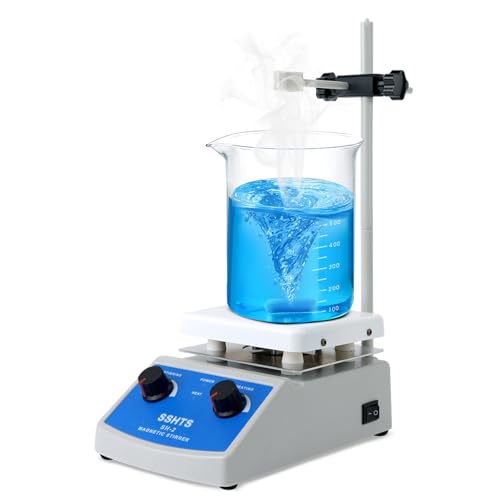
The XiWiLiYOTA magnetic stir plate combines heating and stirring in a compact aluminum body, designed for high-temperature performance. It reaches up to 520°F, suitable for reactions requiring precise heat input. The dual control design lets users adjust heating output and stirring speed independently, enabling simultaneous heating and mixing without cross-interference. A 2000 mL stirring capacity supports larger reaction volumes, while the aluminum construction offers durability and good heat transfer. Note: the surface color may yellow during operation and return to white after cooling. Exercise caution to avoid burns when the plate is hot.
FOUR E’S SCIENTIFIC 5 Inch Magnetic Stirrer Hot Plate

This 5 Inch unit features accurate temperature control with an internal sensor and PT1000 probe, delivering up to 600 W heating and a maximum temperature of 536°F. The ceramic coating provides strong thermal conductivity and quick cool-down. It supports stirring up to 5 liters at 100–1500 rpm, and can operate with heating and stirring combined or separately. Safety features include hot warnings at 50°C and high-temperature protection, plus splash protection for the stirrer. The motor is designed for long operation, capable of running for extended periods.
LABHOUSE Digital Cast Iron Hot Plate (Single Station)
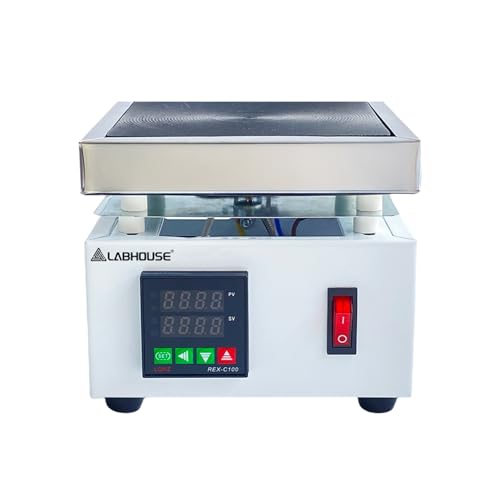
Featuring a cast iron heating plate and heat-resistant insulation, this LABHOUSE hot plate prioritizes durability and safety. It provides rapid and uniform heat transfer, with a surface temperature capability up to 500°C. The 3D ventilation design supports effective cooling, helping maintain safe operation during extended use. The unit is designed for demanding lab workflows, offering robust thermal performance and dependable heating stability for glassware and other lab vessels.
LABHOUSE Digital Cast Iron Hot Plate (Double Station)

This double-station LABHOUSE model offers two independent heating surfaces of 120×120 mm each, enabling different temperatures and workflows concurrently. With a total of 2 kW, the plate maintains high thermal efficiency across both stations. Like the single-station version, it uses a cast iron heating plate and features three-sided ventilation for quiet, effective cooling. It is suitable for labs needing parallel processing or sequential experiments without cross-interference between stations.
JOANLAB Digital Large Magnetic Stirrer Plate

The JOANLAB MS-15L provides a large working plate (8.7″ x 8.7″) with a stirring range of 50–1500 rpm and timing from 1 minute to nearly 20 hours. The model supports forward and reverse stirring, useful for varied mixing patterns and homogeneous sample preparation. It is designed for high-capacity stirring in large-volume experiments, while maintaining precise speed control and user-friendly operation. This option is well-suited for labs handling sizeable liquid volumes or requiring meticulous timing for reactions.
HYCC Digital Magnetic Stirrer With LCD

The HYCC stir plate emphasizes digital precision with an LCD display and timing function. Time can be set from 1 to 2880 minutes (48 hours), and the unit supports stirring up to 3500 ml, with a maximum speed of 2000 rpm. Its stepless speed adjustment ensures smooth control and durability. This model balances large-volume stirring with reliable heating control, suitable for long-duration experiments and研究 settings that require exact timing alongside stirring.
Buying Guide: Key Considerations For Choosing A Laboratory Hot Plate
- Stirring capacity and plate size: Match the vessel size and batch volume to ensure efficient heat transfer and uniform mixing. Larger plates handle bigger flasks but may have slower heating responses.
- Temperature range and control: Consider max temperature, temperature stability, and sensor quality. Internal sensors and PID control improve repeatability for critical reactions.
- Power and heat distribution: Higher wattage generally translates to faster heating. Ceramic or cast-iron surfaces provide durability and good thermal conductivity, but may affect cleaning and compatibility with certain samples.
- Safety features: Look for hot surface indicators, overheat protection, splash guards, and insulation to minimize burn risk and contamination.
- Control features: Dual control (separate heat and stir), timing functions, forward/reverse stirring, and Bluetooth or digital displays can improve workflow efficiency and data logging.
- Durability and maintenance: Aluminum, stainless steel, and cast iron surfaces offer different durability and corrosion resistance. Consider cleaning convenience and compatibility with common lab chemicals.
- Compatibility and accessories: Some models support additional holders or probes, useful for monitoring temperature or viscosity during experiments.
Overall, selecting a lab hot plate with robust temperature control, adequate stirring capacity, and reliable safety features helps ensure consistent results across various experimental setups. The options listed above cover a spectrum from compact dual-control units to large-capacity, multi-station plates, allowing researchers to align equipment with specific application needs.