Best Hot Water Electric Heaters for Quick, Efficient Home Use
Choosing an electric heater that delivers reliable hot water without high energy bills can be challenging. This guide highlights five top options, including tankless and compact storage models, to help homeowners find a best-fit solution for apartments, small homes, or single outlets. Each pick balances performance, efficiency, and ease of installation, with real-world considerations such as electrical needs and space requirements. Read on to compare features, specs, and suitability for different usage patterns.
| Product | Brand | Type | Key Benefit |
|---|---|---|---|
| EcoSmart ECO 11 | EcoSmart | Tankless | Self-modulating technology for energy efficiency |
| Rheem 18kW Tankless | Rheem | Tankless | High flow up to 4.4 GPM with LED temp display |
| Rheem RTEX-24 | Rheem | Tankless | High power, adjustable 80–140°F with digital display |
| Orbek 14kW Tankless | Orbek | Tankless | High output for 2–3 points of use; LED display and safety notes |
| GE 18 Gallon Versatile | GE | Storage (Electric) | Flexible, plug-and-play installation for small spaces |
EcoSmart ECO 11 Electric Tankless Water Heater

Endless on-demand hot water with 54 A amperage draw. Featuring patented self-modulating technology, the EcoSmart ECO 11 regulates energy use by adjusting heater output to match demand. It’s noted for being 90% smaller than traditional tank heaters and is designed for wall mounting or point-of-use installation. The unit emphasizes energy efficiency, claiming 99% thermal energy efficiency by heating water only when called. Suitable for compact spaces, it measures 11.5 x 8 x 3.75 inches.
Rheem 18kW 240V Tankless Electric Water Heater
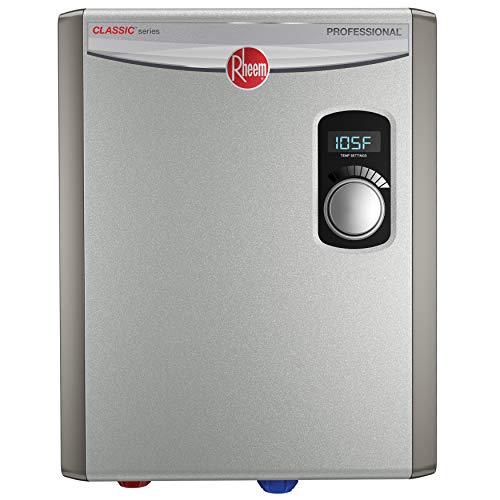
Rheem’s high-capacity unit features an external digital thermostat with LED display for precise control (+/- 1 degree). It employs advanced self-modulation to adjust power to match demand and includes durable copper immersion heating elements. The system is field serviceable and can deliver up to 4.4 GPM, making it suitable for whole-house usage in moderate climates or multi-point setups. Expect robust performance with straightforward temperature management and maintenance access.
Rheem RTEX-24 24kW 240V Electric Tankless
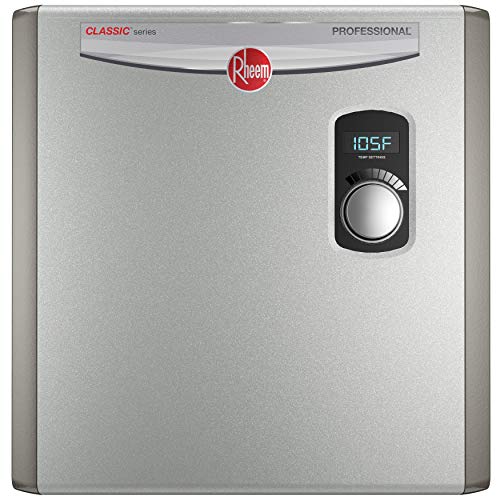
RTEX-24 requires 3 x 40-amp double-pole breakers with a 200-amp service recommended. It provides continuous hot water for whole-home use, with performance varying by groundwater temperature and location. The unit supports adjustable temperature from 80–140°F via ON/OFF dial control and digital display. It emphasizes high power and reliable on-demand supply for larger homes or higher simultaneous hot water needs.
Orbek 14kW Tankless Electric Water Heater

Orbek’s 14kW unit supports up to 3.38 GPM for 2–3 simultaneous points of use. It requires a 240V/60A two-pole breaker and suggests ensuring the total panel capacity is at least 150 amps. The system highlights energy efficiency through water-electricity separation and claims rapid hot water delivery with a notable efficiency advantage over traditional tank systems. A practical choice for spots needing compact, high-output hot water.
GE Appliances 18 Gallon Versatile Plug and Play Electric Water Heater

GE’s compact 18-gallon electric water heater is designed for easy installation in tight spaces, ideal for apartments or small homes. It uses standard ¾-inch NPT connections and works with a 120-volt supply, making it a practical plug-and-play solution. The flexible design supports single-point hot water or small-house setups, providing dependable storage without extensive remodeling.
Buying Guide: Key Considerations For Electric Hot Water Heaters
- Hot water demand: Tankless units shine when you need continuous supply for multiple outlets, while storage heaters are simpler for lower or intermittent use.
- Electrical requirements: Tankless models often need dedicated high-amperage circuits (e.g., 3x40A for larger units), whereas small storage heaters may run on standard 120V or simple 240V circuits.
- Flow rate and temperature rise: For tankless models, GPM and local groundwater temperature determine how much hot water you get at a given outlet temperature. Consider climate and typical shower or faucet usage.
- Space and installation: Tankless units save space but may require venting or fireproof clearances; compact storage heaters offer plug-and-play options for apartments.
- Energy efficiency: Self-modulating technology in tankless models reduces standby heat loss. Storage heaters carry different insulation levels; look for energy efficiency specifications and warranty terms.
- Maintenance and serviceability: Field-serviceable components and standard part availability affect long-term reliability and costs.
- Multi-use considerations: If you need hot water at multiple points of use, ensure the model supports the intended flow, temperature consistency, and electrical capacity.
- Installation environment: Consider water hardness, mineral content, and space constraints when choosing a unit to avoid scale buildup and ensure longevity.