Best Range Plug 3 Prong Solutions for Home Kitchens and Garages
Whether you’re wiring a new range or replacing a worn outlet, choosing the right 3-prong range plug and receptacle matters for safety and reliability. This guide highlights five top options, explaining who each is best for and why. It’s ideal for homeowners, contractors, and DIYers aiming for straightforward, code-friendly installation.
The following quick-reference table summarizes the featured products to help you compare at a glance:
| Product | Best For | Key Feature |
|---|---|---|
| Eaton WD112 50-Amp Range Receptacle | Heavy-duty, corrosion-resistant installations | Galvanized steel body with adjustable cord clamp |
| 50 Amp NEMA 10-50P (DEALTUS) | Industrial-grade, 3-wire, 125/250V compatibility | Back and bottom wiring, wide AWG compatibility |
| Eastman 3-Prong Range Cord, 40 Amps | Standard three-conductor cords for ranges | Includes 8/10 AWG conductors, universal compatibility |
| Legrand Pass & Seymour 385 50A 3R Outlet | Flush-mounted, 3-wire range outlets | Dead front, copper/aluminum compatibility |
| DEALTUS 30 Amp 3-Prong NEMA 10-30P | Smaller-range or older-dryer setups | Industrial-grade straight-blade design |
Eaton WD112 50-Amp Range Receptacle

The Eaton WD112 is a heavy-duty 2-pole, 3-wire range power receptacle designed for durable installations. It features heavy galvanized steel construction and a mounting strap to resist corrosion in challenging environments. The patented lay-in terminals accept up to #4 AWG wire, and the back features concentric knockouts with an adjustable cord clamp for flexible wiring from back or bottom. Best for: installations where long-term durability and robust wiring options are priorities. Limitation: may require more space and mounting planning for retrofits.
50Amp 3-Prong Dryer NEMA 10-50P (DEALTUS)

The DEALTUS 50A NEMA 10-50P plug is suitable for dryers and ranges, with 3-wire grounding and compatibility with 125/250V AC. It supports cord types SJT, SVT, SJTO, SJTW, and various AWG ranges from 8 to 18. This option is best for: older appliance setups needing a robust, interchangeable plug. Caution: ensure compatibility with the receptacle and housing to maintain a safe, grounded connection.
Eastman 3-Prong Electric Range Cord, 40 Amps
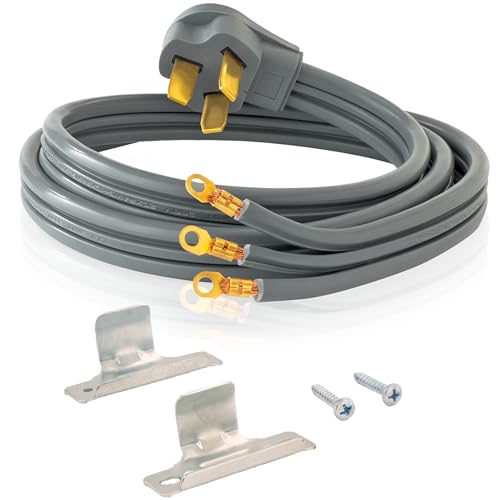
The Eastman 3-prong range cord is designed to connect electric ranges to a universal three-conductor power source. It uses a middle neutral wire with outside hot conductors and includes multiple conductor gauges (AWG 8/10/12/14/16). Best for: standard renovations or new installations that require a flexible, widely-compatible cord. Limitation: 40-amp rating may not suit higher-power ranges in some configurations.
Legrand Pass & Seymour 385 50 Amp Outlet

The Legrand Pass & Seymour 385 flush range outlet is designed for 3-angled prong configurations. It accepts copper or aluminum wire and uses a dead front design for safety. Best for: clean, flush-mounted installations where outlet aesthetics and code compliance matter. Limitation: 50A capacity requires compatible range and circuit sizing.
DEALTUS 30 Amp 3-Prong NEMA 10-30P

The DEALTUS 30A NEMA 10-30P is a 3-wire, 3-prong plug designed for dryers and ranges with 125/250V capability. It supports SJT, SVT, SJTO, SJTW cords and a range of AWG sizes. Best for: smaller-range setups or older installations that require a lower amperage plug. Caution: ensure your outlet and circuit are sized for 30A to avoid nuisance tripping.
Buying Guide
Key considerations when selecting a 3-prong range plug or receptacle:
- Amperage rating: Match the device to the appliance’s electrical draw and circuit capacity. Higher amperage helps support heavy-duty ranges but requires appropriate wiring and circuit protection.
- Wiring configuration: Decide between back or side (bottom) wiring, and confirm whether a cord clamp is needed for your installation.
- Wire type compatibility: Check AWG range compatibility and whether the device accepts copper or aluminum conductors where required.
- Mounting and enclosure: Consider a flush-mount receptacle for neat installations or a rugged surface-mount receptacle for garage or workshop use.
- Safety and compliance: Ensure the outlet type (NEMA 10-50P, NEMA 10-30P, etc.) matches your appliance and local electrical codes. Look for dead-front designs where exposed metal parts must be shielded.
Practical questions the guide answers:
- What is a NEMA 10-50P, and where is it used? — It is a 3-wire, 125/250V plug typically used for older dryers and ranges; it provides a grounding path and hot-neutral arrangement for power delivery.
- When should I choose a 30A vs 50A plug? — Choose 30A for smaller or older units; 50A is needed for higher-demand ranges or larger appliances, provided the circuit and wiring support it.
- Can I mix copper and aluminum wiring with these outlets? — Some outlets accept copper or aluminum; always verify the product’s compatibility and follow local codes.
- Is flush-mount always better than surface-mount? — Flush-mount outlets offer a cleaner look and safer edge exposure, often preferred in finished spaces, while surface-mount can be easier to install in unfinished areas.
- Do I need a new receptacle if I replace a 3-prong cord? — If the appliance and wiring match the outlet type (NEMA 10-50P or NEMA 10-30P), a corresponding receptacle may be sufficient; otherwise, consider upgrading the outlet and wiring together.
Frequently Asked Questions
- What is the difference between NEMA 10-50P and NEMA 10-30P? — They differ in amperage rating and plug design; 50A supports higher-draw appliances, while 30A is for smaller units.
- Can I install a 3-prong outlet in any kitchen or garage? — Yes, as long as the outlet matches the appliance’s plug type and complies with local electrical codes.
- Should I hire a licensed electrician for range wiring? — For electrical safety and code compliance, hiring a licensed professional is recommended for range wiring and receptacle upgrades.
- Are three-prong range cords universal? — Compatibility varies by plug type and amperage; verify that the cord and outlet pair correctly with the appliance specifications.
- What maintenance does a range outlet require? — Periodic inspection for corrosion, loose connections, and wear on cord ends helps prevent safety hazards.
- What if my appliance uses both 125V and 250V? — Outlets designed for dual voltage (125/250V) are needed; ensure the outlet and wiring are rated accordingly.