Best Salad Bar Refrigeration Units for Efficient Kitchen Prep
Answering the common buyer question: these 48″ to 49″ salad bar refrigerators are designed to keep ingredients cold, accessible, and organized for busy kitchens, buffets, and food trucks. They’re best for medium to high-volume establishments that need a durable, easy-to-clean prep station with multiple pans and a cutting board. The top picks below balance capacity, durability, and cooling reliability to suit restaurants, bars, cafes, and catering operations. The following table highlights the key options to compare at a glance.
- VEVOR 48″W Commercial Refrigerator – 12 Pans, 12.5 Cu. Ft
- ROVSUN 48″ Refrigerated Condiment Prep Station – 25.1 QT, 3 1/3 Pan
- ECEVT 48″ W Commercial Refrigerator – 12 Pans, Built for Cafes
- TUATNUT 48″ W Commercial Salad Bar Refrigerator – 12 Pans
- ICEVIVAL 48″ Commercial Refrigerator – 12 Pans, 13 Cu.Ft
| Product | Capacity | Key Feature | Best For |
|---|---|---|---|
| VEVOR 48″W Commercial Refrigerator | 12.5 Cu. Ft | 12 pans, cutting board, Cubigle cooling | Medium-volume sandwich prep bars |
| ROVSUN 48″ Refrigerated Condiment Prep Station | 25.1 Qt / 3 1/3 Pan | Digital temp control, defrost, R290 | Flexibility for varied ingredients |
| ECEVT 48″ W Commercial Refrigerator | 12 Pans, 15 cu ft storage | NSF pans, lift-up lid, automatic defrost | Buffet setups and cafes |
| TUATNUT 48″ W Commercial Salad Bar | 12 Pans, heavy-duty build | Stainless steel, two interior shelves | High-traffic kitchens |
| ICEVIVAL 48″ Commercial Refrigerator | 13 Cu.Ft, 12 Pans | NSF pans, fan cooling | Restaurants and bars needing capacity |
VEVOR 48″W Commercial Refrigerator

The VEVOR 48″W is a 12.5 Cu. Ft sandwich prep refrigerator with a 48.4 by 9.5 inch cutting board and 12 pans. It employs a Cubigle compressor and finned copper tubing for reliable cooling and meets UL/CSA standards. Best for mid-sized operations needing a ready-to-use salad bar with a sturdy stainless steel build. Caution: large footprint may limit placement in compact kitchens.
ROVSUN 48″ Refrigerated Condiment Prep Station

The ROVSUN unit uses a 125W compressor and R290 refrigerant for efficient cooling, with digital temperature control from 32 to 53.6 ℉ and a one-click defrost. Its detachable stainless steel cover and durable construction make it suitable for busy buffets and food trucks. Best for operators needing adjustable temperature and easy cleaning. Limitation: smaller pan capacity may require frequent restocking for high-volume needs.
ECEVT 48″ W Commercial Refrigerator

The ECEVT model offers 15 cubic feet of storage with 12 pans, NSF-standard pans, and a lift-up lid plus detachable stainless steel cover to protect ingredients. It features fan cooling and automatic defrost to maintain consistent temperatures. Best for restaurants and buffets that emphasize food safety and easy access. Caution: spacious storage may require a larger working area.
TUATNUT 48″ W Commercial Salad Bar

The TUATNUT model uses a 12-pan configuration with a robust stainless steel exterior and interior, designed for heavy daily use. It emphasizes precision cooling with auto defrost and a two-shelf interior. Best for high-traffic kitchens needing strong build quality and reliable operation. Caution: design focuses on durability; check cabinet dimensions to fit your space.
ICEVIVAL 48″ Commercial Refrigerator
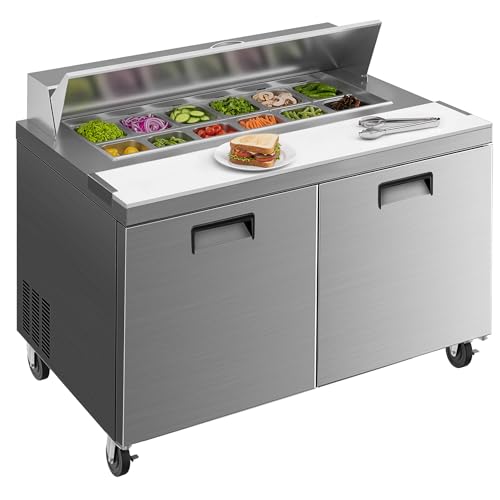
The ICEVIVAL unit features 13 cu.ft of capacity with 12 pans and a fan cooling system that maintains uniform temperatures between 33℉-41℉. It provides NSF-certified GN pans and adjustable shelves, making it adaptable for varied prep needs. Best for kitchens seeking reliable cooling with spacious cutting-area work surface. Caution: older models may have temperature drift if not regularly serviced.
Buying Guide: Key Considerations For Your Salad Bar
What capacity do you actually need? Consider guest volume, menu complexity, and how many pans you require at peak service. Higher capacity models reduce the frequency of restocking and can improve kitchen efficiency.
- Pan configuration: 1/6 GN pans are common; ensure the number matches your menu components to minimize waste and search time.
- Cutting board size: A larger board speeds prep but requires more space; balance with kitchen layout.
- Temperature range and defrost: Look for a unit with a stable temperature range suitable for perishable ingredients and automatic defrost to minimize manual maintenance.
- Materials and build: Stainless steel interiors and solid doors reduce corrosion and improve durability in busy environments.
- Movement and footprint: Wheels with brakes or casters help reposition for cleaning and space optimization without compromising stability.
- Energy efficiency: Refrigeration units with efficient compressors and proper insulation reduce energy use and operating costs.
Choosing By Kitchen Type
If you run a busy restaurant or bar with frequent guest traffic, prioritize models with robust construction, ample storage, and easy cleaning features. For food trucks or mobile setups, lighter models with good insulation and simple temperature controls offer practical advantages. Buffets and catering services benefit from lift-up lids and detachable covers to protect ingredients during service.
FAQ
- What size salad bar refrigerator should I buy? Choose a size based on daily ingredient volume, menu variety, and available kitchen footprint. 48″ models are common for mid-sized operations with multiple pans.
- Do these units require special electrical requirements? Most commercial prep refrigerators need standard 110V–120V supply with dedicated circuits; check each model’s specifications.
- Is auto defrost important? Yes, it helps prevent frost buildup, ensuring consistent cooling and reducing maintenance.
- Can these units be moved easily? Models with heavy-duty casters or wheels provide mobility for cleaning and reconfiguration, but consider weight and space.
- Which unit is best for high-volume buffets? Look for larger capacities, strong insulation, and a lift-up lid or detachable cover to reduce heat exposure during service.
- Do these units meet safety standards? Opt for models that advertise NSF/ETL or UL/CSA listings to ensure compliance with health and safety requirements.