Best Sous Vide Immersion Heaters for Precision Home Cooking
Answering the search for reliable sous vide immersion heaters, these picks deliver precise temperature control, stable heat, and quiet operation for home cooks and meal-prep enthusiasts. They’re ideal for busy households, multi-dish prep, and anyone seeking restaurant-grade results at home. The top five selections below balance accuracy, app connectivity, ease of use, and durability to cover a range of budgets and cooking styles.
| Product | Best For | Key Feature |
|---|---|---|
| Wancle 1100W Immersion Circulator | All-around home chefs | High power, 3D water circulation |
| INKBIRD ISV-100W | Smart control lovers | WiFi app remote control |
| InkSous ISSV-200-W | Remote and quiet cooks | 2.4GHz WiFi, multi-user, 40 dB |
| INKBIRD WiFi Immersion Circulator (IPX7) | Stable WiFi control | IPX7 waterproof, calibration |
| Anova Culinary Precision Cooker 3.0 (WiFi) | Tech-enabled doneness | Dual-band WiFi, two-line display |
The following product sections provide concise, shopping-focused details to help you compare features, determine fit, and avoid common limitations.
Wancle 1100W Immersion Circulator

Best for: Home cooks needing fast heatup and compact storage. This model delivers up to 1100W with 3D water circulation for even heating and faster temperature attainment. Its reduced size makes it easier to store after use, and a reservation function helps with meal timing for busy days.
Why selected: It combines strong power with space-conscious design, suitable for cooks who want reliable performance without a large footprint. The temperature control ranges from 25°C to 90°C with a ±0.1°C accuracy, and time up to 99 hours 59 minutes.
Limitation: Some users may prefer app-based remote control, which this model does not emphasize. Basic operation is straightforward without WiFi integration.
INKBIRD ISV-100W Sous Vide Cooker

Best for: Cooks who want remote monitoring and precise control via an app. This 1000W unit supports WiFi connectivity for monitoring temperatures and starting/stopping cooks from anywhere.
Why selected: It offers precise control with a wide range (25–99°C) and ±0.1°C accuracy, plus an intuitive touchscreen for local adjustments. It also includes calibration features and a free recipe guide for beginners.
Limitation: Some setups may require a stable 2.4GHz network for optimal app performance; ensure your router compatibility before purchase.
InkSous WIFI 2.4G Sous Vide Cooker ISSV-200-W
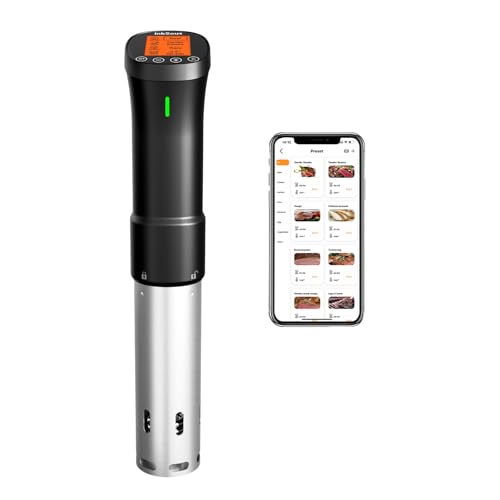
Best for: Remote cooks who want multi-user access and quiet operation. The ISSV-200-W uses 2.4GHz WiFi with a broad temperature range and a silent performance profile (under 40 dB).
Why selected: Its app-driven features and built-in recipes help beginners achieve consistent tenderness, while the ultra-quiet operation supports night cooking or busy households. It reaches 0–90°C (32°F–194°F) with ±1°F accuracy and a long timer up to 100 hours.
Limitation: The device relies heavily on app features; ensure your smartphone compatibility and app reliability align with your cooking habits.
INKBIRD IPX7 WiFi Immersion Circulator

Best for: Those seeking durable, waterproof performance with WiFi control. The IPX7 rating supports robust immersion during long cooks with stainless steel construction.
Why selected: Remote control via the Inkbird app, high accuracy (±0.1°C), and a wide 32°F–194°F range help deliver precise results for a variety of dishes. Calibrate to maintain repeatability and extend longevity in busy kitchens.
Limitation: App reliability can influence real-time cooking; ensure stable connectivity for optimal results.
Anova Culinary Precision Cooker 3.0 (WiFi)

Best for: Tech-forward cooks who want guided doneness and convenient app-enabled cooking. The third-generation Anova adds dual-band WiFi and a two-line display for quick checks.
Why selected: It is a well-established option with broad compatibility and a robust ecosystem of recipes and support. The ability to set precise time and temperature with a clear display makes it a reliable all-rounder.
Limitation: Some users may prefer a visible dial or a simpler interface; the app-centric approach may be overkill for occasional cooks.
Buying Guide: Key Considerations For Choosing A Sous Vide Immersion Heater
- Power and speed: Higher wattage generally reaches target temperatures faster. For frequent large batches, consider models around 1000–1100W.
- Temperature range and accuracy: Look for a range that covers 25–90°C (77–194°F) with ±0.1°C accuracy for precise doneness.
- Water flow design: 3D circulation or powerful convection helps even heat distribution and nutrient retention.
- Connectivity: Decide if you want WiFi/app control or purely manual operation. App-enabled models enable remote monitoring and scheduling.
- Durability and waterproofing: IPX7 or equivalent waterproofing adds resilience for long cooks and splash resistance.
- Noise level: Quiet operation is important for home environments; look for models touting silent or low-noise designs.
- Ease of use: A clear display, intuitive controls, and quick-release clamps improve everyday usability.
- Compatibility: Ensure the unit clamps securely to standard pots and containers you own.
- Recipes and support: Free or included recipe guides can shorten the learning curve for beginners.
Quick Comparison At A Glance
- Best for speed and compact storage: Wancle 1100W
- Best for app-based control without breaking the bank: INKBIRD ISV-100W
- Best for multi-user remote cooking: InkSous ISSV-200-W
- Best for rugged, waterproof reliability: INKBIRD IPX7
- Best for tech-enabled doneness with strong ecosystem: Anova Culinary 3.0
Frequently Asked Questions
- What is sous vide immersion heating? – It is a precise cooking method using a water bath to maintain a set temperature for even doneness.
- Do I need WiFi for sous vide? – Not necessary, but WiFi models offer remote monitoring and scheduling for busy households.
- Is IPX7 waterproof important? – It enhances durability and safety during long cooks or splash-prone setups.
- Can I use any pot with a sous vide device? – Most immersion circulators clamp to pots of various sizes; ensure a secure fit.
- What is a good temperature range for most proteins? – Common ranges are 50–85°C (122–185°F) depending on doneness and protein type.
- How do I calibrate a sous vide device? – Use the device’s calibration feature to adjust the displayed temperature against a known standard.