Best Stackable Canned Food Organizer Solutions for Efficient Pantries
Find the right stackable canned food organizer to maximize pantry space and improve can retrieval. This guide highlights five top options suited for different spaces and needs, from compact countertops to tall pantry shelves. Ideal buyers include small-apartment dwellers seeking compact units, families needing bulk-can storage, and organizers who want modular, reusable systems. The table below compares key takeaways for quick decision-making.
| Product | Best For | Capacity | Mount/Placement |
|---|---|---|---|
| Deco Brothers Stackable Can Rack Organizer | Moderate-sized pantries, cabinet shelves | Up to 36 cans | Freestanding or in cabinet |
| Simple Houseware Stackable Can Organizer Rack | Fridges, counters, pantries | 36 cans per tier, up to 72 cans total | Freestanding or on shelves |
| Attelite Can Organizer for Pantry | Multi-set configurations, larger layouts | Up to 108 cans with 3 sets | Stackable interlock |
| JKsmart 2-Tier Stackable Can Rack (2-Pack) | Flexible space savers, adjustable can sizes | Up to 60 cans per unit | Stackable or separate |
| LXLXXL Can Organizer For Pantry | First-in-first-out rotation, linkable trays | 36 or 48 cans per configuration | Stackable rolling trays |
The right option depends on your space, can sizes, and whether you prefer a rolling, layered, or foldable design. The following sections explore each product’s strengths, intended user, and any noted limitations.
Deco Brothers Stackable Can Rack Organizer
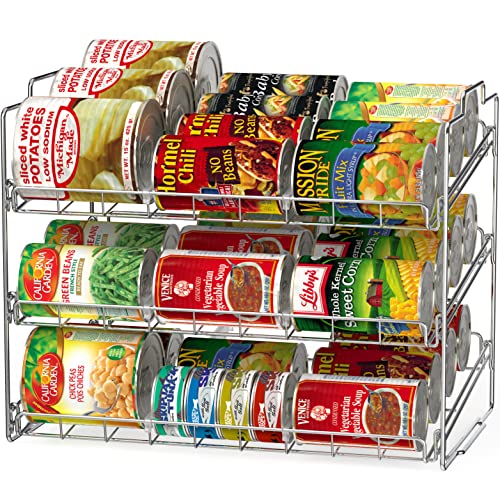
This chrome-finished stackable rack holds up to 36 cans and is best for medium-size pantries or cabinet shelves. The stackable design allows multiple racks to be combined, increasing capacity as needed. The product lists dimensions of 17.3 W x 11.25 D x 13.75 H inches with a minimum clearance of 17.5 W x 11.5 D x 16 H inches. It is suited for buyers who want a sturdy, metal construction that can be expanded over time. A potential limitation is the need for precise space planning to meet the minimum clearance in tight cabinets.
Who it’s best for: Small households or apartment kitchens looking to maximize a single cabinet or shelf without sacrificing accessibility. It’s ideal for buyers who prefer a chrome finish and modular stacking options to grow the system later.
8-Pack Can Organizer for Pantry (72 Cans)

This multi-layer design is described as a space-saving solution for pantries, cabinets, and fridges. Each layer is designed to hold about 9 cans, totaling up to 72 cans across eight layers. It uses a heavy-duty steel frame with interlocking wire mesh for stability and higher load-bearing capacity. The unit emphasizes easy installation and reconfiguration for different spaces, making it a strong choice for homes that regularly reorganize. A noted limitation is the overall footprint required for eight layers, which may not fit smaller kitchens.
Who it’s best for: Households that want a tall, modular system with clear visibility of contents and easy reconfiguration for shelves, countertops, or RV storage. Better for families who rotate cans by type and want quick access to multiple beverage or food categories.
Sonyabecca 4-Pack Stackable Canned Food Organizer

This set of four stackable baskets focuses on foldable wire design with built-in handles, enabling easy movement and stacking stability. It’s suitable for countertop, cabinet, or pantry use. The set’s design supports overlaying baskets and separate use, making it flexible for varied can sizes and storage needs. A potential limitation is that capacity per basket is lower than larger three-tier rack systems, so it’s best when used as a supplementary organizer or for smaller collections.
Who it’s best for: Buyers who want portable, lightweight organizers that can be moved and reconfigured without heavy tools. Choose this if you value foldable design and built-in handles to simplify stacking and mobility.
Simple Houseware Stackable Can Organizer Rack

This chrome, 3-tier rack holds up to 36 cans and is described as fast to assemble with durable construction. It’s designed for freestanding use or placement on shelves, pantries, countertops, or floors. The design emphasizes easy front access, which helps prevent cans from getting lost in the back. A limitation is that the third tier may feel crowded if you store larger can sizes or unevenly shaped items.
Who it’s best for: Shoppers seeking a straightforward, freestanding solution that fits standard pantry sizes and offers simple front-loading access. It’s a robust choice for households that prefer a single, roomy tier setup with solid stability.
JKsmart 2-Tier Stackable Can Rack (2-Pack)

The JKsmart system comprises two-tier racks with adjustable intervals to accommodate different can sizes, up to 60 cans per unit. The frame uses heavy-gauge steel to improve stability and reduce deformation. It can be stacked or used separately, and can fold down for compact storage when not in use. A caveat is that the stacking connectors are essential for stability; without proper assembly, the system may feel less secure.
Who it’s best for: Buyers who need a highly adaptable, high-capacity solution that can scale up or down. Ideal for households with varying can sizes or those who want to pair multiple units for a larger pantry footprint.
LXLXXL Can Organizer For Pantry

This rolling can organizer features smart rolling trays with three small parallel slopes to promote first-in, first-out rotation. It’s designed to reduce spills and improve retrieval with wide openings. It comes in configurations that hold 36 or 48 cans, depending on the chosen layout. A possible limitation is that the larger footprints require adequate space for rolling trays to move freely.
Who it’s best for: Buyers prioritizing FIFO rotation and easy reach across multiple shelves or cabinet areas. Best for those who want a rolling solution that stays organized while moving between storage zones.
Buying Guide: Key Considerations for Choosing a Stackable Canned Food Organizer
- Space and placement: Measure cabinet depth, width, and height to ensure the unit fits with clearance for doors and shelf movement. If space is limited, consider compact or foldable designs.
- Capacity needs: Calculate weekly or monthly can purchases to determine how many cans you store. For large households, multi-tier or multi-unit systems offer better scalability.
- Access and visibility: Front-loading, rolling trays, and open-front designs reduce the time spent searching for cans. Consider whether you prefer seeing labels at a glance or stacking in a back-row arrangement.
- Material and durability: Metal frames with chrome or stainless finishes tend to be sturdier than plastic. Heavy-gauge steel improves stability when loading heavier can groups.
- Modularity: If you anticipate changing layouts, choose systems that interlock, stack, or fold, enabling easy reconfiguration without tools.
- Rotation and organization style: First-in, first-out designs help prevent expired cans. Align shelves by category (vegetables, beans, soups) to minimize rummaging.
- Installation effort: Some units require simple assembly; others are freestanding or shelf-mitu. Decide whether you want a quick setup or a fixed install solution.
FAQ
- Q: Do these organizers fit on kitchen countertops or only inside cabinets?
- Q: Can I stack multiple units for higher capacity?
- Q: Are the frames prone to tipping when fully loaded?
- Q: Do these organizers accommodate different can sizes?
- Q: Is assembly required?
- Q: What is the best choice for FIFO storage?
A: Most options support both countertop and cabinet placement, though some models are optimized for freestanding use or shelf integration. Check dimensions before purchasing.
A: Yes, several products are designed to stack or interlock with other units to expand storage space.
A: Materials like heavy-gauge steel and interlocking designs reduce tipping risk. Ensure proper assembly and distribute weight evenly.
A: Some models offer adjustable intervals or tiers to fit various can diameters; check product specs for compatibility.
A: Most are designed for straightforward assembly, though the time varies by model. Foldable or modular designs may require fewer tools.
A: Models with rolling trays or forward-facing ramps are ideal for first-in, first-out rotation, helping you use cans in order.