Best Thermostats for Gas Ovens: Accurate, Durable Picks for Home Cooks
Answering the question, these thermostats help you monitor oven temperature accurately in gas ovens, grills, and related appliances. They’re ideal for baking roasts, smoking meats, and ensuring fried foods come out right. The best picks below cover straightforward dial readers, battery-free designs, and digital options for precise control. They suit home cooks who want reliable temperature readouts, commercial-kitchen-minded durability, or easy integration with existing ovens.
| Product | Best For | Key Benefit |
|---|---|---|
| PECULA Stainless Steel Oven Thermometer | Oven, Grill, and Fryer Enthusiasts | Battery-free, clear dual-zone dial |
| TempPro 2-Pack Oven Thermometer | Budget-conscious cooks | Two units, broad 100–600°F range |
| AcuRite 00620A2 Oven Thermometer | Simple, durable readings | Stainless steel with protective glass |
| Hotloop Digital Oven Thermometer | High-precision digital tracking | LCD display, ±1°C accuracy |
| Efeng Large 3.5″ Oven Thermometer | Large-reading gauge lovers | Extra-large dial, NSF-approved |
PECULA Stainless Steel Oven Thermometer—Analog, Battery-Free
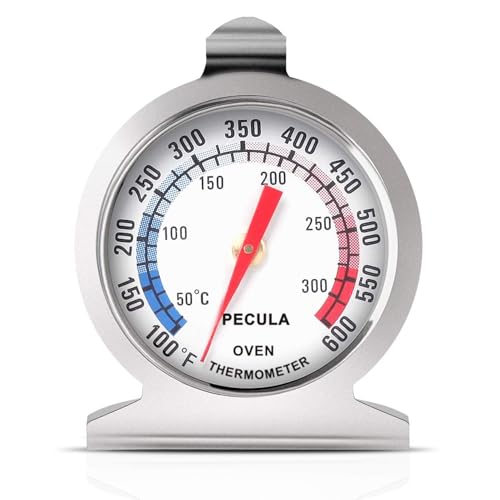
The PECULA thermometer uses a clear dial to deliver precise readings from 50–300°C (100–600°F). It features dual-zone color indicators (blue and red) for quick at-a-glance monitoring, making it suitable for ovens, grills, smokers, and deep fryers. Best for cooks who want a simple, reliable, battery-free option that does not require calibration or replacements.
Who it’s best for: Home bakers and grillers who value passive operation and a visible temperature readout. Why selected: The combination of a hook-and-stand design and a broad temperature range covers most oven-use cases without extra gadgets. Caution: Not ideal for ovens requiring digital data or constant automated monitoring.
TempPro 2-Pack Oven Thermometer

This 2-pack provides a practical value with a temperature range from 50–300°C (100–600°F). It uses an analog dial with clear markings and a durable 431 stainless steel body designed for high-heat environments. Best for households that want redundancy or to place one thermometer in the oven and one on the grill.
Who it’s best for: Families or frequent entertainers who need multiple units for consistent cooking results. Why selected: The two-pack format and wide range make it versatile for baking, smoking, and roasting. Caution: Some users report limited visibility in very tight oven spaces; layout matters for readability.
AcuRite 00620A2 Stainless Oven Thermometer

AcuRite’s model covers 150–600°F with a sturdy stainless steel build and a protective glass lens, making it suitable for both ovens and grills. It’s designed for leave-in use while cooking, offering durability and straightforward temperature readings. Best for cooks who want a simple, long-lasting dial thermometer with reliable protection from heat exposure.
Who it’s best for: Everyday cooks who want a low-maintenance, durable thermometer. Why selected: It balances straightforward readouts with robust construction. Caution: The minimum readable temperature starts at 150°F, so it won’t help with very low-temperature tasks.
Hotloop Digital Oven Thermometer

The Hotloop thermometer provides a digital readout with an LCD display, allowing precise temperature tracking from 32°F to 572°F (0°C to 300°C). It emphasizes accuracy (±1.8°F/±1°C) and ease of use, with a probe that fits through oven doors or grill lids. Best for cooks who want exact temperature control and quick adjustments based on real-time data.
Who it’s best for: Precision-focused bakers and roasters who need real-time numbers to guide cooking. Why selected: Its digital readout and tight accuracy help prevent under- or over-cooking. Caution: The sensor cable and transmitter infrastructure require careful placement to avoid interference with oven seals.
Robertshaw Gas Cooking Control Thermostat Kit

This thermostat kit offers adaptable mounting with multiple outlet orientations and can be configured for different temperature ranges. It’s designed for gas cooking control, providing precise regulation around baking and broiling temperatures. Best for those upgrading or replacing a wall or range thermostat component in gas ovens.
Who it’s best for: DIY enthusiasts or professionals seeking a flexible control solution for gas ovens. Why selected: The kit’s versatility makes it suitable for varied appliance configurations. Caution: It’s a component kit, so installation may require some technical knowledge; verify compatibility with your oven model.
Efeng Large 3.5″ Oven Thermometer

Efeng’s thermometer features a large 3.5″ dial with a hanger and base for easy placement on shelves or racks. It ranges from 100°F to 600°F and is NSF-approved for oven use. Best for readers who prioritize readability from a distance and a sturdy, professional-grade look for home kitchens.
Who it’s best for: Cooks who frequently check temperatures from across the kitchen and want a clearly legible dial. Why selected: The large dial improves readability and reduces guesswork. Caution: The oversized dial may not fit into very compact oven spaces without shelf clearance.
Rubbermaid Commercial Stainless Steel Monitoring Thermometer
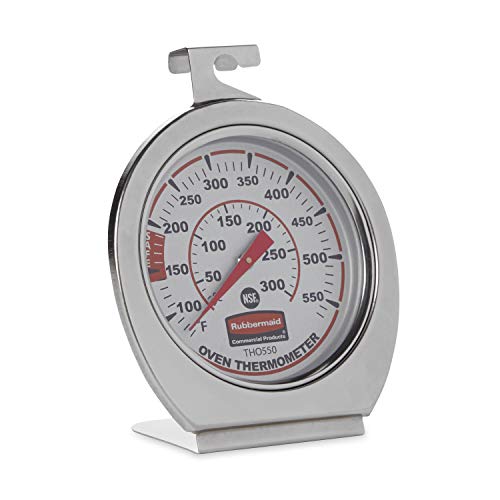
Rubbermaid’s thermometer covers a broad range from 60°F to 580°F, designed for use in ovens, grills, and smokers. It’s built with a professional kitchen focus, offering easy readability for hot environments. Best for those needing a robust, restaurant-grade option for consistent monitoring.
Who it’s best for: Commercial or serious home cooks looking for a rugged, easy-to-read device. Why selected: The wide range and professional design support reliable temperature control. Caution: It is geared toward high-usage environments; users seeking ultra-compact devices may prefer smaller models.
Awoco KKTB-18-48 Gas Stove Thermostat Kit

Awoco’s gas stove thermostat provides precise control up to 599°F with a 150–500°F adjustment range and a copper bulb with a long capillary. It is designed for broiling and baking applications. Best for updating oven control components in gas ranges where space and mounting options vary. Caution: Do not bend the capillary excessively or disassemble the knob shaft, as it can affect accurate operation.
Buying Guide: Key Considerations for Choosing a Gas-Oven Thermostat
- Temperature range: Ensure it covers the temperatures you commonly cook at, including broiling and roasting.
- Display type: Analog dials are simple and battery-free; digital displays offer precise readings and may integrate with smart setups.
- Mounting flexibility: Look for devices with both hanging hooks and stands for versatile placement.
- Durability: Stainless steel bodies and heat-resistant lenses extend life in high-heat environments.
- Readability: Large dials or bright displays help reduce guesswork during busy cooking sessions.
- Installation: Some devices require minimal setup; others may involve more complex installation or replacement of components.
- Usage scenario: In-oven monitoring vs. grill or smoker use may dictate choice of dial size, range, and mounting.
- Maintenance: Battery-free options reduce upkeep; digital models may require occasional battery or transmitter care.
FAQ
- What is the typical temperature range I need for most gas oven tasks?
Most home cooking tasks are well-served by 100–600°F (50–315°C) ranges, covering baking, roasting, and broiling. - Are analog oven thermometers as reliable as digital ones?
Yes, analog thermometers with a clear dial can be highly reliable and require no power source, though digital models offer precise numeric readouts. - Can I use an oven thermometer for grilling or smoking?
Many models are designed for ovens but can work in grills or smokers if placement and heat exposure are suitable. - How should I place an oven thermometer for best readings?
Place it where air flow and oven heat are representative of the cooking area; use the hook or stand options as needed for stability. - Is it necessary to calibrate these thermometers?
Most good-quality units arrive pre-calibrated; if readings seem off, some models allow minor re-calibration by following the manufacturer’s guidance. - Which thermometer is best for a busy kitchen with varied tasks?
A digital thermometer with a wide range and clear LCD readout is helpful for quick checks during busy cooking cycles.