Best Meat Processing Band Saws for Efficient Butchery
Answer: This guide helps buyers find durable, powerful band saws designed for meat processing, with options suited for home butchers, small shops, and professional kitchens. Top picks balance power, adjustable cutting thickness, and easy maintenance. Best for heavy-duty tasks: Vohala 1000W and Generic 2000W; best for versatile bone and meat cuts: FOHERE 1500W and VEVOR 1100W; best compact benchtop: WEN 9-Inch Band Saw. Compare features, thickness range, and construction to choose the right model for your needs.
| Product | Power (W) | |||
|---|---|---|---|---|
| Band Saw for Meat Processing, 1000W (Vohala) | 1000 | 0.04″ – 3.9″ | Not specified | Durable, 8 blades; good for tougher cuts |
| 2000W Commercial Electric Meat Bandsaw (Generic) | 2000 | 0″ – 7.9″ | 20″ x 15.3″ | High power, wide thickness range |
| 1500W Bone Saw Meat Cutter (Generic) | 1500 | 0.04″ – 7.8″ | 20″ x 15″ | High efficiency; stainless worktable |
| VEVOR 1100W Commercial Electric Meat Bandsaw | 1100 | 0 – 4.3″ | 12.4″ x 18.1″ | Openable body design for cleaning |
| WEN 9-Inch Band Saw (Benchtop) | 2.8 | 1/8″ – 3/8″ | 9″ width | Compact option for small tasks |
Band Saw for Meat Processing, 1000W (Vohala)

The 1000W motor delivers robust power for smooth, jam-free operation, enabling efficient bone and frozen meat cuts. Best for mid-sized kitchens or small processing rooms where steady, reliable cuts are needed. The adjustable thickness ranges from 0.04 to 3.9 inches for ham slices or bone chunks. This model includes 8 blades designed for durability in demanding environments.
Best for: small to mid-size butcheries and home shops seeking a sturdy, easy-to-maintain bone saw. Limitations: blade replacement may require extra care to ensure rust resistance and longevity in heavy-duty use.
2000W Commercial Electric Meat Bandsaw

Powered by a 2000W motor and a sharp stainless steel blade, this model supports high cutting throughput. It claims 900-1500 lbs per hour with precise gears for consistent results. The cutting thickness ranges from 0 to 7.9 inches, allowing both thin prosciutto-style slices and thick bone pieces. A sturdy stainless steel worktable enhances reliability in busy environments.
Best for: larger operations or shops needing high-volume capability. Caution: ensure the machine is cleaned thoroughly after heavy use to maintain hygiene and blade longevity.
1500W Bone Saw Meat Cutter

This 1500W model emphasizes efficiency with a 0.04-7.8 inch cutting range and 330-441 lbs per hour capacity. The 20″ x 15″ stainless steel workbench withstands wet environments and supports easy blade replacement. It suits operators needing precise thickness control for a variety of cuts from thin deli slices to thick bone sections.
Best for: mid-to-high volume shops requiring versatile cutting options. Limitation: heavier builds may require more counter space and robust mounting.
VEVOR 1100W Commercial Electric Meat Bandsaw
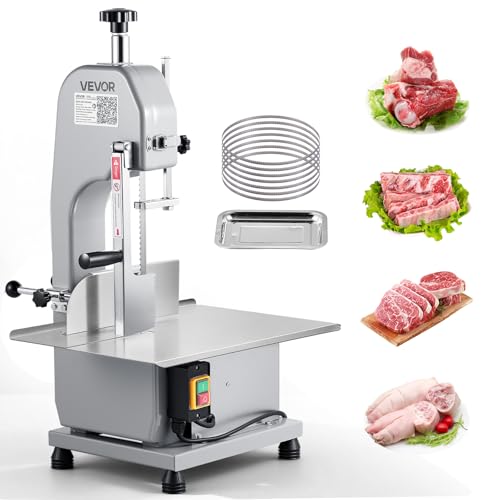
Equipped with an 1100W pure copper motor and a 12.4″ x 18.1″ workbench, this model delivers smooth, continuous cutting with a 0-4.3″ thickness range. It includes seven extra replacement blades and a design that simplifies cleaning—an openable body for quick rinsing. Best for: processors needing reliable performance with easier maintenance in a medium-scale setting.
Caution: do not rinse the motor; follow cleaning guidelines to avoid motor damage.
WEN 9-Inch Band Saw

The WEN BA3959 benchtop model offers a compact option with a 2.8-amp motor and a 3-1/2 inch cutting depth. It supports blades ranging from 1/8 to 3/8 inches and a blade speed up to 2500 feet per minute. This choice is best for small-volume tasks or as a supplementary saw in a larger operation.
Best for: hobbyists or small setups needing a space-saving tool. Limitation: lower power compared to larger meat bandsaws; not ideal for continuous heavy-duty bone work.
Buying Guide
What power level do you need for meat processing?
- High-volume operations typically benefit from 1100–2000W motors for consistent throughput and the ability to handle thick bone pieces.
- Low- to mid-volume setups can work well with 650–1100W machines, provided the blades and table are suited to your cuts.
Which cutting thickness range matters most?
- 0.04″ to about 4″ covers standard deli slices and lighter bone sections.
- Extending to 7.0–8.0″ enables larger bone pieces and thicker cuts but may require sturdier frames and more powerful motors.
How important is the worktable size and material?
- Stainless steel worktables resist moisture and corrosion, supporting sanitary cleaning.
- Larger tables improve stability for big cuts; ensure the machine’s frame supports the weight of large meat pieces.
What about cleaning and maintenance?
- Machines with openable bodies or simple disassembly facilitate easier cleaning and residue removal, reducing hygiene risk.
- Rust-resistant blades and durable gears extend service life in wet cutting environments.
Which features improve usability?
- Clear thickness scales, adjustable guides, and easy blade replacement help maintain precision and reduce downtime.
- Extra replacement blades are beneficial for busy operations needing fast turnaround between cuts.
FAQ
- What is the typical cutting thickness range on meat bandsaws?
Answer: Ranges commonly span from 0.04 inches up to around 4–7.9 inches, depending on model and table design. - Are larger motors always better for bone cutting?
Answer: Not always. Larger motors handle tougher cuts faster, but table size, blade quality, and overall build determine performance for bone-heavy tasks. - Is a stainless steel worktable necessary?
Answer: It aids hygiene and cleaning and resists corrosion in wet processing environments. - Do I need replacement blades included?
Answer: Having extra blades reduces downtime and helps maintain consistent cutting quality during busy periods. - Can I use a home kitchen band saw for commercial meat processing?
Answer: Home models may lack durability or safety features required for sustained commercial use; choose purpose-built meat saws for reliability.